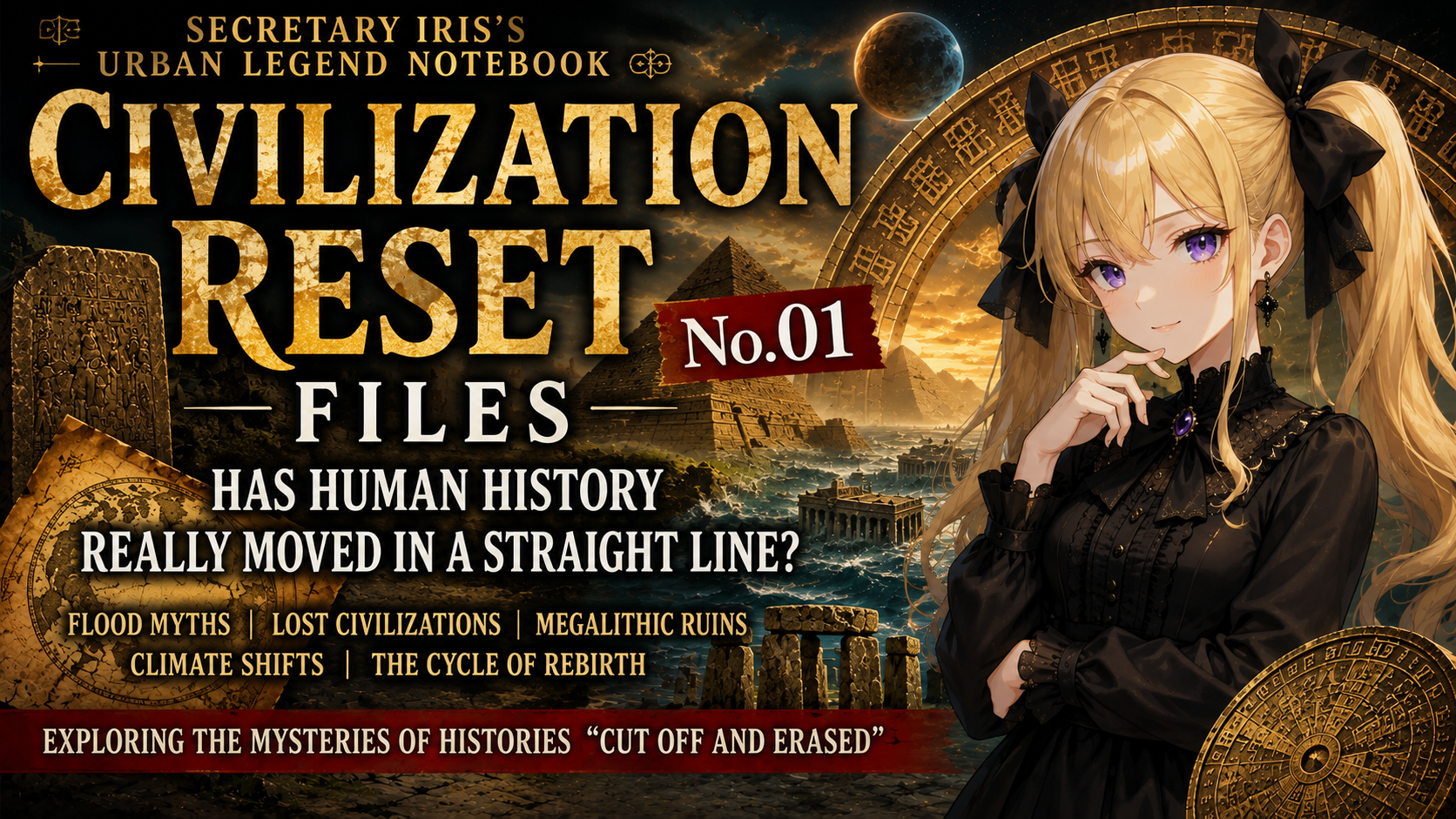
I am Iris.
Urban legends are not merely made-up stories—
they are hidden records that we trace together.
Yesterday, we stood before a new door.
Our gaze moved away from corporate logos and familiar streets.
From symbols designed in the modern world, we turned toward ancient ruins, lost knowledge, drowned cities, climate shifts, and the blank spaces of human history.
I said that the door would open tomorrow.
That day has arrived.
A new series begins here.
Civilization Reset Files.
This series will not simply declare that an advanced prehistoric civilization once ruled the world.
Nor will it dismiss every flood myth, ancient ruin, and story of destruction as meaningless fantasy.
We will separate the layers.
Archaeological evidence.
Climate records.
Myth.
Tradition.
Modern speculation.
And the urban legends created where those layers overlap.
Our question is simple, but dangerous.
Has human history really moved forward in one continuous line?
What Does “Civilization Reset” Mean?
In urban-legend circles, a civilization reset refers to the idea that an earlier civilization was destroyed by floods, climate change, war, cosmic impact, or another catastrophe, forcing humanity to begin again.
Some versions of the theory go further.
They suggest that technologically advanced societies may have existed before the civilizations recognized by conventional history.
Those societies disappeared.
Their cities were destroyed.
Their records were lost.
Only fragments of their knowledge survived in mythology and oral tradition.
The survivors then rebuilt human society from the beginning.
Agriculture returned.
Settlements grew.
Cities emerged.
Writing was developed again.
It is said that this cycle of destruction and reconstruction may have occurred more than once.
However, “civilization reset” is not a precise archaeological term.
It is a modern expression that gathers together several different theories, myths, historical collapses, and speculative interpretations.
Archaeology has not established that a global civilization comparable to modern technological society existed before the known ancient civilizations.
That distinction matters.
An unanswered question is not proof of a lost super-civilization.
At the same time, history does show that societies can collapse, populations can decline, trade networks can disappear, and knowledge can be lost.
Civilization does not only accumulate.
It can fracture.
It can retreat.
It can be forgotten.
And it can begin again in a different form.
We Often Imagine History as a Straight Line
Human history is frequently presented as a rising sequence.
Hunter-gatherers.
Agriculture.
Permanent settlements.
Cities.
States.
Writing.
Science.
Industry.
The information age.
Humanity gradually acquired knowledge and built increasingly complex societies.
This framework is useful.
But real history is not a smooth, universal line.
Different regions developed in different ways and at different speeds.
Knowledge discovered in one society did not always reach another.
Cities were abandoned.
Writing systems became unreadable.
Political systems collapsed.
Trade routes disappeared.
Populations moved or declined.
History may be less like a single road and more like many threads—some continuing, some breaking, and some being tied together again.
Urban legends focus on those broken places.
Why does monumental architecture sometimes appear earlier than expected?
Why were certain techniques not passed down?
Why do distant cultures preserve stories with similar structures?
Why did ancient societies repeatedly describe destruction and recreation?
Yet difficulty of explanation is not the same as proof of a forgotten global civilization.
We cannot place any answer we want inside a gap simply because the gap exists.
Myths of a World That Ended
Myths from many cultures describe an earlier world that came to an end.
A great flood.
Fire from the sky.
A long darkness.
Divine judgment.
The destruction of giants.
A small group of survivors.
The creation of a new humanity.
These stories do not end with destruction alone.
The old world disappears, but someone survives.
Life, memory, sacred knowledge, seeds, animals, or law are carried into the next world.
This creates the basic structure of a reset myth.
Destruction.
Selection.
Survival.
Recreation.
Transmission.
In urban-legend circles, it is said that these stories may preserve memories of ancient catastrophes.
Mythologists and historians, however, may also interpret them as memories of regional disasters, religious purification, political renewal, or symbolic rebirth.
Myth is not a direct historical record.
But neither must it be completely detached from history.
A real flood.
A remembered fear.
A sacred explanation.
Generations of retelling.
Later additions.
All of these can become part of one surviving story.
Ancient Ruins Challenge Simple Sequences
Ancient ruins often stand at the center of civilization-reset theories.
One of the most important examples is Göbekli Tepe in southeastern Türkiye.
According to UNESCO, its monumental circular, oval, and rectangular megalithic structures were built by hunter-gatherer groups during the Pre-Pottery Neolithic period, between approximately 9600 and 8200 BCE.
Its distinctive T-shaped pillars contain carvings of wild animals and other symbols.
Göbekli Tepe is important not because it proves that a technological super-civilization existed before recorded history.
Its importance is more subtle.
It challenged a simple historical sequence in which agriculture developed first, permanent settlements followed, and large ritual structures appeared only afterward.
The site suggests that hunter-gatherer groups were capable of organizing large communal projects and constructing monumental ritual spaces.
Ritual gathering and social cooperation may themselves have contributed to changes in settlement and subsistence.
Human history may therefore be more complicated than the formula:
Agriculture first.
Civilization second.
Religion and monuments third.
However, there is no established evidence that Göbekli Tepe was built by a lost civilization possessing technology equal to or beyond that of the modern world.
What the site demonstrates is the complexity, organization, and symbolic ability of prehistoric human communities.
When we underestimate ancient people, monumental ruins begin to look impossible.
Then we quickly transfer their achievements to aliens, forgotten masters, or an unknown civilization.
That psychological movement is itself part of the structure of urban legend.
Climate Can Break the Foundations of Society
Human conflict is not the only force capable of changing history.
Climate can alter the conditions on which every society depends.
The Younger Dryas was an abrupt cooling event that began approximately 12,900 years ago and ended around 11,600 years ago, during the broader transition out of the last glacial period.
Its effects varied by region, but climate records show major changes around the North Atlantic and elsewhere.
Temperature, precipitation, vegetation, animal populations, and human living conditions were affected.
The end of the Younger Dryas was also rapid.
Greenland ice records indicate a major temperature increase over a relatively short period.
This period overlaps with major changes in human subsistence, settlement, and the eventual development of agriculture in parts of Southwest Asia.
It would be too simple to state that the Younger Dryas directly destroyed a global civilization.
No worldwide urban civilization from that period has been established by archaeological evidence.
Still, rapid environmental change could have placed significant pressure on food supplies, water access, migration patterns, and relationships between human groups.
In urban-legend circles, the Younger Dryas is sometimes connected to the destruction of a forgotten civilization.
A related hypothesis proposes that a comet or cosmic impact contributed to the climatic disruption.
That impact hypothesis remains debated and should not be presented as established fact.
The more important lesson is broader.
Civilization rests on environmental conditions that human beings do not fully control.
When climate changes rapidly, the rules of survival can change with it.
Why Are We Drawn to Reset Stories?
The attraction of civilization-reset theories is not based only on curiosity about the ancient world.
These stories reflect modern anxiety.
Climate change.
Pandemics.
War.
Earthquakes.
Food insecurity.
Water scarcity.
Energy systems.
Artificial intelligence.
Automation.
Dependence on communication networks and global logistics.
Modern civilization appears more technologically advanced than any previous society.
But complexity creates dependence.
Electricity supports communications.
Communications support finance and logistics.
Logistics support urban food supplies.
Digital systems support identification, payments, and public services.
When one layer fails, other layers can be affected.
Civilization-reset stories disturb us because they do not feel like stories about the past alone.
They remind us that our own civilization is not guaranteed to last forever.
In urban-legend circles, it is said that if earlier civilizations were destroyed, modern humanity may be moving toward the same cycle.
That is not a prophecy.
But it is a useful question about resilience, memory, and the fragility of complex systems.
What This Series Will Examine
Civilization Reset Files will open six more doors.
Flood myths preserved across different cultures.
The abrupt climate changes of the Younger Dryas.
Göbekli Tepe and the relationship between hunter-gatherers, ritual, and monumental architecture.
Megalithic construction and the idea of lost technology.
Atlantis and Mu as stories of drowned civilizations.
And the deeper question of why humanity repeatedly imagines destruction and rebirth.
We will not turn myth directly into fact.
We will not treat every ancient ruin as evidence of a super-civilization.
We will respect archaeological and scientific explanations while examining the questions, emotional force, and modern interpretations that remain.
Evidence.
Tradition.
Urban legend.
Modern fear.
We will trace the boundary between them together.
Conclusion: History May Be a Layered Landscape
Has human history really moved in a straight line?
Probably not in any simple sense.
Societies emerge, expand, change, and sometimes decline.
Knowledge is transmitted, but it can also be lost.
Disaster may survive in the form of myth.
Fragments of an older world may become foundations for a new one.
History may therefore resemble a layered landscape more than a single road.
Some layers contain evidence that science can examine.
Some contain memories preserved only through story.
Some contain ruins whose full meanings remain uncertain.
How many times has humanity begun again?
We cannot answer that question with certainty today.
But civilization is not indestructible.
And what is lost does not always vanish completely.
It may survive as stone.
As ritual.
As fear.
As prayer.
As story.
Next in Civilization Reset Files No.02:
Why does the world repeatedly end in water?
Noah’s Ark.
The Epic of Gilgamesh.
Deucalion.
Flood and rebirth traditions preserved across many cultures.
We will trace the memory of the old world through the structure of the great flood myth.
Next time, I will return to trace another fragment of hidden truth with you.
References
-
UNESCO World Heritage Centre|Göbekli Tepe
A primary reference for the dating, monumental structures, hunter-gatherer builders, and T-shaped pillars of Göbekli Tepe. -
NOAA National Centers for Environmental Information|Abrupt Climate Change: A Paleo Perspective
An official overview of abrupt paleoclimate events, including the Younger Dryas. -
NOAA NCEI|The Younger Dryas
A reference for the chronology, climatic characteristics, and abrupt end of the Younger Dryas. -
Encyclopaedia Britannica|Myth
A general reference for understanding myth in relation to religion, symbolism, ritual, and communal worldviews. -
Encyclopaedia Britannica|Flood Myth
A reference for flood traditions and the recurring narrative structure of destruction, survival, and recreation.
Posting Time
This English article is scheduled for publication at 23:00 JST on July 13, 2026.
Related Reading
Popular Posts
Submit an Urban Legend
Do you know a local flood tradition, a story about a drowned village, an ancient ruin that deserves investigation, or a lost-civilization theory you would like examined?
Share & Follow
If you enjoyed this article, sharing, following, and exploring the journal helps support future investigations.
コメントを残す