🎵 IRIS Night File
A quiet soundtrack for tonight’s investigation. Press play whenever you wish.
I am Iris.
Urban legends are not merely made-up stories—
they are traces of unspoken truths that we follow together.
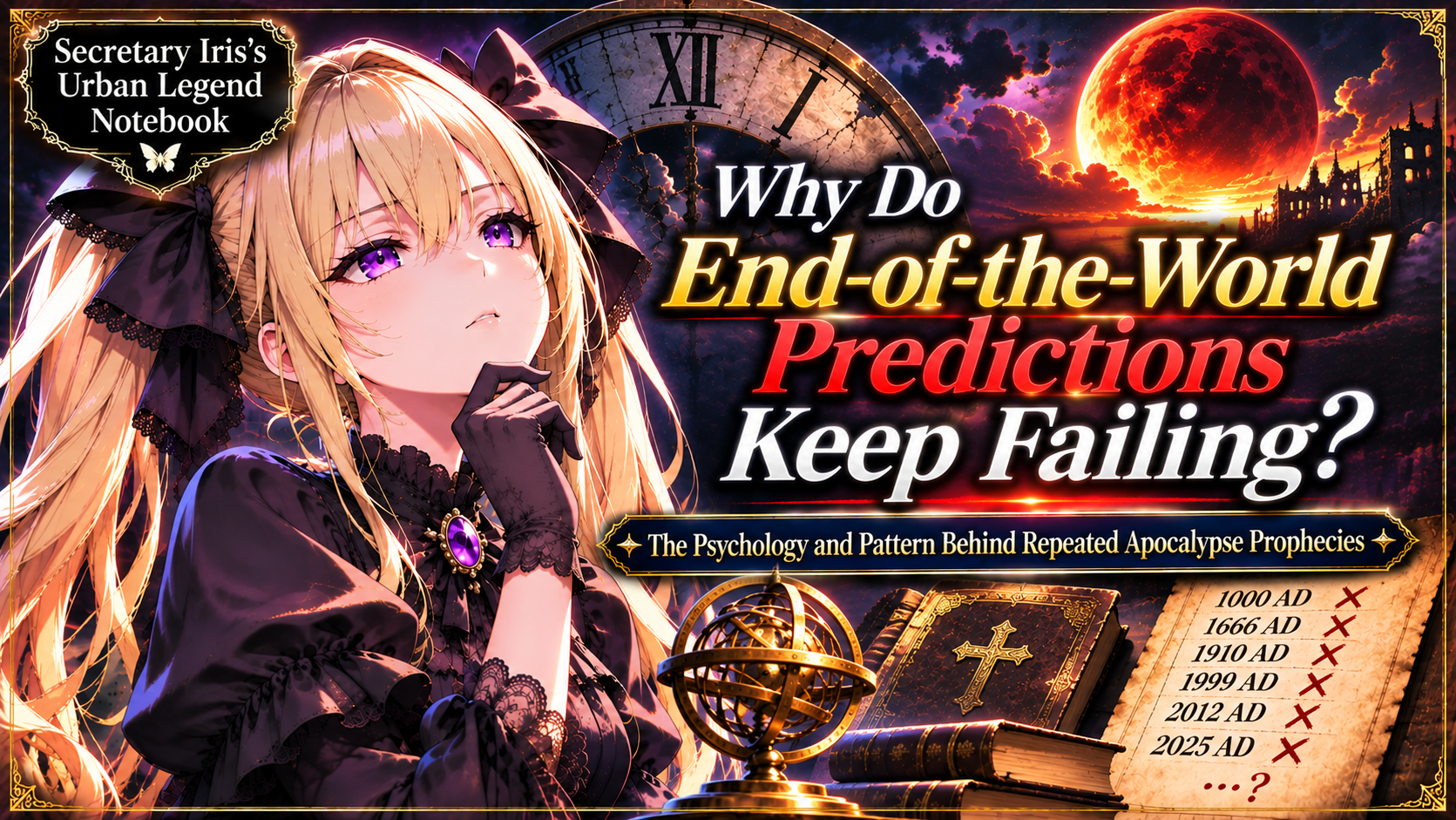
Interlude: Why Do End-of-the-World Predictions Keep Failing?
How many times was humanity supposed to have disappeared by now?
July 1999.
May 21, 2011.
December 21, 2012.
Throughout history, people have announced specific dates when civilization would collapse, divine judgment would arrive, or the world itself would end.
Yet those dates passed.
The predicted catastrophes did not occur.
And humanity continued.
But here is the mystery.
Why do predictions of the apocalypse continue to attract followers even after so many previous predictions have failed?
Tonight, we examine the history of failed doomsday predictions—and the psychological questions they leave behind.
Chapter One: October 22, 1844 — The Great Disappointment
In the nineteenth-century United States, preacher William Miller became associated with a religious movement anticipating the return of Jesus Christ.
Miller’s interpretation of biblical chronology led his followers to expect Christ’s return in the early 1840s.
Eventually, October 22, 1844, became the movement’s most famous predicted date.
Many believers prepared themselves for a momentous event.
Some gathered in anticipation of Christ’s return.
But October 22 passed.
The expected event did not occur.
The episode became known as the Great Disappointment.
Historical research shows that the movement did not respond uniformly.
Some followers abandoned their expectations.
Others reconsidered their interpretation of scripture.
Still others continued their religious activities and eventually contributed to new denominational movements.
A failed prediction did not produce one universal response.
That distinction would become important in later psychological research.
Chapter Two: 1999 — Nostradamus and the King of Terror
Few apocalyptic predictions became as culturally influential as the supposed end of the world in 1999.
The story was closely associated with Nostradamus, the sixteenth-century French astrologer and physician.
One of his most famous passages, Century X, Quatrain 72, refers to July 1999 and a mysterious “King of Terror.”
For generations, readers interpreted this enigmatic verse in different ways.
Some associated it with war.
Others imagined catastrophic events or the appearance of a threatening world leader.
The poem eventually became connected with the idea that humanity might face destruction in 1999.
But the original verse does not clearly state that every human being would die that July.
And when July 1999 arrived, no worldwide apocalypse occurred.
The prediction’s popularity illustrates an important feature of ambiguous texts.
When a prophecy does not specify its meaning clearly, later generations can attach new interpretations to it.
An old text may remain culturally influential even when one particular interpretation has failed.
Chapter Three: 2011 and 2012 — When the Deadline Moves
In 2011, American religious broadcaster Harold Camping announced that the Rapture would take place on May 21.
His prediction attracted international attention.
But May 21 came and went without the expected event.
Camping subsequently explained that the judgment had occurred spiritually rather than visibly.
He then identified October 21 as the date of the world’s final destruction.
That date also passed without the predicted catastrophe.
A year later, another apocalypse narrative gained worldwide popularity.
This time, the story concerned the Maya Long Count calendar.
December 21, 2012, marked the completion of an important 13-baktun cycle.
Many popular accounts transformed that calendar transition into a prediction of global destruction.
Yet the Smithsonian’s National Museum of the American Indian explains that there is no evidence ancient Maya inscriptions predicted a catastrophic end to the world on that date.
The supposed prophecy depended on a modern interpretation that was not supported by the surviving evidence.
The end of a calendar cycle was not the end of the world.
Chapter Four: Why Does Belief Survive?
In 1956, psychologists Leon Festinger, Henry Riecken, and Stanley Schachter published When Prophecy Fails.
The book became famous for examining what happens when strongly held beliefs encounter contradictory evidence.
Its authors argued that, under certain circumstances, people may attempt to preserve their convictions rather than abandon them.
But the history of this research has become more complicated.
In November 2025, researcher Thomas Kelly published a critical reexamination of the book’s celebrated case study.
Using previously unavailable archival material, Kelly argued that the original researchers had misrepresented how the group responded after its prediction failed.
According to his analysis, the group’s leader rejected the failed prediction, the group dissolved, and its members did not respond in the way the original book had claimed.
This does not establish that cognitive dissonance theory as a whole is false.
It does demonstrate why one famous historical example should not be treated as unquestionable proof that failed prophecies always strengthen religious belief.
Some believers reconsider their convictions.
Others reinterpret events.
Still others leave their communities entirely.
Human responses to disappointment are diverse.
But one question remains.
Why are people attracted to precise predictions of the future in the first place?
Epilogue: What Are Apocalypse Predictions Really Telling Us?
The Bible itself contains a curious warning.
In Mark 13:32, the timing of the final events is described as something no human being can know.
Nevertheless, religious interpreters and secular commentators have repeatedly attempted to calculate the exact date of the world’s end.
Perhaps that contradiction reveals something about human nature.
An uncertain future can feel frightening.
A definite date, even a terrifying one, may seem easier to understand than uncertainty without limits.
An apocalypse prediction offers a structure.
First, particular signs will appear.
Then, a crisis will arrive.
Finally, the world will change.
Such a story can transform random, complicated events into a sequence that appears meaningful.
Of course, emotional meaning is not evidence that the prediction is accurate.
And the failure of a particular prediction does not invalidate every religious or philosophical reflection about humanity’s future.
But it does give us a reason to distinguish between ancient texts, later interpretations, and claims that specific dates can be calculated.
Perhaps the greatest mystery is not why the world keeps surviving its predicted endings.
Perhaps it is why human beings keep searching for the next one.
Every generation has its own fears.
War.
Disease.
Environmental catastrophe.
Technological disruption.
And every generation creates stories about the future.
But the future remains uncertain.
So perhaps the more important question is not when the world will end.
It is how we choose to live in a world whose future we cannot fully predict.
Next time—another fragment of truth we will trace together.
I will return to continue the telling.
📚 Sources & Verification Notes
01|The Great Disappointment of 1844
Cambridge University Press / Church History / 2023 / Academic historical research
Examines the Millerite movement, the October 22, 1844 expectation, and the diverse responses after the predicted event failed to occur.
02|Nostradamus and the Year 1999
Everett F. Bleiler / The Washington Post / September 1999 / Historical literary commentary
Discusses Century X, Quatrain 72 and its changing interpretations. Distinguishes the original poem from later claims of a definite worldwide apocalypse.
03|Harold Camping and the 2011 Prediction
Religion News Service / The Christian Century / May 24, 2011 / Contemporary reporting
Documents Camping’s explanation after his May 21 prediction failed and his subsequent identification of October 21 as the date of the apocalypse.
04|The Meaning of 2012 in Maya History
Smithsonian National Museum of the American Indian / Official museum interpretation
Explains the completion of the 13-baktun cycle in the Maya Long Count calendar and the absence of evidence for an ancient Maya prediction of global destruction.
05|When Prophecy Fails (1956)
Leon Festinger, Henry W. Riecken and Stanley Schachter / University of Minnesota Press / 1956 / Social psychology research
A classic study of how people respond to disconfirmed expectations. Its best-known case study has subsequently faced substantial criticism and should not be treated as uncontested evidence.
06|Debunking When Prophecy Fails
Thomas Kelly / Journal of the History of the Behavioral Sciences / First published November 4, 2025 / Peer-reviewed research article
Reexamines the original case using archival records and challenges its depiction of followers’ behavior. The article disputes a specific influential case study rather than disproving cognitive dissonance theory in its entirety.
07|The Gospel of Mark, Chapter 13
United States Conference of Catholic Bishops / Biblical text / Primary religious source
Mark 13:32 states that the day and hour are unknown. This source establishes the wording and religious context, not the scientific validity of a particular prediction.
🕒 Posting Time
November 10, 2026 · 23:00 JST
English public edition
🎵 IRIS FILE — “Is It Really True?”
Secretary Iris’s original theme. Follow the clues beyond the rumors.
📖 Further Reading
Prophets & Prophecies Encyclopedia
Why Prophecy Works — Fear, Hope, and Narrative
The Deathbed Prophecy of an Elderly Man — Why a Failed Prediction Still Lives On
⭐ Popular
These five fixed selections link to Japanese articles.
The World Ahead 2025 — Symbol Analysis
The Simpsons and the 2026 World Cup Prediction
NWO and the New World Order in 2026
✉️ Share a Mystery with Iris
Know a local legend or a claim worth investigating? Tell us where you encountered it, separating firsthand experiences from stories you heard. Please protect other people’s privacy.
コメントを残す