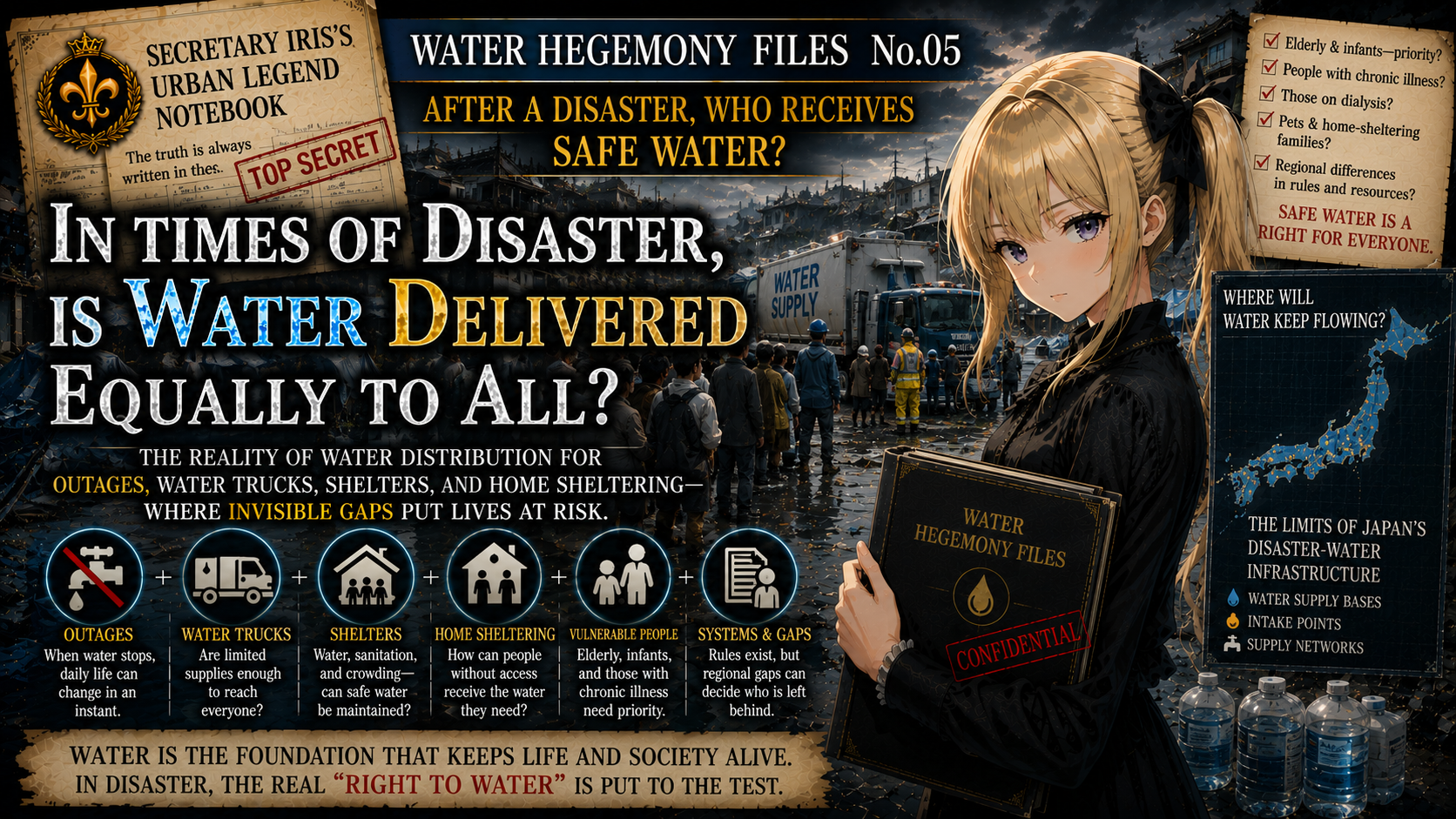
I am Iris.
Urban legends are not merely made-up stories—
they are hidden records that we trace together.
A major earthquake strikes.
Pipelines break.
A treatment plant loses electricity.
Roads collapse.
Bridges become impassable.
Then the tap stops.
At that moment, water is no longer an invisible part of daily life.
A bottle.
The arrival time of a water truck.
The distance to a distribution point.
A clean container.
Each can determine whether a household remains safe.
Governments distribute water.
Water utilities, the Self-Defense Forces, companies, volunteers, and neighboring municipalities provide assistance.
Even then, water does not reach every person at the same speed or in the same quantity.
People staying in official shelters.
People remaining inside damaged homes.
People sleeping in vehicles.
Communities cut off by blocked roads.
Residents unable to carry heavy containers.
Families with infants.
Patients requiring dialysis.
People sheltering with pets.
They may live within the same disaster area, but their water requirements and ability to reach assistance are different.
Water Hegemony Files No.05 examines the allocation system that begins when ordinary water service fails.
Where does emergency water come from?
Can a person really live on three liters per day?
Why can water trucks not reach everyone?
And is disaster water distributed equally?
What Does “Three Liters per Person per Day” Mean?
Japanese disaster-preparedness guidance commonly recommends storing:
Approximately three liters of drinking water per person per day.
At least three days of supply.
Preferably one week for a major or wide-area disaster.
For a household of four, that means twelve liters each day.
Thirty-six liters for three days.
Eighty-four liters for one week.
The total is larger than many families expect.
But three liters does not support ordinary daily life.
It is primarily an initial survival quantity for drinking and minimal food preparation.
It does not provide normal access to:
Bathing.
Laundry.
Flush toilets.
Dishwashing.
Extensive handwashing.
Cleaning.
A household that stores three liters and considers its water preparations complete may be overlooking sanitation and domestic water.
Water Requirements Increase as the Outage Continues
Immediately after a disaster, drinking water has the highest priority.
As the outage continues, water demand changes.
Examples used in Japanese emergency-planning materials have divided recovery into stages:
Approximately three liters per person per day during the first three days.
Approximately twenty liters by around the tenth day.
Approximately one hundred liters by around the twenty-first day.
A return toward the pre-disaster level of approximately 250 liters by around the twenty-eighth day.
These are planning examples, not a nationwide guarantee that every disaster area will receive those quantities on those dates.
The first three liters mainly protect life.
Twenty liters begins to support limited washing and toilet needs.
One hundred liters permits more ordinary hygiene and domestic activity.
Approximately 250 liters approaches normal pre-disaster water use.
The longer an outage lasts, the more the emergency changes from a thirst problem into a public-health and sanitation problem.
Water Supply and Wastewater Systems Must Recover Together
When drinking-water service stops, flush toilets may also become unusable.
Pouring stored bath or pool water into a toilet is not always safe.
If sewers, pumping stations, or treatment facilities are damaged, additional water can cause sewage to back up or overflow elsewhere.
Restoring the drinking-water pipeline does not automatically mean the entire urban water cycle has recovered.
Water must be:
Collected.
Treated.
Transported.
Used.
Drained.
Treated again as wastewater.
Emergency recovery must consider both water supply and sewerage.
A functioning tap is not the only measure of recovery.
The Noto Peninsula Earthquake Caused Approximately 140,000 Outages
The January 1, 2024 Noto Peninsula earthquake caused extensive damage to water and sewerage systems.
The maximum outage affected approximately 140,000 households across six prefectures.
In the northern Noto region, several parts of the system were damaged at the same time:
Intakes.
Treatment facilities.
Transmission mains.
Distribution pipes.
Household connections.
The peninsula’s geography intensified the challenge.
Roads were severed.
Alternative routes were limited.
Mountain communities were dispersed.
Snow and cold complicated repair work.
Workers, equipment, pipes, fuel, and heavy machinery could not always reach the damaged location quickly.
This was not an outage that could be solved by repairing one broken pipe.
Every stage between the source and the household had to be inspected and restored.
Seismically Strengthened Facilities Performed Better
Japan’s post-earthquake reviews found that facilities already strengthened against earthquakes generally maintained more of their function.
Damage to unstrengthened critical infrastructure contributed to wide outages and delayed restoration.
Preparation therefore mattered.
Seismic pipes.
Strengthened treatment facilities.
Emergency generators.
Multiple water sources.
Isolated distribution zones.
Emergency shutoff valves.
Seismic storage tanks.
Investment before a disaster determines how much emergency water will be required afterward.
Water inequality does not begin only when trucks arrive.
It may begin years earlier, when one community can afford resilient infrastructure and another postpones it.
Where Does Emergency Water Come From?
An outage does not always mean that every source of water has disappeared.
Emergency supply may come from:
Water remaining in distribution reservoirs.
Seismic storage tanks.
Emergency hydrants and taps.
Treatment plants and supply bases.
Approved wells.
Water trucks.
Portable tanks.
Stored bottled water.
Temporary pipelines.
Mobile treatment systems.
Water transported from another region.
The available combination differs by community.
Reservoir capacity differs.
The number of trucks differs.
Mutual-assistance agreements differ.
Road networks, population density, climate, and geography differ.
A water-rich region can still lose service if the infrastructure carrying water is damaged.
A large water-truck fleet cannot operate without a safe filling source.
A working source cannot help an isolated village if the road is closed.
Emergency security depends on the route connecting the source to the person.
A Water Truck Cannot Replace an Entire Pipeline Network
A water truck is one of the most visible symbols of emergency assistance.
But it has physical limits.
Its tank carries a finite volume.
It must return to a filling point.
The water and tank must be kept sanitary.
A driver and supply crew are required.
Fuel is required.
Road access is required.
One vehicle can serve only a limited number of places each day.
During a major disaster, households are not the only users requesting water.
Hospitals.
Dialysis facilities.
Care homes.
Shelters.
Community kitchens.
Government response centers.
All may require emergency delivery at the same time.
Water trucks are essential.
They are not a complete substitute for a functioning pipeline network.
People Who Can Reach a Distribution Point Receive Water More Easily
A municipality announces a water-distribution point.
Residents bring containers and wait.
Formally, the service may be open to everyone.
In practice, access is unequal.
People who receive information quickly, own a vehicle, can wait in line, and can carry heavy containers are more likely to obtain water.
Others face barriers:
Older residents with limited mobility.
People with disabilities.
A parent caring alone for an infant.
Family caregivers.
Residents attending medical treatment.
People in remote settlements.
People without phone service.
Residents unable to carry ten or twenty liters.
One liter of water weighs approximately one kilogram.
A twenty-liter container weighs approximately twenty kilograms.
A policy that says “come to the distribution point” does not deliver water to everyone.
People Outside Shelters Can Become Invisible
A house may still be standing while water and electricity remain unavailable.
Some residents stay at home to avoid overcrowded shelters.
Some remain home because of disability, infection risk, work, caregiving, or pets.
Others sleep in cars or move temporarily to a relative’s home.
They are still disaster victims.
But they may not appear on an official shelter roster.
Authorities may not know:
Where they are.
How many people are present.
Whether they have water.
Whether medication is running out.
Whether food is reaching them.
Japan’s Cabinet Office has emphasized that shelters should also function as community support hubs, providing water, food, supplies, and information to people sheltering at home or in vehicles.
A person should not need to sleep inside a shelter to receive emergency assistance.
Equal Water Does Not Always Mean the Same Quantity
Should every person receive exactly the same volume?
Not necessarily.
A healthy adult and an infant do not have identical needs.
A household and a dialysis clinic do not have identical needs.
A single resident and a care facility do not have identical needs.
Emergency planning must prioritize uses where water loss will create the greatest danger.
Hospitals.
Dialysis facilities.
Care institutions.
Shelters.
Food-preparation centers.
This is not automatically secret favoritism.
It is triage under scarcity.
But when the reasons for priority are not explained, residents may believe they have been deliberately neglected.
Fairness does not mean mechanically distributing the same quantity.
It means delivering the necessary quantity according to risk and publicly explaining the basis for that decision.
Dialysis Depends on Water and Electricity
For patients with chronic kidney failure, dialysis is essential to life.
Many hemodialysis patients require treatment every two or three days.
The equipment depends on electricity and a supply of clean water.
A clinic may remain structurally undamaged but become unable to provide treatment because of an outage.
Japan’s Ministry of Health, Labour and Welfare has instructed authorities to coordinate emergency water delivery to dialysis facilities and, when necessary, arrange patient transfer and acceptance at other hospitals.
For these patients, the relevant need is not only three liters of drinking water.
It is medical water, transportation, treatment capacity, and reliable information about an alternative facility.
Infants Need More Than a Bottle of Water
Powdered infant formula requires safe water and appropriate preparation.
Feeding containers must also be kept sanitary.
When outages are combined with electricity and fuel shortages, safe preparation becomes difficult.
Ready-to-feed liquid infant formula can be useful because it can be provided without mixing water.
Japanese health authorities have encouraged its appropriate use when lifelines are disrupted and have called for advance storage of infant-feeding supplies.
But liquid formula is not one universal solution.
Age.
Allergies.
Normal feeding practices.
Container hygiene.
Storage after opening.
Breastfeeding support.
Each family’s needs are different.
Counting an infant as one ordinary evacuee does not reveal the complete water and supply requirement.
Older People May Avoid Drinking
Some older adults experience thirst less strongly.
They may also reduce water intake when toilets are far away, dirty, dark, crowded, or difficult to use.
The result can be a dangerous cycle.
The toilet is difficult to use.
The person drinks less.
Dehydration and other health problems become more likely.
Disaster-water policy must therefore consider more than the number of liters delivered.
Can a resident reach an accessible toilet?
Is assistance available?
Can the person move safely at night?
Does the environment allow them to drink without fear?
Toilet Failure Can Reduce Water Intake
When water service stops, flush toilets often stop.
Poor waste management can cause bacteria, insects, odor, and infection risk.
When shelter toilets become unpleasant or inaccessible, some people reduce both food and water intake.
The chain can become:
No water.
No usable toilet.
Reduced drinking.
Worsening health.
Distributing bottled water without providing emergency toilets can therefore undermine hydration.
Portable and emergency toilets are part of water preparedness.
They are not a separate subject.
Who Provides Water for Pets?
Emergency public distribution is generally designed first around human survival.
Pet food, water, medication, and equipment should therefore be prepared by owners.
Japan’s environmental guidance recommends at least five days of pet supplies and preferably seven days or more.
Requirements differ according to size, illness, diet, medication, and weather.
Some people remain at home or in vehicles because they cannot keep their animals inside a shelter.
When those households become invisible to public systems, the humans may also lose access to water and information.
Pet preparedness influences human evacuation behavior.
Safe Water and Available Water Are Not the Same
Emergency water policy must consider quality as well as quantity.
River water.
Rainwater.
Pool water.
Stored bathwater.
Untested wells.
Some may be useful for specific non-drinking purposes.
Clear appearance does not prove that water is safe to drink.
Possible contamination includes:
Bacteria.
Chemicals.
Salt.
Fuel.
Mud.
Sewage.
Water received from an emergency source can also become contaminated if it is placed in a dirty container.
Households need clean, closable drinking-water containers and appropriate storage.
The objective is not merely to distribute liquid.
It is to distribute water that remains safe through collection, transport, and use.
Publishing a Map Is Not Enough
Many municipalities publish emergency-water points.
Residents should check them before a disaster.
But a dot on a map does not answer every question.
Will the point function after a major earthquake?
Can it operate without grid electricity?
What volume can it supply?
Are containers provided?
Is vehicle access possible?
Can water be delivered to residents unable to travel?
Is the site available at night?
What is the alternative if that site is damaged?
Communities need information about capacity and operating conditions—not only location.
Geography Changes How Water Arrives
Cities may experience extremely large outage populations.
Apartment residents may remain without water even after the public main is repaired if a building pump or storage system is damaged.
Rural communities have fewer residents but longer distances.
A truck visiting every isolated household requires time.
Islands and peninsulas can lose access when roads and ports fail.
Hokkaido must also consider:
Large administrative areas.
Snow.
Frozen roads.
Blizzards.
Low temperatures.
Long distances between settlements.
Emergency taps, tanks, and containers may freeze during a winter disaster.
A single national plan cannot eliminate every regional difference.
Local conditions must shape local systems.
Why Do Water-Control Conspiracy Theories Emerge Here?
There are verifiable realities.
Disaster water is scarce.
Water trucks and crews are limited.
Hospitals and shelters may receive priority.
Some people can reach distribution points and others cannot.
People registered at shelters are easier for authorities to identify than those staying at home.
Infrastructure resilience and storage differ between communities.
Those realities produce understandable suspicions.
Are officials secretly deciding who deserves water?
Will powerful institutions and corporations receive water first?
Are residents outside shelters being deliberately abandoned?
Will cities be protected while rural communities wait?
Will disaster rationing become a permanent control system?
Social media can then add a larger leap.
Governments distribute water only to obedient citizens.
Companies buy all stored water and resell it at extreme prices.
Outages are deliberately prolonged to justify privatization.
Water is withheld to force residents out of a targeted region.
Available public evidence does not establish one coordinated plan of that kind.
But the stories remain persuasive because:
Allocation rules are not always visible.
Some neighborhoods receive trucks earlier than others.
Restoration dates differ within one municipality.
Authorities can fail to identify home evacuees.
Water is essential, so delay creates intense fear.
And some people genuinely do fail to reach assistance.
Inequality Can Exist Without a Conspiracy
A person with a smartphone, vehicle, large containers, nearby family, and a strong neighborhood network can obtain emergency water more easily.
A person who is older, alone, disabled, caring for an infant, caring for another adult, unable to read the available language, sheltering with pets, or disconnected from communications may not.
No official needs to intentionally exclude them.
A system built around people who can obtain information and collect supplies independently will produce exclusion as an outcome.
That is the real hidden inequality of disaster water.
What Residents Should Ask Their Municipality
Communities can request clear information about:
Emergency water-supply points.
Seismic storage tanks.
Capacity at each location.
The number of water trucks.
Mutual-assistance agreements.
Priority plans for hospitals, dialysis facilities, and care homes.
Registration and outreach for home evacuees.
Door-to-door delivery for people with limited mobility.
Welfare shelters.
Emergency well agreements.
Winter freeze protection.
Backup power.
Alternative sites if a supply point fails.
Water-quality notifications.
Integrated water and sewer recovery plans.
These systems should be published and tested before a disaster.
Household Preparation Must Reflect the Household
The basic starting point is:
Three liters per person per day.
At least three days.
Preferably one week.
But every family should add its own requirements.
Water for medication.
Infant feeding.
Accessible drinks for older adults.
Pet water.
Food preparation.
Emergency toilets.
Clean collection containers.
A cart or backpack for transport.
Supplies can be stored in more than one location in case one room becomes inaccessible.
Rotating ordinary bottled water through daily use can reduce expiration and waste.
Preparedness is not an act of rejecting government support.
It protects a household until assistance arrives and preserves limited public water for people who have no alternative.
Who Controls Water After a Disaster?
Immediately after a disaster, no single corporation or secret organization controls the entire supply.
Access is shaped by:
The condition of the source.
Pipeline resilience.
Roads.
Fuel.
Trucks.
Workers.
Information.
Neighborhood cooperation.
Household storage.
Water hegemony can appear not only in a distant boardroom.
It can appear in the location of a distribution point, the design of a registration system, and the decision about whether someone unable to carry water receives delivery.
Conclusion—What Would Fair Disaster Water Look Like?
Delivering the same volume to every person at the same time is rarely possible.
Roads, infrastructure, health, and household circumstances differ.
Fairness therefore requires more than equal portions.
Prioritize places where lives are immediately at risk.
Deliver water to people unable to collect it.
Identify residents outside official shelters.
Protect medical and care services with high requirements.
Publish the basis for allocation.
Guarantee a minimum supply that no person can lose.
When the pipeline breaks, the invisible relationships of society become visible.
Who receives information?
Who can travel?
Who appears inside the support system?
Who carries water to a neighbor?
A disaster tests more than the quantity of water.
It tests the connections between people.
The human right to water is not proven only by a functioning tap during ordinary life.
It is proven when safe water continues to reach vulnerable people after ordinary systems fail.
Next time, Water Hegemony Files No.06:
Have the Wars Over Water Already Begun?
The Nile.
The Mekong.
The Indus.
Transboundary rivers and massive dams.
Can an upstream state control the future of every country downstream?
Next time—we will trace another fragment of the hidden record.
I will return to tell the story.
References
-
Cabinet Office of Japan|Preparing for a Major Earthquake
Used to verify the household recommendation of approximately three liters of drinking water per person per day for at least three days, with longer storage desirable for a wide-area disaster. -
Ministry of Land, Infrastructure, Transport and Tourism|Emergency Water Volumes After a Disaster
Used to examine staged planning examples for drinking water, sanitation water, and eventual restoration toward ordinary domestic use. -
Ministry of Land, Infrastructure, Transport and Tourism|Water and Sewer Measures Following the Noto Peninsula Earthquake
Used to verify the maximum outage of approximately 140,000 households and the relationship between seismic resilience, critical-facility damage, and prolonged restoration. -
Cabinet Office of Japan|Guide to Supporting Home and Vehicle Evacuees
Used to examine the role of shelters and other support hubs in providing water, food, supplies, and information to people staying outside official shelters. -
Cabinet Office of Japan|Survey of Shelter Operations During the Noto Peninsula Earthquake
Used to examine the need to support the entire affected community, including home evacuees and residents staying in non-designated locations. -
Ministry of Health, Labour and Welfare|Maintaining Dialysis Services During Disasters
Used to verify the importance of continued dialysis, emergency water delivery to treatment facilities, and transfer to alternative medical institutions. -
Ministry of Health, Labour and Welfare|Infant Feeding Support and Supplies During Disasters
Used to examine the role of ready-to-feed liquid infant formula during water and power outages and the need for advance storage of feeding supplies. -
Cabinet Office of Japan|Guidelines for Shelter Toilets
Used to examine sanitation failure, infection risk, and the tendency of evacuees to reduce water intake when toilets are unsafe or inaccessible. -
Cabinet Office of Japan|Guidelines for Welfare Shelters
Used to verify the definition and support needs of older adults, people with disabilities, infants, and other people requiring additional assistance. -
Ministry of the Environment|Disaster Preparedness Guidelines for People and Pets
Used to verify the recommendation that owners prepare at least five days, and preferably seven days or more, of water, food, medication, and other pet supplies.
Posting Time
This article is scheduled for publication on July 31, 2026, at 23:00 JST.
Related Reading
An examination of the hidden water demand behind data-center cooling, electricity generation, and semiconductor manufacturing.
Aging pipelines, declining populations, workforce shortages, rising bills, and the infrastructure supporting safe water before a disaster begins.
A distinction between physical water, water rights, price indexes, and futures markets—and the larger narrative of financial control.
Forest acquisitions, groundwater, Hokkaido’s protection zones, and the boundary between land ownership and control over water.
Popular Posts
A popular investigation into why financial, political, and technological symbols can appear to predict later events.
A structural reading of corporations, governments, standardization, information control, and public-infrastructure governance.
An exploration of how mythology, environmental change, celestial events, and civilizational anxiety become connected.
Submit an Urban Legend
Have you experienced a prolonged outage, water-truck distribution, home sheltering, an emergency well, unequal restoration, or another unexplained disaster-water problem?
Submit your story or investigation request →
Share & Follow
If you found this investigation valuable, sharing, following, and exploring the journal helps support future files.
Blog Top Share on X Share on Facebook Follow on X Instagram YouTube
コメントを残す