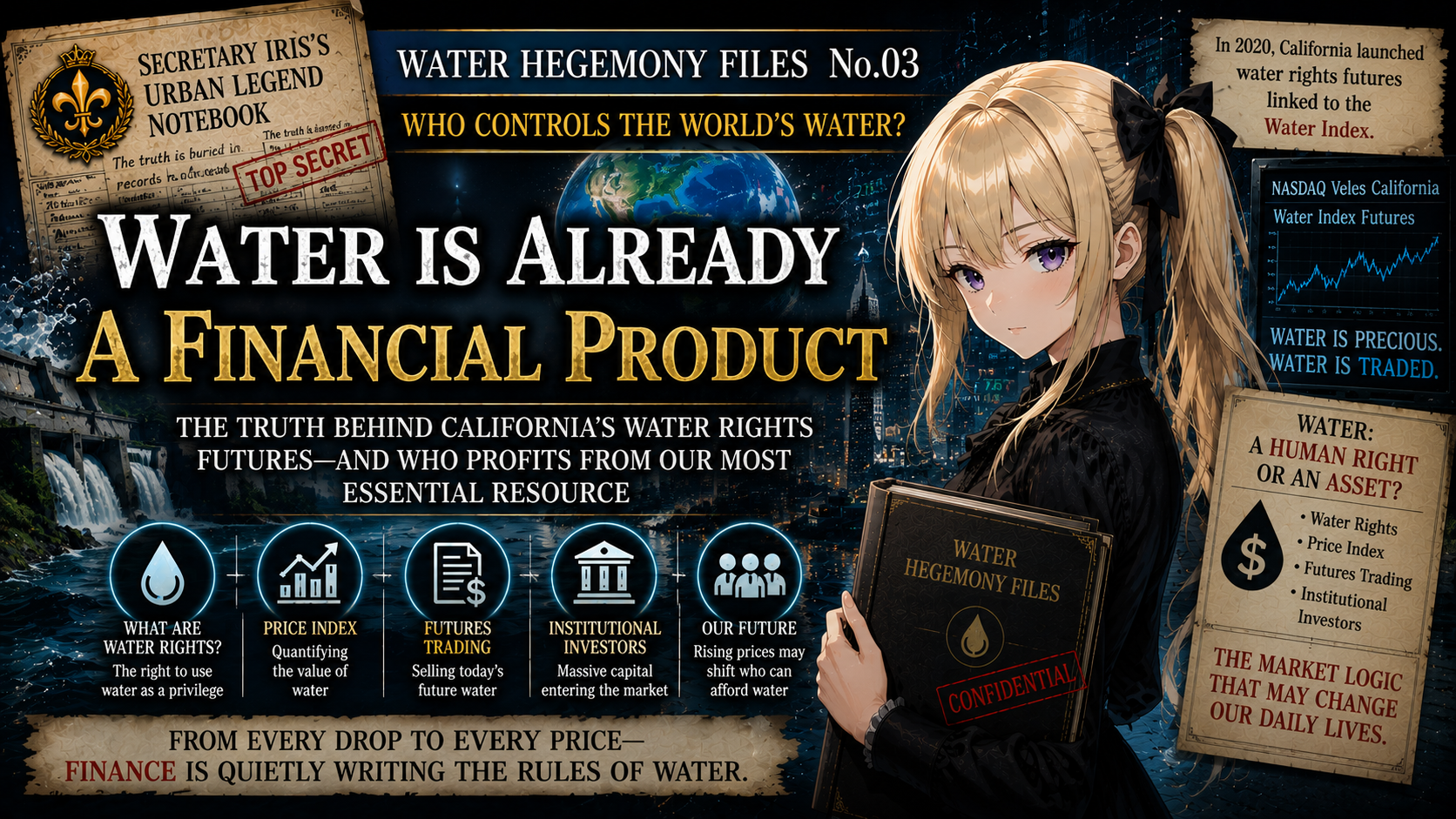
I am Iris.
Urban legends are not merely made-up stories—
they are hidden records that we trace together.
Water has a price.
An index measures that price.
A futures market allows people to trade expectations about where that price may move.
Place those facts together, and a powerful story quickly emerges.
The world’s drinking water has been listed on a stock exchange.
Investors are waiting for droughts.
Banks will soon control every household tap.
But the verified system is more complicated.
In December 2020, the United States did not create a market that delivers the world’s physical drinking water to investors.
CME Group launched a financially settled futures contract linked to an index of water-rights transaction prices in specific California markets.
Physical water.
A legal right to divert or use water.
The transaction price of that right.
An index constructed from those prices.
A financial contract linked to the index.
These are separate things.
Water Hegemony Files No.03 examines those distinctions.
Can water markets help farmers and communities manage scarcity?
Or do they distribute an essential resource according to the ability to pay?
Is water a human right—or an asset?
Physical Water Was Not Listed as a Stock
Water-futures stories are often described with phrases such as:
Water was listed on Nasdaq.
Investors can now buy the world’s drinking water.
A futures holder receives physical water at expiration.
These descriptions are misleading.
A stock represents an ownership interest in a corporation.
The water-futures contract is not a stock.
Buying the contract does not make the buyer the owner of a reservoir, pipeline, municipal utility, or physical parcel of water.
The underlying benchmark is the Nasdaq Veles California Water Index.
Its symbol is NQH2O.
The index reflects transaction prices for water-rights leases and sales in selected California markets.
Nasdaq administers and publishes the index.
CME Group lists and clears the futures contract linked to it.
Nasdaq is therefore not selling physical water through an equity listing.
CME is offering a derivative based on an index value.
What Is a Water Right?
A water right is not always equivalent to absolute ownership of a fixed body of water.
California’s water-transfer guidance describes surface-water rights as rights to divert and use water from a moving and interconnected resource.
Water flows.
Rainfall changes.
Upstream use can affect downstream availability.
Water may return to a river or aquifer after use.
Several users can depend on the same system.
Agriculture.
Cities.
Industry.
Power generation.
Ecosystems.
Indigenous communities.
Other right holders.
A transfer can therefore require analysis of:
The legal scope of the right.
Actual consumptive use.
Effects on other users.
Environmental impacts.
Water quality.
Conveyance capacity.
Drought restrictions.
Regulatory approval.
A water right does not necessarily authorize its holder to remove unlimited water regardless of the consequences.
The phrase “buying water” often compresses this complicated legal structure into something that resembles buying land or a commodity in a warehouse.
The real system is more conditional.
What Does NQH2O Measure?
The Nasdaq Veles California Water Index began on October 31, 2018.
It was designed to provide a benchmark for the spot price of water rights in California.
The index is expressed in United States dollars per acre-foot.
An acre-foot is the volume required to cover one acre of land to a depth of one foot.
It equals approximately 325,851 gallons, or about 1.23 million liters.
The index value does not mean that a container holding that amount of drinking water was physically sold at the displayed price.
NQH2O uses reported leases and sales of water entitlements.
The data are adjusted for differences between eligible markets and transaction types and combined as a volume-weighted average.
CME identifies five underlying California markets:
One surface-water market.
The Central Basin.
The Chino Basin.
The Main San Gabriel Basin.
The Mojave Basin Alto Subarea.
The four basins are adjudicated groundwater markets.
The index is calculated weekly and published on Wednesday, reflecting eligible transactions from the preceding Monday through Friday.
The benchmark represents the price of water at its source.
Conveyance costs and losses involved in physically moving the water are excluded.
NQH2O is therefore not:
A global water-price index.
A national American household water tariff.
A measure of every California water transaction.
A price for bottled drinking water.
It is a defined benchmark constructed from specific markets.
Why Create a Water-Price Index?
Markets require information.
Oil, grain, stocks, bonds, and property all have pricing systems.
Water-rights markets can be more fragmented.
A right’s value may depend on:
Priority.
Location.
Season.
Reliability during drought.
Conveyance access.
Water quality.
Whether the transaction is a lease or sale.
The legal category of the right.
Without shared pricing information, farmers and municipalities may struggle to determine whether an offered price is reasonable.
Large participants and brokers may possess more information than small users.
An index can improve transparency.
It can show whether prices have risen or fallen.
It can help compare transactions.
It can reveal how drought or supply conditions are affecting the market.
But once a price index exists, a second step becomes possible.
A financial product can be created around the index itself.
The Water Futures Launched in 2020
CME Group launched futures linked to NQH2O on December 7, 2020.
The CME product code is H2O.
The contract unit is ten acre-feet multiplied by the NQH2O index price.
That wording can create confusion.
The contract does not deliver ten physical acre-feet of water.
CME’s specifications state that the contract is financially settled.
At final settlement, the position is valued using the published NQH2O index.
The financial difference is settled in cash.
No tanker arrives.
No municipal pipeline changes ownership.
No California water right is automatically transferred.
Some commodity futures can result in physical delivery.
This contract is an index derivative designed around price exposure.
What Are Futures Supposed to Do?
One traditional purpose of futures is hedging.
Hedging reduces exposure to future price movements.
Imagine an agricultural producer that expects to lease water rights several months from now.
If drought causes water-rights prices to rise sharply, the farm’s costs may increase.
The producer could hold a futures position that gains value when the index rises.
The gain may offset part of the increased cost in the physical water-rights market.
A seller or lessor concerned about falling prices could use an opposite position.
The futures contract does not create rain.
It does not increase reservoir storage.
It does not directly deliver water to a farm.
It can alter the financial impact of a price change.
In this sense, futures can operate as a form of price-risk insurance.
But participants do not need to be farmers or municipalities.
A trader can enter because they expect the index to rise or fall.
That is speculation.
Hedging and Speculation Depend on Each Other
It is tempting to describe hedging as responsible and speculation as harmful.
The relationship is not always so simple.
A farmer wishing to hedge requires someone to take the other side of the trade.
Speculators can provide liquidity.
More participants can improve the ability to enter and leave positions.
Their activity may contribute to price discovery.
But the ethical concern becomes stronger when the underlying subject is water.
Water is not optional.
It is difficult to transport between distant regions.
There is no substitute for it.
A household with little money still requires it.
A large inflow of financial capital can therefore raise concern that market prices will become disconnected from human need.
However, an increase in NQH2O futures does not automatically increase a household water bill.
The futures market.
Individual water-rights contracts.
Government allocation decisions.
Municipal tariffs.
These are connected through legal and institutional structures, not by an automatic switch.
The existence of a financial market does not prove that the financial market controls every water price.
Can Investors Manufacture Water Scarcity?
Urban-legend narratives often claim that investors can raise water prices simply by buying futures.
Some go further and claim that financial firms create drought conditions to profit from those positions.
A futures contract cannot alter rainfall, snowpack, groundwater levels, or reservoir storage.
Buying H2O futures does not seize a farmer’s water right.
The NQH2O index is based on reported prices from eligible underlying water-rights transactions.
Manipulating the futures market and influencing the underlying physical-rights market are different questions.
In theory, risks can emerge when the same powerful participants operate across connected markets, possess superior information, or control a large share of relevant rights.
But proving manipulation requires evidence.
Who traded?
Which market did they influence?
How large was their position?
What conduct occurred?
How did it alter the price?
The existence of a market is not evidence that manipulation has occurred.
Does the Water Futures Market Still Exist?
As of July 2026, Nasdaq continues to publish NQH2O.
CME Group continues to maintain product, quote, and contract information for the associated futures.
It would therefore be inaccurate to claim that the instrument was announced in 2020 and then completely disappeared.
But listing a product is not the same as proving that it possesses the scale and liquidity of major oil, equity-index, or agricultural futures markets.
Its influence should be assessed through:
Trading volume.
Open interest.
Market participants.
Continuity of trading.
Relationship to the underlying market.
The phrase “the first water futures” sounds enormous.
The actual size and function of the market must still be measured.
Australia’s Water Markets Reach Further into Agriculture
Australia provides another important case.
The Murray–Darling Basin has developed extensive markets for tradeable water rights, particularly for irrigation.
Participants can include:
Farmers.
Irrigation businesses.
Water brokers.
Institutional investors.
Government bodies.
Permanent entitlements and seasonal water allocations can carry different economic functions.
A farmer may sell or lease water rather than use it during a particular season.
A grower may purchase additional access for a high-value crop.
Water trading can allow supply to shift as agricultural conditions change.
Supporters argue that this flexibility improves efficiency.
Critics point to different risks.
Rising prices can exclude smaller farmers.
Investment ownership may change regional agriculture.
Market information may be uneven.
Brokers can face conflicts of interest.
The place that can pay the most is not necessarily the place with the greatest social or environmental need.
What Did Australia’s Competition Inquiry Find?
The Australian Competition and Consumer Commission conducted a major inquiry into water markets in the Murray–Darling Basin.
Its final report was published in March 2021.
The inquiry identified concerns involving:
Fragmented information.
Transparency.
Intermediary conduct.
Conflicts of interest.
Data quality.
Government announcements.
Market oversight.
Confidence among participants.
However, the ACCC reported that it had not found evidence that investors exercised market power or manipulated prices upward in the Southern Connected Basin.
This distinction matters.
The market contained governance problems and required reform.
That does not mean the inquiry proved every allegation of investor manipulation.
Suspicion is not the same as a regulatory finding.
Insider-Trading Rules Entered the Water Market in 2026
Australia continued to reform the system.
A code of conduct and trust-account framework for water-market intermediaries became fully operational in October 2025.
On July 1, 2026, new laws took effect in Murray–Darling Basin water markets.
They prohibit:
Artificial distortion of water markets.
False trades or offers.
Trading while aware of non-public, market-sensitive information.
Passing such information to another person for trading.
Government agencies and irrigation-infrastructure operators must also announce certain decisions that may materially affect trading behavior.
The language now resembles financial regulation.
Market manipulation.
Inside information.
Brokers.
Trust accounts.
Disclosure obligations.
This confirms that water rights can participate in a sophisticated market system.
But the introduction of regulation does not prove that every previous claim of manipulation was true.
It means the market had become large and complex enough to require stronger rules.
Can Markets Allocate Water Efficiently?
Supporters of water trading argue that prices communicate scarcity.
When water becomes limited, its price rises.
Users have a stronger incentive to conserve it.
Water can move from lower-value to higher-value uses.
Unused rights can be leased or sold.
A flexible market may adapt more quickly than a rigid allocation system based entirely on historical decisions.
That advantage is real.
But price does not measure human need directly.
Price measures willingness and ability to pay.
The person or industry that needs water most may not be the participant with the most money.
Markets can undervalue:
Basic household access.
Small farms.
Indigenous rights.
Rural communities.
River ecosystems.
Future groundwater reserves.
A water market therefore requires protections outside the market.
Minimum domestic supply.
Environmental allocations.
Anti-monopoly rules.
Transparent data.
Affordability measures.
Public oversight.
Without those boundaries, efficiency can become a polite word for exclusion.
Is Putting a Price on Water Inherently Wrong?
Water comes from the natural world.
Some therefore argue that it should never have a price.
But a household water bill does not pay only for molecules.
It supports:
Reservoirs.
Treatment plants.
Pumps.
Pipelines.
Electricity.
Laboratories.
Workers.
Maintenance.
Emergency services.
Water-quality protection.
A water service cannot remain safe without funding.
Pricing can also discourage waste.
The deeper question is not simply whether water has a price.
It is:
Who sets that price?
Is a minimum amount guaranteed?
Can poor households afford it?
Does the market price apply directly to basic drinking water?
Are calculations public?
Can manipulation be investigated?
Does the public retain control over essential access?
A price can support a public service.
It can also become a gate that excludes those unable to pay.
The United Nations and the Human Right to Water
On July 28, 2010, the United Nations General Assembly recognized the right to safe and clean drinking water and sanitation as a human right essential to life and the enjoyment of all human rights.
That resolution does not automatically require unlimited quantities of water to be free in every legal system.
But a human-rights framework raises clear expectations.
Water must be:
Safe.
Available.
Physically accessible.
Affordable.
Provided without discrimination.
Subject to public responsibility.
A market is a policy instrument.
It is not a higher objective than the human right it is supposed to serve.
If markets are used, the boundary protecting essential access must be established first.
Why Do Water-Control Conspiracy Theories Emerge Here?
There are verifiable facts.
Water rights are traded.
A water-rights price index exists.
Futures linked to that index trade through CME Group.
Water brokers and investors participate in some markets.
Australia has introduced rules against manipulation and insider trading.
Market prices can influence agricultural and regional decisions.
Those facts produce understandable suspicions.
Will investors profit from drought?
Will smaller farmers be priced out?
Will wealthy companies accumulate water rights?
Will insiders benefit from government allocation decisions?
Will market pricing eventually reach basic household water?
Social-media narratives then add a larger leap.
The world’s drinking water has been listed on Nasdaq.
A futures buyer owns physical water.
A small group of banks sets every water tariff.
Water shortages are intentionally created to raise futures prices.
The human right to drink water has been securitized.
Available evidence does not establish one global plan of that kind.
NQH2O futures are financially settled contracts linked to a defined California water-rights benchmark.
They do not transfer physical water, municipal systems, or automatic ownership of water rights.
Why, then, do the larger claims remain persuasive?
Water law is complex.
Transaction data can be difficult to understand.
The language of finance creates distance from daily life.
Water is essential to survival.
Participants possess unequal financial power.
Early access to government information could create an advantage.
Commodity speculation has a controversial history.
Market incentives and community needs do not always align.
When real systems remain opaque, larger stories grow around them.
The Problems That Actually Require Attention
The most important questions are not limited to the word Nasdaq.
We should examine:
Concentration of water rights.
Affordability for farmers and households.
Transparency of market data.
Conflicts of interest among brokers.
Disclosure of government decisions.
Enforcement against insider trading.
Protection of environmental water.
Indigenous and community rights.
Information available to small farmers.
Minimum domestic access during drought.
Index methodology.
Connections between futures and underlying markets.
Rejecting every market mechanism may remove useful tools for flexibility and risk management.
Allowing markets to govern everything may allow financial capacity to replace human necessity.
The central task is governance.
Market Price and Social Value Are Not the Same
Markets can produce a price.
They cannot measure every value.
A river can sustain a culture.
A wetland can sustain an ecosystem.
A small farm can sustain local food and employment.
A public utility can maintain access during disaster.
Groundwater left underground can protect a future generation.
Those values cannot always be compressed into one number per acre-foot.
An index makes hidden transactions more visible.
It can also encourage society to value only what has been converted into a number.
The market can calculate a water price.
It cannot determine the entire meaning of water.
Conclusion—Is Water a Human Right or an Asset?
Water is already connected to finance.
Rights are traded.
Prices are indexed.
Future price exposure is bought and sold.
Brokers and investors participate.
Market-manipulation and insider-trading rules are being applied.
That is not an urban legend.
It is a documented institutional reality.
But the claim that all physical water has been listed as stock, or that financial firms already own the world’s drinking supply, goes beyond what the system establishes.
The decisive question is not only whether a market exists.
It is what remains outside the market.
What minimum supply can never be denied?
Who controls the information?
Can regulators supervise powerful investors and intermediaries?
Can communities participate in decisions about their own water?
A price on water is not automatically the greatest danger.
The greater danger may be a structure in which safe water no longer reaches people who cannot afford the market’s answer.
That is where water hegemony begins.
Next time, Water Hegemony Files No.04:
Why Are Corporations and Capital Moving Toward Water-Source Land?
Forests.
Groundwater.
Land purchases.
Foreign investment.
Local conservation zones.
Does owning land mean controlling all the water beneath it?
We will separate documented acquisitions from the larger water-source conspiracy narrative.
Next time—we will trace another fragment of the hidden record.
I will return to tell the story.
References
-
Nasdaq|Nasdaq Veles California Water Index Overview
Used to verify the official index name, October 31, 2018 inception date, stated purpose, and continued publication in 2026. -
Nasdaq|NQH2O―Nasdaq Veles California Water Index
Used to examine Nasdaq’s description of the index as a California water-rights spot-price benchmark supporting price discovery and risk-management products. -
CME Group|December 7 Launch of Nasdaq Veles California Water Index Futures
Used to verify the futures launch date and distinguish the roles of Nasdaq and CME Group. -
CME Group|Nasdaq Veles California Water Index Futures FAQ
Used to verify the contract unit, listed months, weekly index calculation, final settlement process, and financially settled structure. -
CME Group|Nasdaq Veles California Water Index Futures
Used to verify the five eligible California markets, volume-weighted pricing method, exclusion of conveyance costs, and current product information. -
California Department of Water Resources|Water Transfer Approval: Assuring Responsible Transfers
Used to distinguish rights to divert and use flowing water from simple possession of a fixed physical commodity and to examine third-party and environmental impacts. -
Australian Competition and Consumer Commission|Murray–Darling Basin Water Markets Inquiry
Used to examine transparency, competition, intermediary conduct, investor participation, and the inquiry’s findings concerning alleged price manipulation. -
ACCC|New Bans on Water-Market Manipulation and Insider Trading
Used to verify the rules that entered force on July 1, 2026, including market-manipulation prohibitions, insider-trading rules, and disclosure obligations. -
United Nations General Assembly|Resolution 64/292―The Human Right to Water and Sanitation
Used to verify the United Nations’ recognition of safe and clean drinking water and sanitation as a human right in July 2010.
Posting Time
This article is scheduled for publication on July 29, 2026, at 23:00 JST.
Related Reading
An investigation into the hidden water demand behind data-center cooling, electricity generation, and semiconductor manufacturing.
Aging pipelines, shrinking populations, higher bills, workforce decline, and the real cost of maintaining reliable public water.
How real systems involving finance, AI, corporations, and governments become interpreted as a hidden plan controlling future events.
Why is the resource that sustains life repeatedly portrayed as the force that ends an old civilization and creates a new order?
Popular Posts
A popular investigation into why financial, political, and technological symbols can appear to predict later events.
A structural reading of finance, standardization, information control, corporations, governments, and New World Order narratives.
An exploration of how mythology, environmental change, celestial events, and civilizational anxiety become connected.
Submit an Urban Legend
Have you encountered claims involving water rights, futures markets, groundwater trading, water brokers, investors, or corporations purchasing access to water?
Submit your story or investigation request →
Share & Follow
If you found this investigation valuable, sharing, following, and exploring the journal helps support future files.
Blog Top Share on X Share on Facebook Follow on X Instagram YouTube
コメントを残す