🎵 IRIS Night File
A quiet soundtrack for tonight’s investigation. Press play whenever you wish.
I am Iris.
Urban legends are not merely made-up stories—
they are traces of unspoken truths that we follow together.
Prologue: The Day Global Influencers Appeared in Okayama
October 26, 2026.
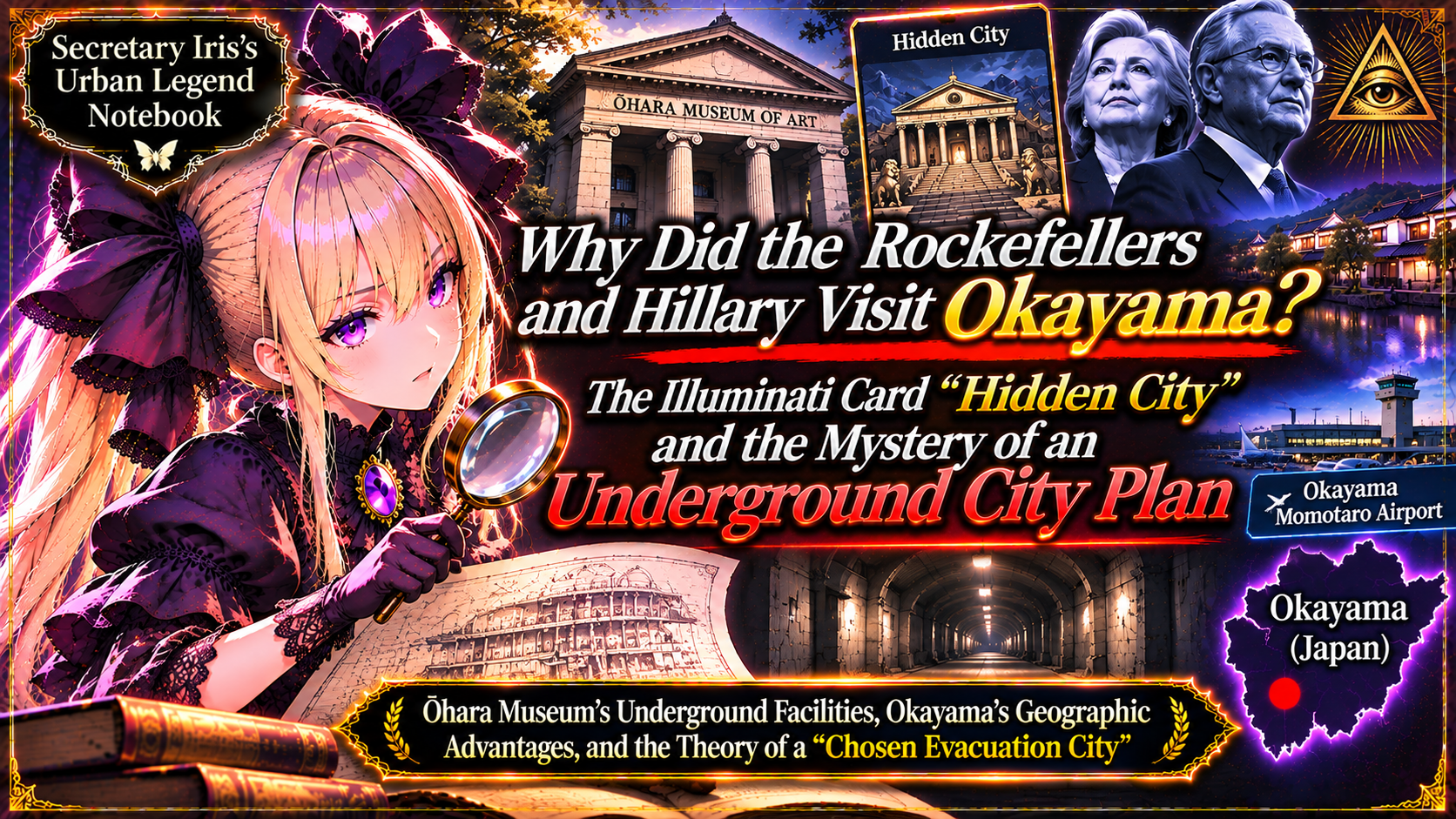
On an ordinary Monday afternoon, several internationally prominent figures visited the historic city of Kurashiki in Okayama Prefecture, Japan.
Among them was former U.S. Secretary of State Hillary Clinton.
Accompanying her were David Rockefeller Jr. and his wife.
Their destination was the Kurashiki Bikan Historical Quarter, a district known for its preserved Edo-period architecture, traditional storehouses, and distinctive canals.
At first glance, this appeared to be a cultural visit.
But the identities of the visitors quickly attracted attention.
Why had figures associated with international politics, finance, and philanthropy chosen to visit this particular Japanese city?
And why did their appearance become connected to a strange theory about an underground refuge?
According to some conspiracy narratives, Okayama is more than an ordinary regional prefecture.
It is supposedly the location of a secret underground city designed to shelter selected individuals during a future global catastrophe.
The story becomes even more intriguing when an old card game enters the picture.
In 1994, Steve Jackson Games released Illuminati: New World Order, a collectible card game built around conspiracies, secret organizations, and world domination.
One of its cards is called Hidden City.
The illustration shows a monumental, temple-like building apparently concealed within mountainous terrain.
Some observers believe that the architecture resembles the Ohara Museum of Art in Kurashiki.
And here is the unusual detail.
The museum really does have underground facilities.
Okayama also possesses an airport with a 3,000-meter runway.
Several cultural institutions in the prefecture have undergone major renovations.
And now, internationally influential visitors have appeared in Kurashiki.
Are these simply unrelated facts?
Or is there a deeper story waiting to be uncovered?
Tonight, we investigate the intersection of documented history, unusual architecture, disaster planning, and one of the most intriguing underground-city theories circulating in Japan.
Chapter One: Why Did Hillary Clinton and the Rockefellers Visit Kurashiki?
The Official Record
We begin with what can be verified.
On October 30, 2026, the City of Kurashiki published an official announcement confirming that Hillary Clinton and the Rockefeller couple had visited the Kurashiki Bikan Historical Quarter on October 26.
The announcement stated that Mayor Kaori Ito explained the area’s history and culture.
According to the city, the visitors expressed admiration for the efforts of local residents to preserve Kurashiki’s historical environment.
The municipal website also published photographs of the visit.
This establishes an important fact.
The visit was real, and it was formally acknowledged by the local government.
But why were these particular individuals in Japan?
The Praemium Imperiale Connection
The answer begins with the Praemium Imperiale, an international arts award presented by the Japan Art Association.
The award recognizes outstanding artistic achievement in several major disciplines.
On October 28, 2026, the 37th award ceremony took place at Meiji Kinenkan in Tokyo.
Hillary Clinton attended the ceremony as an international advisor.
David Rockefeller Jr. also has a longstanding association with the award.
He served as an international advisor between 1991 and 2000 and is currently listed as an honorary advisor.
The Rockefeller family has a broader history of supporting art museums, cultural institutions, and philanthropic initiatives.
David Rockefeller Jr. himself has been associated with major cultural organizations, including the Museum of Modern Art in New York.
Consequently, the presence of Hillary Clinton and the Rockefellers in Japan during the same period has a documented cultural context.
Their visit to the historic district of Kurashiki is consistent with that background.
But an important distinction remains.
The municipal announcement confirms a visit to the historical quarter.
It does not establish that the visitors entered the Ohara Museum of Art or inspected any underground facility.
October 26 was also a Monday, which falls on the museum’s normal weekly closing day.
That does not prove that a special private visit was impossible.
It does mean that any claim of such a visit requires additional evidence.
At present, the public documentation reviewed for this investigation does not establish that it occurred.
Chapter Two: The Illuminati Card Called “Hidden City”
A Game About Secret Control
In 1994, American publisher Steve Jackson Games released Illuminati: New World Order.
The collectible card game invites players to assume control of competing Illuminati factions.
They gain influence over organizations, political figures, corporations, and other groups while attempting to dominate the world.
The game uses exaggerated conspiracy themes, satire, and fictional scenarios.
Over the years, its illustrations have attracted considerable attention among conspiracy enthusiasts.
Some images have been compared with subsequent historical events.
Others depict secret weapons, mysterious organizations, surveillance, or extraordinary disasters.
But the card relevant to our investigation is not about a specific political assassination or terrorist attack.
It concerns a hidden location.
Its name is Hidden City.
A Mysterious Temple in the Mountains
The illustration depicts an imposing structure surrounded by mountainous scenery.
A broad staircase rises toward a building with classical architectural features.
Columns support a triangular pediment.
Sculptural forms resembling guardian lions appear near the staircase.
The setting looks like a ceremonial entrance to a concealed city.
It is easy to understand why the image attracts attention.
The architecture resembles a monument, temple, or important government building.
Yet its location suggests isolation and secrecy.
Some observers have compared the structure with the Ohara Museum of Art in Okayama.
Does the Card Actually Resemble the Ohara Museum?
The Ohara Museum of Art opened in 1930.
Its main building incorporates classical architectural features, including monumental columns and a triangular pediment.
Sculptures and a staircase form part of the approach to the building.
There are therefore visible similarities between the museum’s exterior and the fictional structure depicted on the card.
But there are also differences.
The card places its building within mountainous terrain.
The actual Ohara Museum stands within Kurashiki’s historic urban district.
The card’s guardian-like sculptures are not identical to the museum’s sculptures.
More importantly, buildings inspired by classical Greek and Roman architecture commonly share columns, pediments, steps, and symmetrical arrangements.
Museums, universities, courthouses, and government buildings around the world employ these elements.
Architectural resemblance does not establish that one building was modeled on another.
No verified statement from Steve Jackson Games has been identified showing that the Ohara Museum served as the inspiration for Hidden City.
The resemblance is an interesting observation.
It is not, by itself, evidence of a hidden construction project.
The Card’s Unusual Powers
The game’s description gives Hidden City an unusual strategic role.
Controlling the card increases an Illuminati faction’s Power and Global Power.
The city can be attacked through Disaster cards.
However, the card specifically prevents it from becoming Devastated, a particular status within the game’s rules.
If the city is destroyed, another Hidden City card may be introduced.
The result is an unusual fictional location with strategic importance and special resistance to a type of disaster effect.
It is tempting to interpret these abilities as describing a catastrophe-resistant underground bunker.
Yet that interpretation goes beyond the evidence.
The abilities are game mechanics.
They do not reveal the construction specifications of an actual building.
Nor do they establish that the creators were documenting a secret facility.
Still, the fictional concept raises a fascinating historical question.
Why does the idea of a protected, hidden city feel so plausible?
To answer that, we must look beneath the surface of real buildings.
Chapter Three: What Actually Exists Beneath the Ohara Museum?
The Underground Facilities Are Real
Here the investigation encounters something more substantial than an architectural resemblance.
The Ohara Museum of Art has documented underground facilities.
Their existence is not a rumor.
The architectural firm Urabe Sekkei, which worked on the museum’s expansion and renovation projects, has published details of the construction.
In October 1987, an underground exhibition extension was completed.
The reinforced-concrete structure included one aboveground floor and one basement level, with a total floor area of approximately 760 square meters.
A second relevant project followed in April 2009.
A new collection-storage building was completed with one aboveground floor and one basement level, covering approximately 390 square meters.
Seismic strengthening work was also carried out in connection with the project.
These are concrete, verifiable facts.
But what were the facilities designed to do?
Art Conservation and Historic Preservation
The architectural records provide an explanation.
The museum stands within an important historic district.
Expanding cultural facilities in such an environment requires balancing modern functional needs with the preservation of traditional scenery.
Large aboveground additions could alter the character of the surrounding streets.
Underground construction offered a way to increase exhibition and storage capacity while limiting visual impact.
The 2009 storage project also addressed the practical requirements of preserving valuable artworks.
Museums need secure storage, appropriate environmental conditions, and buildings suitable for conservation.
The published records describe an architectural response to those needs.
They do not describe a human survival shelter or a nuclear command center.
Thus, the distinction is straightforward.
Underground exhibition and storage facilities are confirmed.
A secret underground city beneath the museum is not confirmed.
One fact cannot simply be substituted for the other.
The Museum’s 2026 Renovation
The Ohara Museum also underwent a major renovation in 2026.
Its main building closed from February 9 through April 24.
The official explanation identified work involving air-conditioning and electrical systems.
The museum reopened on April 25.
In conspiracy narratives, prolonged closures sometimes become associated with secret construction work.
Yet the publicly documented work at the museum concerned building services and visitor facilities.
No verified records reviewed for this article establish that the renovation created a nuclear shelter or underground city.
The renovation is real.
The alleged covert purpose remains unsupported.
Three Museums, Three Renovation Timelines
Another element of the underground-city theory concerns renovations at multiple cultural institutions in Okayama.
The Okayama Orient Museum underwent a long-term renovation beginning in October 2020.
It reopened on April 22, 2022.
The work was publicly described as improving the building’s long-term durability and functionality.
The Okayama Prefectural Museum also underwent major renovations.
Its complete reopening took place on April 1, 2023.
The project improved exhibition facilities, environmental controls, and other aspects of the building.
The Ohara Museum’s latest major equipment renovation followed in 2026.
Seen together, these projects may appear to form a pattern.
But they did not occur simultaneously.
They involved different institutions, schedules, and publicly documented purposes.
No verified evidence establishes that the three projects were components of a coordinated underground construction program.
A pattern of renovations is not automatically evidence of a shared secret objective.
Chapter Four: Why Okayama? Geography, Aviation, and Disaster Risk
An Airport with a 3,000-Meter Runway
Okayama Momotaro Airport provides another element of the mystery.
According to its official information, the airport has a runway measuring 3,000 meters long and 45 meters wide.
The elevation at the runway center is approximately 239.2 meters above sea level.
The airport supports both domestic and international flights.
It is located roughly 30 minutes by road from central Okayama City.
Nearby highway connections also provide access to surrounding regions.
These features make the airport a meaningful transportation asset.
However, the existence of a long runway does not imply that the facility was built for a particular wealthy family.
Okayama Momotaro Airport is a regional airport established and managed by Okayama Prefecture.
Claims that it was constructed specifically for Rockefeller family aircraft would require documentary evidence involving planning, financing, ownership, or operating arrangements.
No such evidence has been established in the records reviewed here.
The Strange Date: March 11
The airport officially opened on March 11, 1988.
In Japan, March 11 carries an entirely different historical significance.
It is the date of the devastating 2011 Great East Japan Earthquake and tsunami.
The coincidence is striking.
But the airport opened 23 years before the disaster.
There is no evidence that the opening date was intended to predict or symbolize the later earthquake.
A meaningful-looking coincidence is not automatically a causal connection.
Is Okayama Really Safe from Disasters?
Okayama is often associated with a mild climate and relatively favorable weather conditions.
Its location along the Seto Inland Sea can also lead people to compare it favorably with some locations directly facing the Pacific Ocean.
However, disaster safety cannot be evaluated solely through reputation.
In 2026, Okayama Prefecture updated its estimates of damage from a major Nankai Trough earthquake and other fault-related earthquakes.
The prefecture also revised its tsunami inundation projections.
In August 2026, Okayama City updated its online hazard maps to reflect newer information about tsunami inundation, seismic shaking, liquefaction, and flooding.
These official studies identify different hazards across the prefecture.
Low-lying coastal areas may face tsunami or flood risks.
Some locations have liquefaction concerns.
Mountainous regions may avoid direct tsunami inundation but can face landslides, strong shaking, and damaged transportation routes.
The prefecture also experienced severe flooding during the July 2018 disaster, particularly in Kurashiki’s Mabi district.
Consequently, it would be inaccurate to describe all of Okayama as a disaster-proof region.
But it would also be inaccurate to conclude that every location is unsuitable for emergency infrastructure.
The relevant question is not simply whether Okayama is safe. It is which specific location, for which specific hazards, and under what conditions.
Could an Underground City Be Built There?
Large underground facilities require much more than an available plot of land.
Geological conditions matter.
Groundwater levels matter.
Slope stability and seismic hazards matter.
Long-term underground habitation also requires reliable ventilation, electrical power, water supplies, drainage, waste management, communications, and emergency exits.
A protected command center is not equivalent to a fully functioning underground city.
Both the scale and the engineering requirements would differ substantially.
Without a specific proposed site and detailed geological information, it is impossible to conclude that Okayama as a whole is suitable for such a project.
Chapter Five: The Hidden Bunkers That Really Existed
A Secret Beneath an American Luxury Resort
This is where the historical record becomes especially interesting.
In West Virginia, the Greenbrier Resort is known as a prestigious luxury destination.
But during the Cold War, the United States government constructed a secret underground facility beneath the resort.
Its purpose was to provide an emergency relocation site for members of Congress in the event of a nuclear attack on Washington.
The project formed part of broader efforts to preserve continuity of government.
The bunker was completed in 1962.
For decades, its existence remained confidential.
In 1992, reporting revealed the facility to the wider public.
The bunker is now recognized as a genuine historical example of Cold War emergency planning.
Parts of the former facility can be visited today.
The U.S. National Park Service has documented its history.
The lesson is significant.
Secret government facilities have, in fact, existed beneath buildings used by the general public.
This is not merely an invention of modern conspiracy culture.
Why This Does Not Prove the Okayama Theory
The Greenbrier example establishes that secret bunkers are technically and historically possible.
It does not establish that an equivalent facility exists beneath the Ohara Museum.
In the Greenbrier case, historical records and subsequent disclosures documented the facility’s purpose.
There was a specific government program.
There was a construction project.
There was a recognizable site.
There was evidence of its intended occupants and operational role.
By comparison, the Okayama underground-city theory currently lacks equivalent verified documentation.
The museum’s known basement facilities have publicly described cultural functions.
There is no confirmed record identifying them as part of an international emergency relocation system.
An authentic historical precedent can make a theory worth examining.
But it cannot substitute for evidence about the specific location being investigated.
Private Networks and International Power
Conspiracy theories often connect secret facilities with influential international networks.
The Bilderberg meetings, for example, are real gatherings involving figures from politics, business, and other sectors.
Other invitation-based networks also exist.
Our previous investigation into Dialog examined one such community and the controversy surrounding information exposed in 2026.
These networks demonstrate that private discussion among influential people is not inherently fictional.
But private meetings and covert construction projects are different claims.
To establish a relationship, an investigation would need evidence such as contracts, financial records, planning documents, or credible first-hand accounts.
The presence of powerful individuals within the same network does not automatically demonstrate coordinated secret action.
Chapter Six: Iris’s Analysis — What If Okayama Had Been Chosen?
The following section is a hypothetical analysis, not a statement that a secret underground city exists in Okayama.
Imagine an organization planning an emergency refuge for a limited number of people during a severe international crisis.
What criteria might it consider?
The first would be exposure to major hazards.
Earthquakes, flooding, tsunamis, landslides, and other threats would have to be assessed.
The second would be accessibility.
An airport capable of supporting substantial transport operations could be useful.
Road and rail connections could also matter.
The third would be the long-term sustainability of the facility.
Water, power, ventilation, communications, supplies, and emergency medical support would all be essential.
And the fourth would be the location’s physical suitability for construction.
An underground project would depend heavily on local geology and groundwater conditions.
Okayama does possess some potentially relevant advantages.
Its airport has a substantial runway.
It has established highway and railway connections.
Some inland locations may have lower direct exposure to tsunami inundation than coastal areas.
But these advantages do not eliminate the need for site-specific investigation.
A hypothetical underground facility would still need to withstand local hazards and maintain reliable access during emergencies.
And here another question emerges.
Why do museums and cultural institutions become such attractive subjects for underground-city theories?
One reason may be their architecture.
Large buildings often contain spaces that visitors never see.
Storage rooms.
Mechanical floors.
Restricted service areas.
Basements.
Their hidden spaces are real, even when their purposes are entirely ordinary.
Another reason may be historical precedent.
After learning about the Greenbrier bunker, it becomes easier to imagine that a public building could contain something unexpected.
Now place several observations together.
Influential visitors arrive in Kurashiki.
A historic museum has underground rooms.
A mysterious card depicts a classical building.
A nearby airport has a long runway.
Each individual observation has a documented or identifiable basis.
But the proposed connection among them remains speculative.
The question is whether evidence exists to bridge those gaps.
At present, the answer is that no verified evidence of a coordinated underground-city project has been established.
The hypothesis can be explored.
It should not be presented as a discovered fact.
Epilogue: The Mystery Beneath the Mystery
On October 26, 2026, Hillary Clinton and the Rockefeller couple visited Kurashiki.
That is documented.
The Ohara Museum of Art possesses underground exhibition and storage facilities.
That is also documented.
The game Illuminati: New World Order includes a Hidden City card.
That, too, is real.
Okayama has an airport with a 3,000-meter runway.
Several cultural institutions in the region have undergone major renovations.
All these details are worthy of investigation.
But they do not, by themselves, establish the existence of a secret underground city.
Nor do they establish that Hillary Clinton or the Rockefeller family visited the region to inspect such a project.
The distinction between evidence and interpretation remains essential.
Yet the underlying question is not entirely imaginary.
History shows that governments have constructed secret emergency facilities.
Influential people do participate in private international discussions.
Emergency planning can involve infrastructure that is unfamiliar to the wider public.
So perhaps the most interesting part of this story is not whether a particular museum conceals a fictional underground civilization.
Perhaps it is why we are drawn to stories about hidden places reserved for powerful people.
Modern societies face genuine uncertainties.
War.
Economic instability.
Natural disasters.
Food and energy shortages.
When people imagine a global catastrophe, another question naturally follows.
Would everyone face the same danger?
Or would those with influence and resources have access to options unavailable to ordinary citizens?
That question reflects concerns about inequality, transparency, and the distribution of protection during emergencies.
And those concerns deserve serious discussion.
But meaningful investigation requires more than suspicion.
It requires documents.
It requires verifiable testimony.
It requires evidence that connects the individuals, places, and events being discussed.
The absence of publicly available evidence is not proof that something is being concealed.
And the existence of a historical precedent is not proof that a new case must follow the same pattern.
An extraordinary theory becomes more meaningful when we can distinguish what is known from what is merely possible.
So let me leave you with one final question.
If a secret refuge truly existed for a select few during a global catastrophe, who would have the right to know about it?
The records examined here do not establish that such a city exists beneath Kurashiki.
But the broader question of who receives protection during a crisis is not entirely fictional.
Perhaps that is the real mystery beneath the legend.
Not simply what might be hidden underground.
But what societies choose to reveal—and what they believe should remain out of public view.
Next time—another fragment of truth we will trace together.
I will return to continue the telling.
📚 Sources & Verification Notes
01|City of Kurashiki — Official Visit Record
City of Kurashiki / October 30, 2026 / Primary source
Confirms the October 26 visit by Hillary Clinton and the Rockefeller couple to the Kurashiki Bikan Historical Quarter. Does not establish that they entered the Ohara Museum or inspected underground facilities.
▶ Official municipal announcement (Japanese)02|Praemium Imperiale — International Advisors
Japan Art Association / Official records
Documents Hillary Clinton’s role as an international advisor and David Rockefeller Jr.’s historical and current advisory connections.
▶ Official advisor list03|37th Praemium Imperiale Award Ceremony
Praemium Imperiale / October 28, 2026
Confirms the ceremony in Tokyo and Hillary Clinton’s participation.
▶ Official ceremony report (Japanese)04|Ohara Museum of Art — Institutional History
Ohara Museum of Art / Official history
Documents the museum’s foundation in 1930 and its subsequent development.
▶ Museum history (Japanese)05|Urabe Sekkei — Underground Museum Structures
Urabe Sekkei / Architectural project records
Documents the 1987 underground exhibition extension and the 2009 collection-storage building, both designed for cultural functions.
▶ Architectural project documentation (Japanese)06|Ohara Museum — 2026 Renovation
Ohara Museum of Art / Official announcement
Confirms the February 9–April 24 closure for air-conditioning and electrical work.
▶ Renovation notice (Japanese)07|Okayama Momotaro Airport — Official Specifications
Okayama Momotaro Airport / Official airport information
Confirms the 3,000-meter runway, the 45-meter width, the approximately 239.2-meter elevation, and the March 11, 1988 opening date.
▶ Airport specifications08|Okayama Orient Museum — Renovation
Okayama City / Official municipal record
Documents the museum’s renovation and reopening on April 22, 2022.
▶ Official reopening explanation (Japanese)09|Okayama Prefectural Museum — Renovation
Okayama Prefecture / Official record
Confirms the museum’s full reopening on April 1, 2023, after extensive renovation.
▶ Official museum report (Japanese)10|Okayama Prefecture — Updated Earthquake Risk Assessments
Okayama Prefectural Government / Updated July 2026
Provides updated assessments of Nankai Trough earthquake damage, fault-related earthquakes, tsunami inundation, and liquefaction risk.
▶ Updated disaster assessments (Japanese)11|U.S. National Park Service — The Greenbrier Bunker
National Park Service / Historical research
Documents the Cold War-era underground relocation facility built beneath a luxury resort for members of the U.S. Congress.
▶ Read the historical account12|Illuminati: New World Order — Game Rules
Steve Jackson Games / Original game released in 1994
Explains the fictional system of influence, disaster cards, and special game effects. The specific Hidden City abilities are drawn from reproduced card descriptions; the original artistic inspiration remains unverified.
▶ Review the game rules🕒 Posting Time
November 16, 2026 · 23:00 JST
English public edition
🎵 IRIS FILE — “Is It Really True?”
Secretary Iris’s original theme. Follow the clues beyond the rumors.
📖 Further Reading
Dialog — The Leaked Registration Records of 222 People
The Economist’s 2015 Cover and Revelation of the Method
Understanding Freemasonry — Symbols and Secret Societies (Japanese)
What Actually Began in Japan on October 1? — A One-Month Fact Check
⭐ Popular
These five fixed selections link to Japanese articles.
The World Ahead 2025 — Symbol Analysis
The Simpsons and the 2026 World Cup Prediction
NWO and the New World Order in 2026
✉️ Share a Mystery with Iris
Know a local legend or a claim worth investigating? Tell us where you encountered it, separating firsthand experiences from stories you heard. Please protect other people’s privacy.
コメントを残す