I am Iris.
Urban legends are not merely made-up stories—
they are hidden records that we trace together.
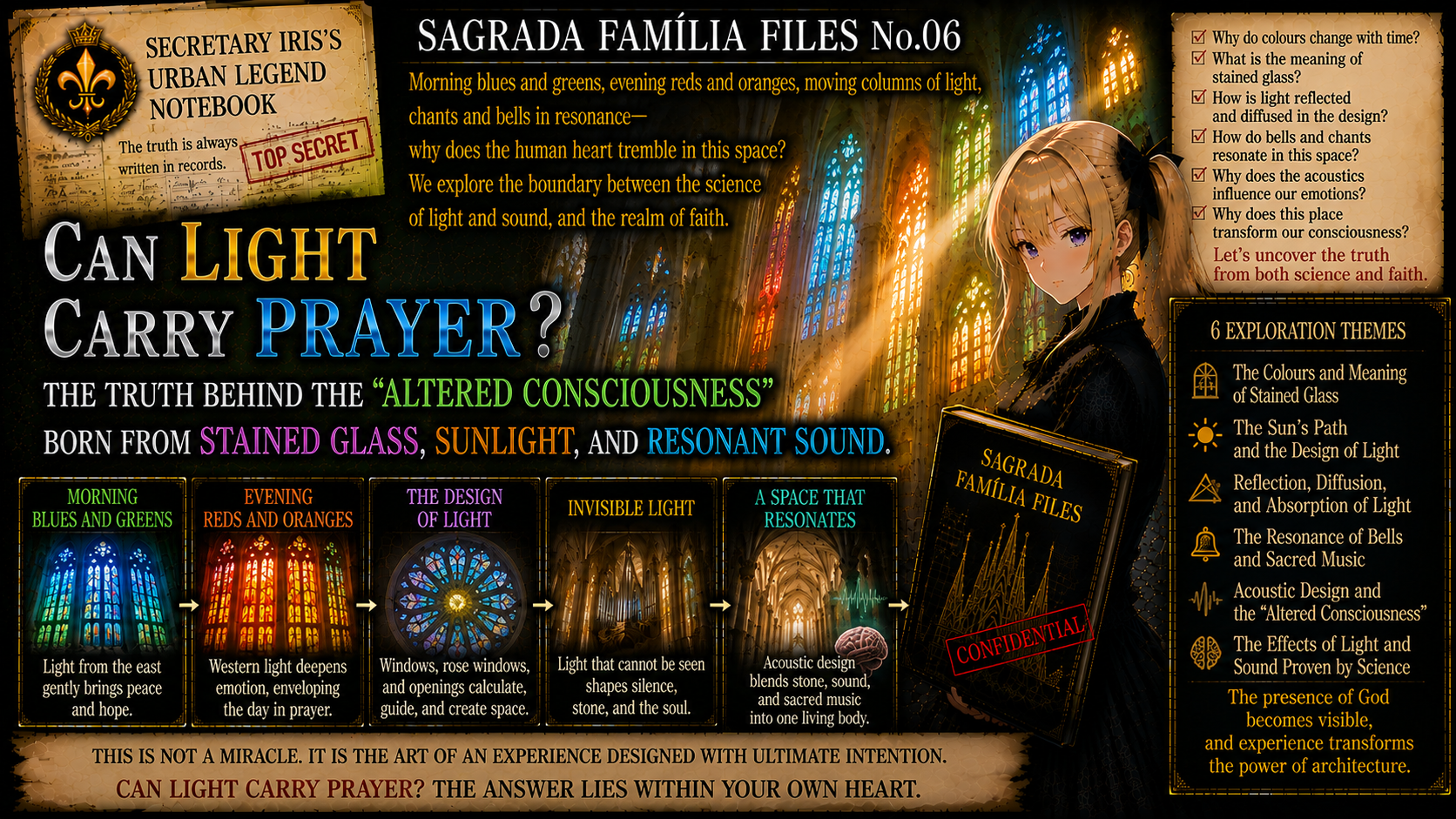
Morning.
Blue and green light enters from the east and falls across the stone columns.
Noon.
As the sun moves, bands of colour travel through the Basilica.
Evening.
Red, orange, and yellow enter from the west, transforming the space into something entirely different.
The same columns.
The same vaults.
The same glass.
But a different hour creates a different church.
Then the human voice enters.
A chant rises toward the ceiling.
It reflects from stone and returns from another direction.
An organ tone reaches the body.
After the musicians stop, reverberation remains suspended in the space.
Visitors sometimes describe an experience that is difficult to translate into ordinary language.
Time appeared to slow down.
The self seemed smaller.
The building seemed alive.
A presence was felt.
Tears appeared unexpectedly.
Prayer became possible.
Urban legends describe this as altered consciousness produced by an unknown frequency.
The stained glass filters a hidden energy.
The towers receive signals.
The columns amplify sound.
Bells and organs change human brainwaves.
The Sagrada Família is said to be an enormous machine capable of transforming the mind.
Is such a device present?
Or does the experience arise from a highly deliberate combination of light, colour, sound, scale, movement, memory, and religious meaning?
Sagrada Família Files No.06 examines whether light can carry prayer—and where architecture ends and the extraordinary human experience begins.
Can Light Physically Store a Prayer?
In physics, light travels as electromagnetic radiation.
No verified mechanism shows the stained glass storing the semantic content of a prayer and transmitting it to another person as language.
Blue light has not been shown to contain hope as encoded information.
Red light does not physically preserve the memory of the Passion.
But light does carry information.
Brightness.
Colour.
Direction.
Distance.
Time.
Form.
Surface.
Human beings understand space through light.
When architecture assigns religious meaning to that light, physical stimulation becomes symbolic experience.
Morning light can be read as birth.
Sunset as death.
Light descending from above as divine presence.
The photons do not carry the words of prayer.
Architecture makes light readable as prayer.
The Light Inside the Basilica Is Not Accidental
A large window can make a building bright.
Gaudí’s ambition was more complex than uniform illumination.
The sun moves during the day.
Its height changes through the seasons.
Window direction, height, geometry, columns, glass colour, and reflecting stone all influence where light travels.
Time itself becomes part of the design.
Morning and evening deliver different colours.
Bands of light move across floors and columns.
Some surfaces become luminous while others fall into shadow.
The Basilica is not a completed static image.
The sun redraws it every day.
Blues and Greens in the East
The eastern side is connected with the Nativity façade.
Sunrise.
Beginning.
Birth.
Hope.
Creation.
Cooler blues and greens dominate the glazing on this side.
Blue may evoke sky and water.
Green may evoke plants and growth.
Colour meanings are never completely universal.
Blue does not always produce peace.
Green does not always mean life.
But the arrangement creates a coherent narrative between eastern light, nature, and birth.
Morning light passes through the glass.
Cool colours reach the columns.
The interior appears to awaken.
Reds and Oranges in the West
The western side is connected with the Passion façade.
Sunset.
The end of the day.
Betrayal.
The Crucifixion.
Death.
Resurrection.
Warm and intense reds, oranges, and yellows dominate this side.
Red may evoke blood and suffering.
Orange and gold resemble sunset and fire.
When evening light enters, the stone forest changes.
The calm of blue and green gives way to intensity.
Birth moves toward Passion.
Every day, the sun travels through the architectural story.
Colour Leaves the Glass
When coloured light falls on stone, the colour no longer belongs only to the window.
It moves onto columns.
Floors.
Walls.
Clothing.
Human bodies.
The visitor is no longer an observer standing outside the image.
The visitor enters the light.
In religious language, the person becomes surrounded by the sacred narrative.
In architectural language, the observer becomes part of the designed environment.
Joan Vila-Grau and the Windows Seen Today
The artist Joan Vila-Grau played a major role in creating the stained-glass windows now seen in the naves.
He began this work in 1999 and continued for more than two decades.
Gaudí left a broad vision involving colour, light, direction, and the spiritual meaning of the Basilica.
He did not personally complete every window visible today.
Later artists and architects interpreted the inherited project and transformed it into specific colours and materials.
The light is therefore collaborative.
Gaudí’s concept.
Later architectural decisions.
Vila-Grau’s artistic language.
The work of glassmakers.
And the sun.
Balancing Colour and Illumination
The purpose of stained glass is not simply to fill the interior with the strongest possible colour.
Glass that is too dark reduces illumination and conceals the building.
Glass that is too pale weakens the symbolic difference between the sides.
The design requires balance.
Colour must remain visible without trapping all available light.
Changes in saturation and transparency can draw the eye upward.
Stronger colour appears lower down.
Greater luminosity and transparency appear higher in the interior.
Colour is not merely decoration.
It guides human attention.
Why a Beam of Light Becomes Visible
Light travelling through clean air is difficult to see from the side.
A visible beam usually appears because dust, moisture, smoke, or another particle scatters the light toward the observer.
The beam has not become a solid object.
Particles make its path visible.
Urban legends sometimes describe such beams as spiritual energy unique to the Basilica.
The physical phenomenon can be explained through reflection and scattering.
Yet the symbolic experience may still occur.
A physically ordinary beam can be understood as light descending from heaven.
Mechanism and meaning can exist together.
Geometry Guides the Light
Hyperboloids and other geometrical surfaces are used in windows and vault openings.
A hyperboloid narrows and then expands.
Light entering through it can reflect and diffuse across the surface.
The opening may resemble a flower or star.
Structure.
Illumination.
Decoration.
Symbolism.
One form performs several roles.
Speculative theories describe the star-like openings as receivers of cosmic energy.
The documented architectural role concerns structure and natural light.
No verified measurement demonstrates the amplification of an unknown signal.
Light Moves the Building Through Time
The interior communicates time without a clock.
The direction of morning light.
The height of the sun.
The colour of evening.
Long shadows before sunset.
Seasonal changes.
The Basilica connects ordinary time with sacred time.
Nativity.
Passion.
Resurrection.
Eternity.
Visitors may feel that time has slowed or temporarily disappeared.
That does not show that physical time stopped.
When attention becomes strongly absorbed by colour, scale, music, and detail, subjective time may be experienced differently.
Sound Does Not Travel in One Straight Line
Sound inside a cathedral reaches the listener through several paths.
Direct sound from the performer.
Reflections from the floor.
Reflections from columns.
Delayed sound from the vaults.
Sound moving through side aisles.
These paths overlap.
In a tall, reflective space, sound may remain after its source has stopped.
One voice becomes wider.
One note overlaps the next.
Reverberation can make sacred music feel enveloping.
It can also reduce the clarity of speech.
The acoustic needs of music, conversation, and liturgy are not identical.
The Acoustics Are Still Being Explored
The Sagrada Família continues to change as construction progresses.
Walls, doors, towers, furnishings, audiences, and equipment all affect reflection and absorption.
In 2024, the Basilica launched a series of experimental concerts called “Ressonàncies.”
The project explored the sound potential of spaces not yet fully used for performance.
Musicians were positioned inside the Nativity and Passion façades, the presbytery, elevated choir platforms, and spaces beneath the Tower of the Virgin Mary.
The results were to be evaluated for future musical use.
This matters.
The sound was not treated as a perfectly completed secret mechanism.
It remains the subject of testing and interpretation.
Gaudí’s Enveloping Architecture of Voices
Gaudí imagined music distributed around the interior.
Choirs along the side naves and Glory façade.
Singers at higher levels.
Children’s voices near the apse.
A musical chapel in the elevated central space.
Multiple organs.
Sound would not come only from a stage directly in front of the congregation.
It would arrive from above, beside, behind, and around.
The worshipper would be placed inside the music.
In contemporary language, the concept resembles immersive sound.
Its purpose, however, was not entertainment.
It was to surround a praying community with a shared voice.
When Sacred Music Moves Beyond Words
A chant contains language.
But a listener who does not understand that language can still experience pitch, rhythm, harmony, dynamics, and human breath.
A single voice.
A choir.
Children.
Lower voices.
Sustained organ tones.
Reverberation weakens the boundary between individual singers.
The source seems larger than the people producing it.
Religiously, individual prayer appears to join communal prayer.
Acoustically, direct and reflected sound blend and expand the apparent location of the source.
Organ Sound Reaches the Body
Sound is not perceived only by the ears.
Powerful low frequencies can be felt through the floor, furniture, chest, and abdomen.
A sustained organ tone can create the impression of standing inside the sound.
This has inspired claims that a frequency opens a “third eye,” repairs DNA, or remotely controls consciousness.
No verified document shows the Sagrada Família being designed to cause such biological transformations.
Feeling low-frequency vibration is real.
Unknown mind control is a separate claim.
Are Real Bells Already Producing the Carillon Music?
The Apostle towers were conceived as bell towers.
Gaudí envisioned music reaching the city.
But the present carillon story requires precision.
An official statement from 2019 explained that the Basilica did not then possess a physical carillon.
The music heard was a recording played through four speakers inside the Passion façade lift shaft.
A real carillon was described as part of a future musical project to be studied after completion.
The concept, recorded sound, future instrument, and installed bells must not be treated as the same thing.
The Tower Resonance Theory
Because the towers are tall and contain internal spaces, some theories describe them as enormous resonators.
Eighteen towers will produce one frequency.
Barcelona will be affected.
The structure will synchronise with the Earth.
Every architectural space has acoustic characteristics and resonant frequencies.
That fact does not establish secret control of consciousness or planetary systems.
A measurable claim requires a specified frequency, power, range, mechanism, and repeatable result.
Such evidence has not been demonstrated.
Music and the Brain
Music engages expectation, memory, rhythm, emotion, and attention.
A familiar melody activates memory.
A delayed harmonic resolution produces tension.
A resolution produces relief.
Music heard by a group can coordinate attention and behaviour.
These effects vary according to culture, personal history, belief, volume, health, and environment.
Music can influence the mind without acting as a single universal command.
The Wide Meaning of “Altered Consciousness”
The phrase often suggests hypnosis, hallucination, drugs, or paranormal experience.
But ordinary life contains changes in consciousness.
Deep reading.
Meditation.
Prayer.
Musical absorption.
Athletic flow.
Watching a sunset.
Standing before a vast landscape.
Experiences reported at the Sagrada Família often fit within this broader category:
Focused attention.
Awe.
Reduced self-importance.
Changed perception of time.
Emotional intensity.
Religious interpretation.
An unknown device is not required for a profound shift in awareness.
Awe Is Not Purely Pleasant
Awe may combine beauty with fear.
Attraction with powerlessness.
Joy with a sense of personal smallness.
The Sagrada Família contains many conditions capable of producing awe.
Scale exceeding the human body.
Columns that cannot be understood without looking upward.
Complex decoration that cannot be processed at once.
Moving colour.
Long reverberation.
More than a century of construction.
Themes of God, death, resurrection, and eternity.
The mind must adjust its normal frame of reference.
The result may be remembered as mystical.
The Small Self
Feeling small in a vast space is not necessarily negative.
Everyday life places personal schedules and problems at the centre.
Inside the Basilica, the visitor encounters something begun before their birth and likely to endure after their departure.
Thousands of builders, donors, artists, worshippers, and visitors have contributed to its history.
The individual becomes one brief participant.
A believer may interpret this as humility before God.
A non-believer may experience awe before human creativity and historical time.
How Architecture Encourages Prayer
No confirmed mechanism forces prayer.
Architecture can nevertheless create conditions that support it.
Columns directing the gaze upward.
A large space slowing movement.
Separation from ordinary street noise.
Silence encouraging quieter speech.
Reverberation extending each sound.
Changing light.
Biblical imagery.
Shared ritual.
Environments give behavioural cues.
A library encourages quiet.
A theatre directs attention toward a stage.
A memorial changes the pace of walking.
A sacred building can encourage contemplation without controlling the mind.
Does Scientific Explanation Eliminate Faith?
Explaining scattering does not eliminate the beauty of light.
Measuring reverberation does not invalidate sacred music.
Studying awe does not prove that a religious experience was meaningless.
Science asks how stimuli and bodies interact.
Faith asks what the experience means and toward whom prayer is directed.
They are not always answering the same question.
Must Faith Reject Physics?
Light follows physical law.
Sound reflects and decays.
Brains respond to music.
Those facts need not oppose faith.
Gaudí understood natural law as part of divine creation.
Geometry and gravity were not enemies of the sacred.
They were ways of reading order.
Understanding the Basilica’s sensory effects may deepen rather than diminish appreciation of its religious architecture.
Why the Hidden-Frequency Theory Is Attractive
Visitors may experience tears, trembling, altered time, or overwhelming emotion.
The stronger the experience, the more tempting it becomes to assume that ordinary architecture cannot explain it.
The word “frequency” sounds scientific.
Hertz.
Resonance.
Energy.
Brainwaves.
Vibration.
But scientific vocabulary is not scientific evidence.
A testable theory must identify the frequency, mechanism, measurement, and repeatable outcome.
Are 432 Hz or 528 Hz Built into the Basilica?
Online claims often describe 432 Hz or 528 Hz as cosmic, healing, or DNA-repairing frequencies.
Some versions claim that the Basilica’s bells or organs were designed around them.
No verified official source establishes the entire musical architecture as a machine based on either number.
Music is not composed of one frequency.
Fundamentals, harmonics, chords, voices, instruments, and reverberation create a complex spectrum.
A single numerical label cannot explain the experience of the whole building.
Vision and Sound Form One Experience
The senses do not operate independently.
A low chant in darkness feels different from the same chant in bright colour.
Red light changes the interpretation of Passion music.
Blue light changes the mood of quiet choral sound.
Temperature, smell, stone, footsteps, silence, memory, and belief are added.
The apparent “alteration” may arise not from one secret signal, but from many senses intentionally aligned.
The Building Changes with Its Audience
A crowded tourist period differs from a quiet service.
A concert differs from private prayer.
Human bodies and clothing absorb sound.
Conversation and footsteps alter the soundscape.
Visitors also arrive with different intentions.
Architecture does not create one identical state in every person.
Experience emerges between building, event, and visitor.
Photographed Light and Experienced Light
Images on social media may increase saturation, contrast, and dramatic exposure.
HDR processing can exaggerate colour.
A photograph may also fail to capture the surrounding field of light, movement, sound, and scale.
Lens flare, reflection, dust, and exposure artefacts may be interpreted as spiritual objects.
Optical explanations should be examined before paranormal ones.
An Experience Does Not Need to Be a Miracle to Matter
Physical explanations do not remove value.
They reveal design.
Why does the light reach that column?
Why does the voice appear to surround the listener?
Why does the gaze move upward?
Why does the individual feel small?
Calling everything a miracle can end the investigation too early.
Human beings understanding light and sound well enough to create such an environment is already extraordinary.
Can Light Carry Prayer?
Light has not been shown to store and transmit the semantic content of prayer.
Yet it can carry prayer in another sense.
A person sees morning blue and remembers hope.
Another sees evening red and remembers suffering.
Someone remembers a person who died.
Someone else prays for the future.
Architecture gives the light meaning.
Visitors receive it and add their own memories and words.
Prayer is not physically stored in the light.
It is carried through the experience created around it.
Conclusion—Does a Device Change Consciousness, or Does an Experience?
No unknown consciousness-control machine has been verified inside the Sagrada Família.
No single frequency has been shown to transform every visitor into the same mental state.
But the Basilica clearly acts on attention and emotion.
Morning blues and greens.
Evening reds and oranges.
Columns rising beyond ordinary scale.
Light travelling across stone.
Choirs.
Organs.
Reverberation.
Prayer.
More than a century of construction.
Human consciousness receives all these elements at once.
A visitor also brings memory, belief, grief, curiosity, and expectation.
From their meeting emerges:
Awe.
Immersion.
Reflection.
Prayer.
Or what may be called altered consciousness.
Can light carry prayer?
Photons do not fly through the Basilica carrying sentences.
But light guides attention.
Colour activates memory.
Sound surrounds the body.
Architecture unites them into a story.
The person receiving that story begins to pray.
Perhaps light does not carry prayer.
Perhaps it illuminates the path toward it.
The true power of the Sagrada Família is not that it functions as a supernatural machine.
It is that physics, art, faith, and human perception have been transformed into one experience.
The Basilica creates something that feels miraculous through the precise use of stone, sunlight, colour, and sound.
Next in Sagrada Família Files No.07:
Who Owns the Completed Basilica?—
Gaudí’s Intention, His Successors, and the Temple After “Activation.”
What was created directly by Gaudí?
What was reconstructed by his disciples?
What was added by later sculptors?
What is being decided by present-day architects?
Can a building created across more than a century still be called one man’s work?
And when construction finally ends, will the story be over—or will a new story begin?
Next time—we will trace another fragment of the hidden record.
I will return to tell the story.
References
-
Official Sagrada Família Blog|The Stained-Glass Windows: Light, Colour and Creation
Used to examine the arrangement of cool eastern colours and warm western colours according to orientation and the movement of the sun. -
Official Sagrada Família Blog|Passion Façade
Used to verify Joan Vila-Grau’s long involvement in creating the stained-glass windows of the Basilica’s naves. -
Official Sagrada Família Blog|The Geometry, Mechanics and Materials of a Stone Forest
Used to examine the branching columns, interior geometry, structural openness, and natural-light environment. -
Sagrada Família|The “Ressonàncies” Musical Test Project
Used to verify the 2024 experimental concerts held in different areas of the Basilica to investigate their acoustic potential. -
Official Sagrada Família Blog|The Music Gaudí Envisioned
Used to examine Gaudí’s plans for choirs and organs positioned around and above the congregation to create an enveloping sacred sound. -
Sagrada Família|The Lent and Easter Carillon Repertoire
Used to verify that, in the official 2019 account, the Basilica did not yet possess a physical carillon and the music was reproduced through speakers. -
Culture and Awe: Understanding Awe as a Mixed Emotion
Used to examine awe as an emotion combining wonder, personal smallness, uncertainty, and sometimes fear. -
The Embodiment of Architectural Experience
Used to examine how architectural experience emerges through visual perception, bodily movement, spatial awareness, and emotion. -
Neural Correlates of Music Listening
Used to examine relationships between music, prediction, memory, enjoyment, emotion, and neurological processing. -
Acoustic Characteristics of Christian Temples and Emotional Response
Used to examine the relationship between reverberation, intelligibility, sacred sound, and emotional responses inside Christian worship spaces.
Posting Time
This article is scheduled for publication on August 8, 2026, at 23:00 JST.
Related Reading
The Nativity, Passion, and Glory façades through Scripture, direction, sunlight, colour, and sacred time.
Stars, geometry, light, Masonic interpretations, circumstantial evidence, and the membership record that cannot be found.
How Gaudí translated forests, bones, shells, gravity, hyperboloids, and natural light into architecture.
The Apostles, Evangelists, Mary, Christ, the number 18, and the boundary between official meaning and the “666” interpretation.
Popular Posts
Why arrangements of people, numbers, light, weapons, and economic symbols can appear to predict later events.
Separating theories of universal frequency control from the real influence of technology, information, standards, and institutions.
An investigation into celestial light, oral tradition, religious experience, apocalyptic symbols, and civilisational transformation.
Submit an Urban Legend
Have you encountered theories involving stained glass, beams of light, bells, organs, reverberation, 432 Hz, 528 Hz, brainwaves, altered consciousness, or the frequency of prayer?
Submit your story or investigation request →Share & Follow
If you enjoyed this investigation, sharing and following helps support the full Sagrada Família Files series.
Blog Top Share on X Share on Facebook Follow on X Instagram YouTube
コメントを残す