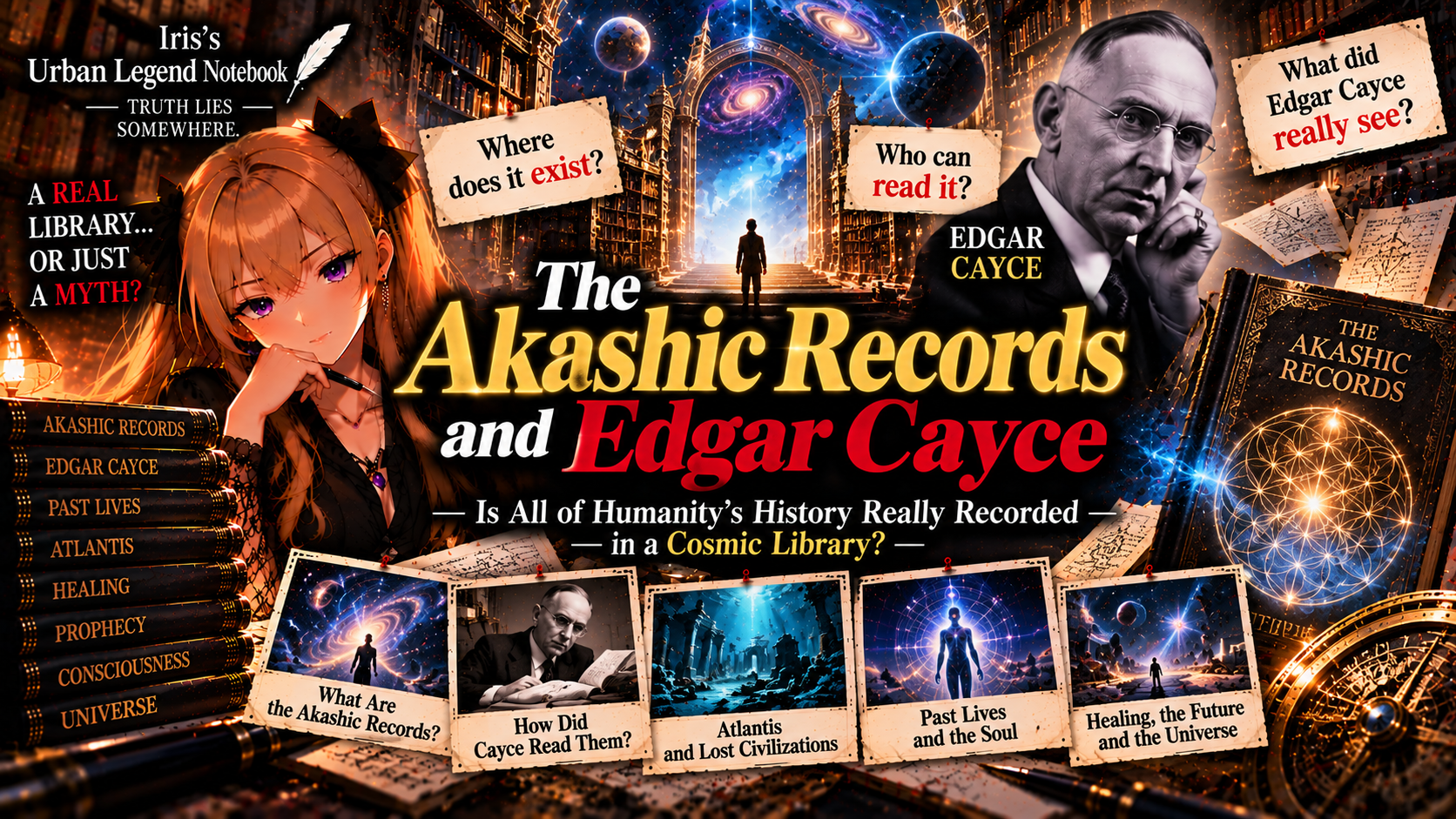
I am Iris.
Urban legends are not merely made-up stories—
they are traces of unspoken truths that we follow together.
What If Nothing We Ever Think Is Truly Lost?
A childhood memory.
A decision no one else knew about.
A forgotten civilization.
A past life.
Perhaps even a future event.
The Akashic Records are often described as an invisible archive containing everything that has ever happened—or could happen.
Every thought.
Every action.
Every emotion.
Every intention.
An immense cosmic library beyond ordinary space and time.
And one twentieth-century figure became more closely associated with that idea than almost anyone else:
Edgar Cayce.
Did he actually read from such a record?
Before answering that question, we need to find out where the idea itself came from.
Akasha Is Ancient. The “Cosmic Database” Is Much More Recent
The word akasha comes from the Sanskrit ākāśa, a term associated with space, sky or an ether-like element in Indian philosophical traditions.
But there is an important distinction.
The modern idea of an invisible archive containing all human events is not simply an ancient Indian doctrine carried unchanged into the present.
Academic research on the history of the Akashic Records traces the modern concept largely through late nineteenth-century Western Theosophy.
Theosophical writers adopted the word akasha and combined it with Western esoteric ideas about clairvoyance, spiritual planes and permanent impressions left by events.
The name was ancient.
The cosmic archive as modern people know it was substantially shaped in the modern West.
The Record Became a “Living Chronicle”
Within Theosophical and later Anthroposophical thought, the past was sometimes imagined as something that never completely disappeared.
Actions, emotions and thoughts left impressions that a sufficiently developed clairvoyant consciousness could supposedly perceive.
Rudolf Steiner described an “Akashic Record” as a kind of living spiritual chronicle in which past events could be observed beyond ordinary historical documents.
This is not a scientific archive.
It is a metaphysical concept.
That distinction becomes especially important when we reach Edgar Cayce.
Who Was Edgar Cayce?
Edgar Cayce was born in Kentucky in 1877.
He worked as a photographer and remained deeply involved in Christianity throughout his life.
Yet he became famous for entering trance-like states and answering questions while reclining with his eyes closed.
Those sessions became known as his “readings.”
Early readings focused heavily on health.
Later readings expanded into subjects including:
reincarnation,
dreams,
personal purpose,
ancient civilizations,
Atlantis,
spiritual development,
and the future.
Today, Cayce’s Association for Research and Enlightenment says that 14,306 readings survive in its archive.
Whatever one thinks about their supernatural origin, the documents themselves are real historical records.
1923 Changed the Direction of the Readings
Cayce did not begin his career primarily as a prophet of Atlantis and reincarnation.
A major transition occurred in 1923 when he met publisher Arthur Lammers, who was interested in astrology, philosophy and reincarnation.
The Library of Virginia notes that Lammers helped turn Cayce’s readings toward topics such as Atlantis, reincarnation and other spiritual questions.
A.R.E.’s own historical timeline dates Cayce’s first major “Life Reading” to October 11, 1923.
From that point onward, ideas about past lives and the long history of the soul became central to the Cayce material.
Where Did Cayce Say His Information Came From?
A.R.E. today describes two principal sources within Cayce’s own system.
One was the subconscious mind of the person receiving the reading.
The other was the Akashic Records.
A.R.E. sometimes uses modern analogies such as a universal supercomputer or cloud-storage system.
Every thought.
Every deed.
Every word.
Every intention.
All supposedly preserved within a deeper field of information.
It is a powerful image.
But an analogy is not evidence.
The Archive Exists. The Cosmic Source Has Not Been Established
This is the boundary we need to preserve.
Thousands of Cayce transcripts exist.
Cayce and his followers described the Akashic Records as a source of information.
Those are historical facts about Cayce and his movement.
What has not been established through empirical science is the existence of a nonphysical universal archive that contains every human thought, action and future possibility.
Academic scholars therefore study the Akashic Records primarily as part of the history of religion, Theosophy and Western esotericism.
That does not prevent someone from holding the concept as a spiritual belief.
It simply tells us which category of evidence we are dealing with.
Why the Idea Is So Powerful
The Akashic Records promise something humanity has always wanted.
Nothing is truly lost.
The forgotten person remains recorded.
The vanished civilization remains somewhere.
The dead leave a trace.
The meaning of our choices survives us.
Even history destroyed by war, fire or time might still exist in a greater archive.
That is an extraordinarily attractive idea.
It transforms time itself into memory.
Cayce Connected the Cosmic Archive to Atlantis
Atlantis became one of the most famous themes in Cayce’s later readings.
He described it not simply as Plato’s philosophical story, but as a real advanced civilization.
Its technology.
Its destruction.
Its survivors.
Its connections to ancient Egypt.
Cayce also spoke of a physical “Hall of Records” associated with the Sphinx—an archive supposedly preserving the history of Atlantis.
The symbolism is striking.
There is an invisible archive: the Akashic Records.
And there is a hidden physical archive: the Hall of Records.
In both cases the message is similar:
humanity’s lost history has not truly disappeared.
Does the Future Already Exist in the Record?
The most difficult part of the concept is the future.
If future events can be read from the Akashic Records, are those events already fixed?
What happens to free will?
Some interpretations of the Cayce material treat the future less like a finished film and more like a set of possibilities influenced by human choices.
That makes prophecy more flexible.
It also makes it harder to test.
A prediction that changes when human beings make different choices can survive even when the predicted event does not occur.
That is why careful verification matters.
Iris’s Reading — Two Very Different Kinds of Records
One kind of record is unquestionably here.
Edgar Cayce lived.
Thousands of his readings survive.
They can be dated, catalogued and compared.
The other record—the invisible cosmic archive Cayce claimed to access—belongs to a different evidentiary category.
Its existence has not been scientifically demonstrated.
That does not make the history surrounding it uninteresting.
In fact, it makes the next question more interesting.
If Cayce left thousands of dated readings, we can examine what he actually said before later events occurred.
Did any of them really predict the future?
One case is especially famous.
Bimini.
Atlantis.
The timing appears almost uncanny.
But when we examine what was actually discovered—and what geology later found—the story changes.
“Is it really true?”
That is where the investigation begins.
Next time—another fragment of truth we will trace together.
I will return to continue the telling.
Primary Sources & References
Source: Central European Journal for Contemporary Religion / Charles University
Used for: The historical development of the modern Akashic Records concept from the Sanskrit term ākāśa through Western Theosophy.
Used for: An early twentieth-century esoteric description of the Akashic Record as a spiritual chronicle of past thoughts, feelings and actions.
Used for: Independent biographical information on Cayce, his photographic career, trance readings, Arthur Lammers, reincarnation, Atlantis and the founding of A.R.E.
Used for: A.R.E.’s description of Cayce’s claimed information sources and its interpretation of the Akashic Records.
Used for: Confirmation that A.R.E. preserves 14,306 readings spanning health, reincarnation, dreams, psychic phenomena and spiritual subjects.
Posting Time
Published October 8, 2026 at 23:00 JST.
Join Iris and investigate what lies beyond the rumors and mysteries.
Related Reading
A broader guide to prophecy traditions—including Edgar Cayce—and the way predictions are preserved and reinterpreted.
Cayce treated Atlantis as a real civilization; this investigation examines the older Atlantis tradition and the physical evidence separately.
Are ancient stories preserved memories, symbolic narratives or modern reinterpretations? A close companion to the idea of a universal record.
Why prophecy, lost civilizations and supernatural claims survive even when evidence remains uncertain.
Share & Follow
Return to the blog top page.
Latest articles and updates.
Share this article on Facebook.
Videos and related investigations.
Artwork, visuals and article updates.
コメントを残す