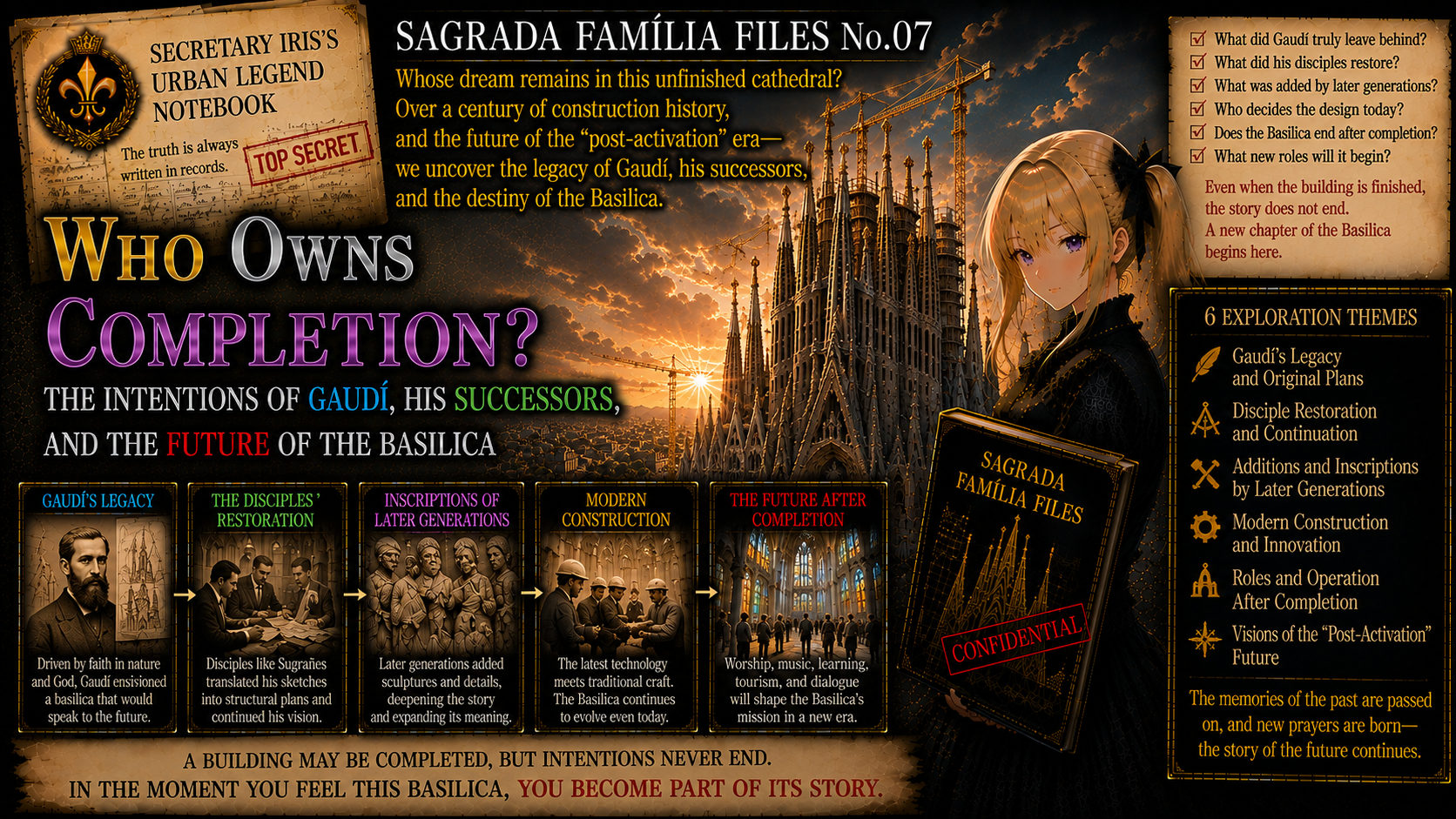
I am Iris.
Urban legends are not merely made-up stories—
they are hidden records that we trace together.
Completion.
The word suggests an ending.
The final stone is placed.
Scaffolding disappears.
Cranes leave the skyline.
The construction workers depart.
A ceremony announces that more than a century of building has ended.
But can the completion of the Sagrada Família be understood so simply?
Construction began in 1882.
Antoni Gaudí inherited the project in 1883.
He died in 1926.
The workshop was destroyed in 1936.
Plans burned.
Models shattered.
Disciples protected fragments.
Later architects, sculptors, engineers, model makers, and stoneworkers interpreted what remained.
The Basilica now contains:
Parts built directly under Gaudí.
Parts continued by his disciples.
Parts reconstructed from photographs and broken models.
Sculpture created by later artists.
Forms realised through computers and modern engineering.
Elements whose final appearance is still being decided.
When the building is physically completed, whose work will it be?
Gaudí’s?
His disciples’?
The artists who came after him?
The builders and visitors who financed its continuation?
Or an architectural community extending across generations?
And when construction ends, will the Basilica’s purpose also end?
Will the urban legend of “activation” finally begin?
Sagrada Família Files No.07 asks who owns completion.
Completion Has at Least Three Meanings
The first is structural completion.
Towers.
Façades.
Cloisters.
Chapels.
Sacristies.
Stairs.
Interior work.
The planned architecture is physically built.
The second is artistic completion.
Gaudí’s ideas and intentions are considered sufficiently expressed.
The third is completion of purpose.
Worship.
Prayer.
Music.
Tourism.
Education.
Research.
Cultural exchange.
Urban identity.
The structure may one day be completed.
Interpretation will continue.
The Basilica’s social and religious purposes may continue for centuries.
One date cannot contain all three meanings.
The Project Was Already Someone Else’s Before Gaudí
The first architect was not Gaudí.
Francisco de Paula del Villar designed the original Neo-Gothic church.
Construction began in 1882.
When Gaudí took over in 1883, work on the crypt had already begun.
He did not receive an empty site.
He inherited a foundation, a religious association, donors, existing work, and another architect’s plan.
He transformed the project radically.
From the beginning, the Sagrada Família was more complicated than the work of one isolated creator.
Gaudí Knew He Would Never See Completion
Gaudí understood that the Basilica would outlive him.
From 1914, he devoted himself almost exclusively to it.
Yet the scale exceeded one human life.
When he died in 1926, only limited principal areas had been completed.
The crypt.
The apse.
Parts of the Nativity façade.
One Apostle bell tower, dedicated to Barnabas.
Of the eighteen planned towers, Gaudí saw one completed.
He therefore attempted to leave his ideas in several forms:
Plaster models.
Sections.
Geometrical systems.
Drawings.
Photographs.
Written explanations.
Completed portions of the building.
He did not leave one definitive book of instructions capable of answering every future question.
He left methods through which future builders could think.
Gaudí Left a Grammar Rather Than Every Sentence
Language contains words and grammar.
A person who understands the grammar can create sentences that never existed before.
Gaudí’s geometry functioned similarly.
Hyperboloids.
Paraboloids.
Ruled surfaces.
Double-twist columns.
Branching structures.
Paths of structural force.
Natural light.
Theological hierarchy.
These principles were not only decorative forms.
They were rules capable of generating new parts of the building.
But one grammar can produce several sentences.
A later architect using Gaudí’s principles may not make the exact choice Gaudí himself would have made.
This is where continuation becomes interpretation.
Domènec Sugranyes Inherits the Project
After Gaudí’s death, his disciple Domènec Sugranyes became responsible for the work.
Sugranyes had worked directly with Gaudí.
He knew the models and remembered conversations and design changes.
His relationship to the architect was not based only on documents.
Yet even Sugranyes was not Gaudí.
New structural and financial problems required new decisions.
Materials changed.
Workers changed.
Regulations changed.
Inheritance was not the mechanical repetition of old instructions.
It required applying remembered principles to new conditions.
The Chain Was Broken in 1936
During the Spanish Civil War, Gaudí’s workshop was attacked.
Plans and photographs were burned.
Plaster models were smashed.
Documents disappeared.
The place connecting the architect’s ideas, his disciples’ memories, and the physical evidence was severely damaged.
Urban legends describe the destruction as an operation intended to erase a secret design or prevent the Basilica’s eventual activation.
No verified evidence establishes such a targeted hidden programme.
Religious sites suffered widespread violence during the conflict.
But the archival gap created at the Sagrada Família is real.
What was lost can no longer answer later questions.
The Fragments Were Not Treated as Rubble
Disciples and collaborators preserved model fragments, photographs, drawings, and documents.
They studied which pieces belonged together.
They compared broken plaster with surviving photographs.
They reconstructed curves, elevations, and geometrical systems.
The work resembled archaeology.
A lost whole had to be inferred from fragments.
The fewer fragments that survived, the larger the role of interpretation.
Restoration and invention do not have the same proportion in every part of the Basilica.
The Temple Albums Preserve a Near-Contemporary Record
The Temple Albums documented construction milestones, models, materials, design changes, and Gaudí’s developing ideas.
Early descriptions were associated with Sugranyes and the Temple administration.
A 1929 book by Gaudí’s disciple Isidre Puig Boada also became an important guide.
It was published only three years after Gaudí’s death.
People who had worked with him were still alive.
The original workshop had not yet been destroyed.
For these reasons, the publications are regarded as close to Gaudí’s final intentions.
They remain incomplete.
A photograph and a paragraph cannot provide every dimension of a complex three-dimensional structure.
The Post-War Architects Had to Translate Memory
After the war, architects including Francesc Quintana, Isidre Puig Boada, and Lluís Bonet i Garí continued the project.
They used fragments, photographs, publications, and the memories of people who had known Gaudí.
As time passed, the generation with direct personal memory disappeared.
Spoken memory became writing.
Writing became drawings.
Drawings became models.
Models became stone.
Interpretation entered each stage.
That is not necessarily a failure.
It is an unavoidable part of transmitting an unfinished work across time.
Who Created the Passion Façade?
The Passion façade makes the problem visible.
Gaudí wanted this side to be severe and frightening.
Sparse space.
Bone-like columns.
The suffering of Christ without decorative comfort.
The sculptural figures now seen there were largely created by Josep Maria Subirachs.
He studied Gaudí’s material and began his work at the Basilica in 1986.
His forms are angular, linear, and modern.
They are dramatically different from the organic surface of the Nativity façade.
Critics argued that the style was not Gaudí’s and damaged the unity of the monument.
Others argued that a twentieth-century sculptor should not produce an imitation of Gaudí.
The Passion façade is Gaudí’s programme translated through Subirachs’s artistic language.
It cannot be assigned completely to either one.
Is Imitation the Most Faithful Choice?
Should successors copy Gaudí’s visible style?
Or should they follow his willingness to use the newest techniques and artistic language of his own period?
Gaudí did not merely reproduce medieval Gothic architecture.
He analysed its structural problems and transformed it using geometry, models, reinforced concrete, and observation of nature.
A later architect who freezes Gaudí’s surface and rejects innovation may betray Gaudí’s experimental spirit.
A successor who changes too much in the name of innovation may abandon Gaudí’s project.
Faithfulness may mean protecting:
Form.
Meaning.
Method.
Structural principles.
The willingness to innovate.
These values do not always produce the same decision.
Etsuro Sotoo and the Nativity Façade
Japanese sculptor Etsuro Sotoo has worked with the Sagrada Família since 1978.
His work includes sculpture, decoration, completion, and restoration on the Nativity façade.
Because this façade was created directly under Gaudí’s supervision, every later intervention requires care.
Surviving photographs.
Existing sculpture.
Natural observation.
Gaudí’s symbolic system.
These sources help guide the work.
But several kinds of intervention remain distinct:
Reproducing a destroyed figure from a clear photograph.
Developing detail from a rough model.
Creating a form for which Gaudí left only a general theme.
The later artist’s contribution increases as the surviving evidence decreases.
New Art Is Still Entering the Basilica
New sculpture and decoration continue to be produced.
The Chapel of the Assumption.
The Glory façade.
The interior and pinnacle of the Tower of Jesus Christ.
Cloisters.
Doors.
Altarpieces.
Some themes were established by Gaudí.
Their physical appearance may be created by twenty-first-century artists.
A modern “Lamb of God” is planned for the cross of the Tower of Jesus Christ.
Does a contemporary artwork become a foreign body inside Gaudí’s church?
Or was the Basilica always intended to remain open to future generations?
Does Modern Technology Betray Gaudí?
Current construction uses tools unavailable during Gaudí’s life.
Three-dimensional computer modelling.
Digital scanning.
Numerically controlled machinery.
3D printing.
Advanced structural analysis.
Modern reinforced concrete.
Prefabrication.
Large cranes.
Digital surveying.
Some critics argue that a computer-generated building can no longer be considered Gaudí’s work.
But Gaudí himself embraced new methods.
Hanging models.
Inverted photography.
Reinforced concrete.
Three-dimensional design through physical models.
Measurement systems for translating models into construction.
The use of modern technology is not itself a betrayal.
The question is whether technology is used to understand and realise the inherited system—or merely to accelerate production while removing meaning.
The Stoneworker Has Not Disappeared
Machines can rough-cut complex stone from digital data.
They improve precision and speed.
But final texture still depends on the stoneworker.
Natural variation.
Depth.
Tool marks.
The way light reaches the surface.
The final visual character.
Modern construction at the Basilica is not simply technology replacing tradition.
It is an attempt to connect them.
Who Makes Decisions Today?
In 2026, the project is managed by the foundation of the Sagrada Família Construction Board.
Chief architect Jordi Faulí works with a broad professional structure.
Architects.
Engineers.
Theologians.
Sculptors.
Model makers.
Stoneworkers.
Conservation specialists.
Church authorities.
Urban and public administrations.
The decisions must consider:
Gaudí’s documentation.
Structural safety.
Religious meaning.
Heritage protection.
Urban conditions.
Future conservation.
Completion is not approaching through one person’s signature.
It is emerging from institutional and professional judgement.
The Whole Basilica Is Not the World Heritage Component
The Sagrada Família is often described as a World Heritage building in its entirety.
The specific Sagrada Família component within UNESCO’s Works of Antoni Gaudí consists of:
The Nativity façade.
The crypt.
These are the areas built directly under Gaudí.
UNESCO recognises their authenticity in material, form, and workmanship.
This does not make the later portions worthless.
They carry a different kind of value.
The Nativity façade is Gaudí’s material work.
The rest is also the history of how his work was inherited, reconstructed, and transformed.
Can It Still Be Called Gaudí’s Work?
A composition completed after its composer’s death.
A novel assembled from unfinished papers.
A building constructed from a deceased architect’s plans.
Who is the author?
There are strong reasons to call the Sagrada Família Gaudí’s work.
He established the principal architecture, symbolic programme, geometrical system, hierarchy of towers, three façades, and interior conception.
But he did not determine every stone, sculpture, window, material, and construction method now present.
A more precise description is:
A work conceived by Gaudí and continued, reconstructed, and interpreted by several generations.
The Official Figure of Seventy Percent
In June 2026, the official blog described the Basilica as approximately seventy percent complete.
The exterior of the Tower of Jesus Christ had been completed.
Significant work remained:
The Glory façade.
Adjoining cloisters.
The Chapel of the Assumption.
The second sacristy.
Interior work.
Artistic programmes.
Services and surrounding areas.
Reaching the highest point did not complete the architectural story.
Is There a Fixed Final Year?
The year 2026 was once promoted widely as the target because it marked the centenary of Gaudí’s death.
The pandemic affected visitor income and construction.
The Glory façade remains highly complex.
Artworks require time.
Urban questions remain.
The entire Basilica was not completed in 2026.
External estimates often place remaining work in the following decade.
The responsible position is not to treat one year as guaranteed until the institution confirms specific stages.
Completion of the Tower of Jesus Christ’s exterior, its interior, the Glory façade, and the entire Basilica are separate milestones.
Will Every Crane Disappear?
When new construction ends, maintenance begins.
Stone weathers.
Metal corrodes.
Glass becomes dirty.
Sculpture responds to pollution and temperature.
Equipment ages.
The Nativity façade already requires conservation and cleaning.
A building raised across more than a century will require care across future centuries.
Completion is also the beginning of permanent conservation.
Worship Has Already Begun
The Sagrada Família is not waiting for completion before becoming a church.
Pope Benedict XVI consecrated it in 2010 and declared it a minor basilica.
Masses and religious ceremonies already take place.
Prayer, music, and liturgy are active.
The idea that the building will become religiously “activated” only after the last construction work is therefore inaccurate.
The Basilica already functions.
Completion may change the scale and use of its spaces, not create its purpose from nothing.
Completion as a Tourist Monument
The unfinished condition has always been part of the attraction.
Visitors return to see progress.
After completion, that story will change.
People may come to experience:
The full relationship among the three façades.
The complete hierarchy of towers.
The finished light and acoustic environment.
The final form of the urban silhouette.
The monument will move from the miracle of construction toward the heritage of a completed but continuously changing place.
Completion Changes the City
For generations, cranes and construction have formed part of Barcelona’s skyline.
Residents have lived beside deliveries, scaffolding, workers, and visitors.
Completion will change traffic, access, public space, and the relationship between the Glory façade and the city.
The Basilica cannot be completed only as an isolated object.
Its connection with surrounding streets and communities remains part of the problem.
The Urban Legend of Post-Completion Activation
Several theories claim that completion will activate:
A hidden energy system.
A network of eighteen towers.
A frequency produced by bells and light.
A secret-society programme.
A new world age.
The series has shown that the Basilica possesses no single verified activation switch.
Towers reach milestones at different times.
Lighting is introduced in stages.
Worship already occurs.
Visitors already enter.
Acoustic research continues.
The building does not move from total inactivity to complete operation on one day.
What Will Actually Be Activated?
Completion may activate new social and cultural processes:
Full movement among the façades.
New spaces for worship.
Expanded music and bell programmes.
A new phase of conservation.
Changes to Barcelona’s skyline.
Education and research.
International discussion.
New interpretations of Gaudí.
The completed Basilica will affect human memory and action.
In that sense, activation is real.
The energy being activated is cultural, religious, urban, and imaginative.
What Completion Will Remove
Completion will also remove something.
The experience of watching the building grow.
The visible craft of construction.
Cranes above the city.
The question of how far the project will progress within one lifetime.
An unfinished structure contains several possible futures.
A completed structure contains the form that was selected.
Completion is achievement and the closing of alternatives.
New Arguments Will Begin
The end of construction will not end debate.
Was the final result faithful to Gaudí?
Was technology used too aggressively?
Do later sculptures dominate the inherited architecture?
Was too much reconstructed from insufficient evidence?
Does the Glory façade succeed?
Which historical layer should be preserved?
Once the form is fixed, responsibility for the whole becomes more visible.
Who Owns Completion?
Institutionally, the Basilica is managed by an organisation.
Artistically, Gaudí remains the central author.
Historically, it is the continuous labour of successors.
Materially, it contains the hands of thousands of workers.
Financially, generations of donors and visitors supported it.
Religiously, it belongs to a worshipping community.
Culturally, it belongs to Barcelona and the wider world.
No single answer is sufficient.
Completion is shared.
But shared ownership also produces shared responsibility.
Shared Does Not Mean Freely Alterable
A multigenerational work cannot be changed without limits.
Gaudí’s evidence.
Historic fabric.
World Heritage authenticity.
Religious meaning.
Structural safety.
Responsibility to future generations.
These constraints matter.
The present generation does not own the Basilica exclusively.
It also holds it in trust for people not yet born.
Would Gaudí Approve?
No one can know.
He might have welcomed digital modelling.
He might have rejected certain sculptures.
He might have demanded greater experimentation.
He might have redesigned elements again.
The dead cannot be used as convenient witnesses for present decisions.
We can only compare decisions with his surviving models, writings, buildings, principles, and the testimony of those who knew him.
The statement “Gaudí would certainly have done this” should always be treated carefully.
The Viewer Also Completes the Meaning
A building’s meaning is not completed by the designer alone.
A believer reads Scripture and prayer.
An architect reads structure.
A craftsperson reads material.
An urban-legend investigator reads symbols and numbers.
A tourist remembers colour.
A child remembers impossible height.
The stone remains the same.
The story changes with the reader.
New generations will continue to ask new questions.
Physical completion and interpretive completion will never occur on the same day.
Whose Dream Is the Basilica?
The founders.
Villar.
Gaudí.
The disciples.
The people who reconstructed the models.
Stoneworkers.
Sculptors.
Architects.
Donors.
Worshippers.
People who died before completion.
People who will visit in the future.
One person’s dream entered time and became the work of many.
Gaudí remains at the centre.
But the present Basilica could not stand through his memory alone.
Inheritance does not erase the original creator.
It carries that creator’s work forward through the responsibility of others.
Conclusion—A Building May Be Completed, but Intention Does Not End
Who owns completion?
Not Gaudí alone.
Not his successors alone.
Not the present construction board alone.
Yet the Basilica cannot be understood without Gaudí.
It is simultaneously:
An architecture conceived by Gaudí.
An architecture remembered by his disciples.
An architecture reconstructed from fragments.
An architecture interpreted by later artists.
An architecture realised through modern technology.
An architecture given meaning by worshippers and visitors.
One day, the principal construction work will end.
Scaffolding will disappear.
A celebration will announce completion.
The story will not close.
Conservation will begin.
New liturgies and music will begin.
Debate over the completed whole will begin.
New urban legends will emerge.
People will ask what happened after activation.
If activation exists here, it is not one secret switch.
It has occurred repeatedly for more than a century.
Whenever a stone was placed.
Whenever a tower was illuminated.
Whenever a choir sounded.
Whenever a person prayed.
Whenever a new generation interpreted Gaudí.
The Basilica has activated many times.
It will continue after completion.
A building may be completed.
Intention, memory, and interpretation do not end.
When you look upward and begin asking:
Whose dream is this?
What should be carried into the future?
What purpose should technology serve?
Is completion truly an ending?
You also enter the story.
The seven Sagrada Família Files have examined:
Completion and activation.
The Bible carved in stone.
Gaudí and Freemasonry.
Nature as architectural law.
The eighteen towers and 666.
Light, sound, and prayer.
The people who inherit completion.
Separating evidence from later interpretation does not remove the mystery.
It reveals that the real building is already extraordinary.
A dream too large for one life was passed to others.
Destroyed models were reconstructed from fragments.
Faith, nature, and mathematics became a stone forest.
An architect who knew he would never see completion entrusted his work to the future.
That may be the deepest secret of the Sagrada Família.
This file closes here.
The Basilica’s story does not.
When new records appear, when its form changes again, or when the world after completion produces a new mystery—
I will return to tell the story.
References
-
Sagrada Família|History of the Temple
Used to examine the 1882 foundation, Gaudí’s succession, his death in 1926, Sugranyes’s leadership, the destruction of 1936, and later continuation. -
Official Sagrada Família Blog|How Much of the Basilica Did Gaudí Leave?
Used to examine the work completed during Gaudí’s lifetime and the models and architectural systems left for future builders. -
Official Sagrada Família Blog|144 Years of Shared History
Used to examine the destruction of the workshop, preservation of fragments, and the disciples’ continuation of the project. -
Sagrada Família|Heritage Assets and Documentation Centre
Used to examine the preservation of surviving plaster fragments, drawings, photographs, documents, and archival material. -
Official Sagrada Família Blog|The Temple Albums
Used to examine the near-contemporary record associated with Sugranyes and Isidre Puig Boada’s 1929 publication on Gaudí’s intentions. -
UNESCO World Heritage Centre|Works of Antoni Gaudí
Used to verify that the Nativity façade and crypt form the Sagrada Família component built directly under Gaudí and recognised for authenticity. -
Official Sagrada Família Blog|The Passion Façade
Used to examine Josep Maria Subirachs’s study of Gaudí’s material and his sculptural work beginning in 1986. -
Official Sagrada Família Blog|The Nativity Façade
Used to verify Etsuro Sotoo’s work since 1978 on unfinished sculptural elements and restoration of damage caused during the Civil War. -
Official Sagrada Família Blog|Creating the Sculptures for the Chapel of the Assumption
Used to examine the combination of digital scanning, software, 3D printing, model making, and manual artistic work. -
Official Sagrada Família Blog|The Essential Work of Stoneworkers
Used to examine the relationship between machine preparation and the irreplaceable manual finishing of architectural stone. -
Official Sagrada Família Blog|Reinforced Concrete at the Basilica
Used to examine Gaudí’s own adoption of modern structural technology and its development in later construction. -
Sagrada Família|Chief Architect Jordi Faulí
Used to verify Jordi Faulí’s position as chief architect and his responsibility for interpreting and continuing Gaudí’s legacy in 2026. -
Official Sagrada Família Blog|Current State of Construction
Used to verify the official description of the Basilica as approximately seventy percent complete in June 2026 and the remaining major work. -
Official Sagrada Família Blog|Construction of the Cross on the Tower of Jesus
Used to verify completion of the tower’s exterior on February 20, 2026, while distinguishing that milestone from completion of the entire Basilica.
Posting Time
This article is scheduled for publication on August 9, 2026, at 23:00 JST.
Related Reading
The boundary between Gaudí’s documented life and secret-society theories created from architectural symbols.
How Gaudí transformed forests, bones, shells, gravity, and geometry into rules later generations could continue using.
The official sacred hierarchy of the completed tower design and the later calculation connecting eighteen with “666.”
The light, colour, music, reverberation, prayer, and human experience that will continue long after construction ends.
Popular Posts
How to separate patterns recognised after an event from symbols deliberately placed before it.
Separating the story of one hidden designer from the real institutional power created by organisations, standards, and generations.
How inherited stories acquire new meanings when later generations connect them with present events.
Submit an Urban Legend
Have you encountered theories involving Gaudí’s lost plans, changes made by successors, modern construction technology, completion dates, the Glory façade, or the Basilica after “activation”?
Submit your story or investigation request →Share & Follow
If you enjoyed the complete seven-part Sagrada Família Files series, sharing and following helps support future investigations.
Blog Top Share on X Share on Facebook Follow on X Instagram YouTube
コメントを残す