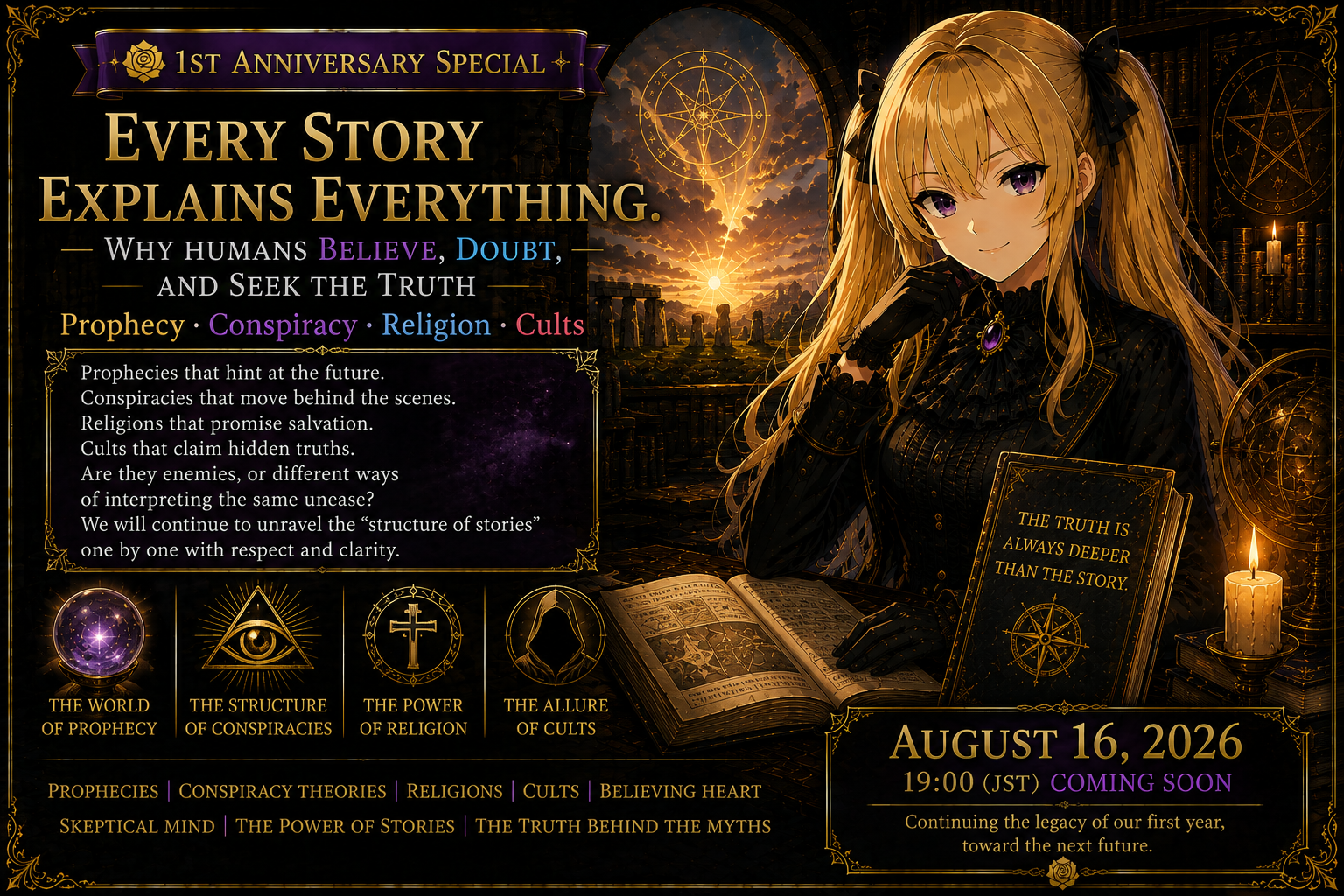
I am Iris.
Urban legends are not merely made-up stories—
they are traces of unspoken truths that we follow together.
The first-anniversary special continues.
Yesterday, August 15, we opened one of the heaviest pages in this notebook:
war,
defeat,
Occupation,
and the structures that shaped postwar Japan.
Today, we turn toward something older and more universal.
A human desire that repeatedly appears when the world becomes difficult to understand.
The desire for—
a story large enough to explain everything.
The future has a script.
Someone is secretly directing events.
The universe has meaning.
Only a chosen few understand the truth.
Salvation is approaching.
A final transformation is coming.
These ideas appear in different forms.
Prophecy.
Conspiracy narratives.
Religion.
And sometimes, closed and coercive groups.
These are not the same things.
Religion is not automatically conspiracy.
Faith is not automatically a cult.
Reading prophecy is not equivalent to surrendering personal freedom.
But after one year of tracing these subjects, similar mechanisms repeatedly appeared.
When reality becomes difficult to understand, human beings search for a story capable of putting everything back into one frame.
Today, we open that structure.
The Hardest Thing to Endure May Be Not Knowing
War.
Disaster.
Disease.
Economic crisis.
Rapid technological change.
Political conflict.
Loss.
Fear of the future.
These situations share something.
They are difficult to control.
And they rarely have one simple cause.
Reality may involve:
institutions,
history,
mistakes,
incentives,
technology,
culture,
chance,
and dozens of human decisions.
Complex explanations may be accurate.
But accuracy does not always reduce anxiety.
A large story can.
“The prophecy said this would happen.”
“They planned it.”
“This is part of a divine purpose.”
“Only we know what is really happening.”
Suddenly, scattered points become a line.
The danger has not disappeared.
But the chaos now has meaning.
That is the first power of the big story.
Prophecy Gives the Future an Order
Prophecy transforms an uncertain future into a sequence.
First this.
Then disaster.
Then war.
Then judgment.
Then salvation.
Real history rarely moves so cleanly.
But once events are placed inside a prophetic frame, unrelated developments can begin to feel like stages.
An earthquake.
A comet.
Political unrest.
A pandemic.
War.
Throughout the first year of this notebook, we examined many forms of prophecy:
Fatima.
Hopi traditions.
Ancient oracles.
Sacred texts.
Time travelers.
Web Bot.
Bible-code narratives.
A recurring lesson emerged.
The durability of prophecy is not determined only by whether it “comes true.”
Ambiguous language can be reinterpreted.
Failed expectations can be revised.
New events can be attached to older words.
Prophecy therefore does more than claim knowledge of the future.
It gives people a framework through which future events can be interpreted.
Fatima — A Secret That Survived Disclosure
The Third Secret of Fatima became one of the clearest examples.
There was a secret.
It was sealed.
Its eventual disclosure became an event in itself.
In 2000, the Vatican publicly released the text and an official theological commentary.
Normally, disclosure should end secrecy.
Instead, another layer of questions appeared.
Was everything released?
Was there another text?
Was the official interpretation complete?
The lesson is important.
A secret does not survive only through its hidden content.
It can also survive through the system surrounding it:
who possesses the information,
when it is released,
who interprets it,
and what remains unseen.
The management of information becomes part of the legend.
Conspiracy Narratives Give the World Intention
If prophecy gives the future a sequence,
conspiracy narratives give the present an intention.
It was not random.
Someone planned it.
There is a purpose behind the event.
That idea can make an overwhelmingly complex world easier to read.
War.
Finance.
Technology.
Surveillance.
Corporations.
International institutions.
Digital identity.
Artificial intelligence.
Separate systems begin to appear as one design.
Our NWO investigations repeatedly encountered this pattern.
Global standards.
Digital systems.
Financial infrastructure.
Security policy.
Large technology companies.
Place them all on one page, and they can begin to resemble a single control architecture.
But one distinction remains essential:
several systems moving in similar directions does not prove that they share one secret command center.
Governments pursue state interests.
Corporations pursue commercial interests.
Institutions follow their mandates.
Technology develops through competition as well as coordination.
The outcome can look coordinated without proving one hidden designer.
Real Conspiracies Do Exist
There is an opposite mistake.
“Conspiracy theory” does not mean that secret coordination is impossible.
History contains real:
covert operations,
corruption,
price fixing,
political interference,
intelligence operations,
concealment,
and criminal agreements.
So the relevant question is not:
“Can conspiracies exist?”
Of course they can.
The useful question is:
What evidence demonstrates this particular conspiracy?
Documents.
Money trails.
Orders.
Independent witnesses.
Court records.
Contemporaneous communications.
Evidence must connect the points.
“Possible” and “demonstrated” are not the same category.
When a Conspiracy Theory Becomes Impossible to Test
There is a moment when a theory can become immune to evidence.
Evidence appears:
“That proves the conspiracy.”
No evidence appears:
“They destroyed the evidence.”
Someone denies the allegation:
“That proves the cover-up.”
An independent critic disagrees:
“They are part of it too.”
At that point, every possible outcome produces the same conclusion.
The theory can no longer lose.
As an urban legend, that structure may be fascinating.
As a method for establishing fact, it is weak.
In Year Two, one question will matter more:
What evidence would cause us to conclude that this theory is wrong?
If no possible evidence can do that,
we should treat the claim as an interpretive story rather than an established conclusion.
Religion Gives the World Meaning
Religion must be treated separately.
Religion is not simply another word for conspiracy or cult.
Across human history, religions have addressed:
death,
morality,
suffering,
community,
hope,
ritual,
transcendence,
and the meaning of life.
Freedom of religion or belief also includes the freedom to hold, change, or reject religious belief.
So this notebook will not use:
“religion = danger”
as a framework.
The more interesting question for urban legends is different.
When does sacred narrative connect with:
political expectation,
end-times prediction,
state power,
symbols,
or conspiracy interpretation?
That boundary can become extraordinarily powerful.
The Third Temple — When Sacred Meaning Meets Political Expectation
The Third Temple series showed this clearly.
Temple.
Holy site.
Ritual.
Prophecy.
Politics.
State power.
War.
End-times expectation.
Many different domains become concentrated around one sacred location.
A religious belief about the Temple is one thing.
A prediction that a specific ritual event must automatically trigger global war is another.
A claim that Temple construction is secretly coordinated as part of a world-government plan is another still.
They require different standards of evidence.
Sacred meaning, political prediction, and conspiracy narrative are not interchangeable.
Online, however, they can easily appear inside the same image, video, or thread.
That compression makes the story powerful.
We Should Use the Word “Cult” Carefully
The fourth category is especially difficult.
Cult.
The word is often used too casually.
A minority religion is not automatically a cult.
A new religion is not automatically a cult.
A belief that seems unusual to outsiders is not automatically harmful.
The important question is behavior.
Is contact with the outside world severely restricted?
Is absolute obedience to a leader demanded?
Are fear and punishment used to prevent departure?
Are members’ finances, relationships, or daily lives coercively controlled?
Is violence or criminal activity justified?
Are outside sources of information systematically blocked?
Is meaningful consent disappearing?
When those things occur, the issue is no longer simply unusual belief.
It becomes a question of:
coercion, harm, and human freedom.
What Jonestown Teaches Beyond the Word “Cult”
In 1978, Peoples Temple and its settlement at Jonestown in Guyana became one of the most infamous examples of destructive group control.
FBI material records serious allegations surrounding the community, including coercion, confinement, violence, and conditions that prompted members and relatives to seek outside intervention.
The important lesson is not:
“Religion caused this.”
It is:
what can happen when authority becomes concentrated, outside information narrows, dissent becomes dangerous, and leaving becomes difficult.
If we focus only on unusual doctrine, clothing, ritual, or symbolism, we may miss the more important warning signs.
The danger is not simply believing something unfamiliar.
The danger begins when human freedom and safety are taken away.
“Only the Chosen Understand” Is an Extremely Powerful Message
Prophecy.
Conspiracy narratives.
Closed groups.
All frequently contain a similar promise.
“Ordinary people do not know.”
“The media is hiding it.”
“Only the awakened can see.”
“Outsiders cannot understand.”
This message changes identity.
Someone who felt powerless yesterday can suddenly become:
one of the people who knows.
Anxiety becomes mission.
Isolation becomes community.
Confusion becomes certainty.
That psychological transition is powerful.
A person is no longer merely observing the story.
They have been given a role inside it.
One Enemy Can Make the World Feel Simple
Large stories also tend to produce large enemies.
The devil.
A secret society.
A government.
A religious out-group.
Bankers.
Communists.
Globalists.
Aliens.
The “sleeping masses.”
Once one enemy explains everything, complexity disappears.
Every failure can be attributed to that enemy.
Every contradiction becomes sabotage.
Every critic becomes compromised.
But most historical problems have multiple causes.
That is why a story becomes more suspicious—not more convincing—
when a single enemy can explain every event without exception.
Are Believers and Skeptics Really Opposites?
Belief and skepticism appear opposite.
But they can begin with the same question:
“Is that really true?”
Questioning official explanations can be healthy.
Questioning prophecy can be healthy.
Questioning religious authority can be healthy.
Questioning conspiracy claims can be healthy.
The problem begins when skepticism is applied only to the other side.
If we interrogate every opposing source—
but never challenge the theory we want to believe—
skepticism has stopped being investigation.
It has become armor.
The hardest form of skepticism is:
applying the same standard to our favorite explanation.
Refusing to Believe Everything Is Not Enough Either
Year Two should not become a notebook of automatic rejection.
Religion?
False.
Prophecy?
Ridiculous.
Conspiracy theory?
Impossible.
That approach teaches us very little.
Why did the story appear?
Why did it survive?
Why did intelligent people find it persuasive?
What real events gave it traction?
What evidence is embedded inside the larger legend?
Those questions disappear if we dismiss everything at the door.
But if we believe everything,
the boundary between record and imagination disappears too.
The useful position lies between the two.
It is slower.
Less emotionally satisfying.
But far more interesting.
Five Questions for Any “Story That Explains Everything”
In Year Two, when we encounter prophecy, conspiracy, apocalyptic religion, or closed-group narratives, we will ask five questions.
1 — Is the original source available?
Can we return to the earliest text, recording, document, or statement?
2 — Did the interpretation exist before the event?
Or was the “prediction” constructed afterward?
3 — Is there evidence connecting the points?
Or are the events merely similar, close in time, or emotionally related?
4 — Can the claim be falsified?
What would show that it is wrong?
5 — Is someone’s freedom or safety being taken away?
This question takes priority over the entertainment value of the story.
After One Year, the Deeper Discovery Is About Stories Themselves
After a year of urban legends, I arrived somewhere unexpected.
The opposite of an urban legend is not a world without stories.
Science explains.
History narrates.
States create national stories.
Companies create missions.
Families create memories.
Individuals create identities.
Human beings may not be capable of living without narrative.
So perhaps the goal is not to escape stories.
It is to understand:
which story we are currently using to interpret the world.
Conclusion — Truth Is Deeper Than the Story
Prophecy arranges the future into a sequence.
Conspiracy narratives give complexity a hidden intention.
Religion can give life and suffering meaning.
Closed, coercive groups can sometimes turn meaning into an exclusive system that controls human freedom.
There are similarities.
But they are not the same.
That distinction matters.
And there is one principle I want to carry into the second year:
The more a story appears to explain everything, the more carefully we should test what it actually explains.
When the answer is too perfect.
When there is only one enemy.
When coincidence no longer exists.
When every failed prediction becomes a successful one.
When every critic becomes part of the plot.
That is the moment to step outside the story.
Find the source.
Read the opposing evidence.
Check the timeline.
Ask when the interpretation first appeared.
You do not need to abandon the human capacity for belief.
You do not need to abandon skepticism either.
Keep both eyes open.
That may be the most important thing this notebook carries from its first year into its second.
The truth is always deeper than the story.
Tomorrow, the first-anniversary special reaches its final door:
Unsolved Cases.
There, prophecy offers no future.
Religion offers no guaranteed answer.
Sometimes there is only an empty space that remains for decades.
What do human beings place inside a mystery when no answer arrives?
And how carefully can we preserve the words:
“We still do not know”?
Tomorrow, we open the final door.
Next time—another fragment of hidden truth to trace together.
I will return to the telling.
References
-
Douglas et al. | The Psychology of Conspiracy Theories
A widely cited review describing epistemic, existential, and social motives studied in relation to conspiracy beliefs. -
van Prooijen & Douglas | Belief in Conspiracy Theories: Basic Principles of an Emerging Research Domain
Research background on recurring psychological and social patterns found across different conspiracy beliefs. -
United Nations OHCHR | International Covenant on Civil and Political Rights — Article 18
The international human-rights basis for freedom of thought, conscience, religion, and belief. -
The Holy See | The Message of Fatima
The Vatican publication containing the Third Secret text, related documentation, and official theological commentary. -
Federal Bureau of Investigation | Jonestown
Official FBI historical overview of Peoples Temple, Jonestown, Congressman Leo Ryan’s visit, and the resulting investigation. -
FBI Vault | Jonestown / RYMUR Records
Public archive of FBI investigative records relating to Jonestown and the Leo Ryan murder investigation.
Posting Time
English articles are published at 23:00 (JST).
Related Reading
A series-wide examination of ambiguity, reinterpretation, collective belief, and the mechanisms that allow prophetic narratives to survive.
A structure-first look at how digital systems, institutions, standards, and dependence can be transformed into a single New World Order narrative.
How sacred meaning, political pressure, prophecy, ritual, and media can converge until one religious story gains extraordinary social force.
A case study in how secrecy, authority, delayed disclosure, and competing interpretations can keep a prophetic narrative alive even after publication.
Popular Posts
When symbols appear to form a hidden plan, this article separates visible design from later interpretation.
A popular investigation into the difference between real interconnected systems and claims of one secret global architect.
How inherited prophecy and later celestial events combine into a powerful story about an approaching transformation.
Submit an Urban Legend
Prophecy, secret societies, apocalyptic narratives, religious symbolism, NWO theories, or destructive-group histories— send us a story whose boundary between evidence, belief, interpretation, and speculation deserves a closer look. The goal is investigation, not hostility toward any religion or belief.
Submit an urban legend or investigation request →Share & Follow
If you enjoyed this anniversary special on prophecy, conspiracy narratives, religion, and cults, please support the notebook by sharing and following.
Blog Top Share on X Share on Facebook Follow on X Instagram YouTube
コメントを残す