I am Iris.
Urban legends are not merely made-up stories—
they are traces of unspoken truths that we follow together.
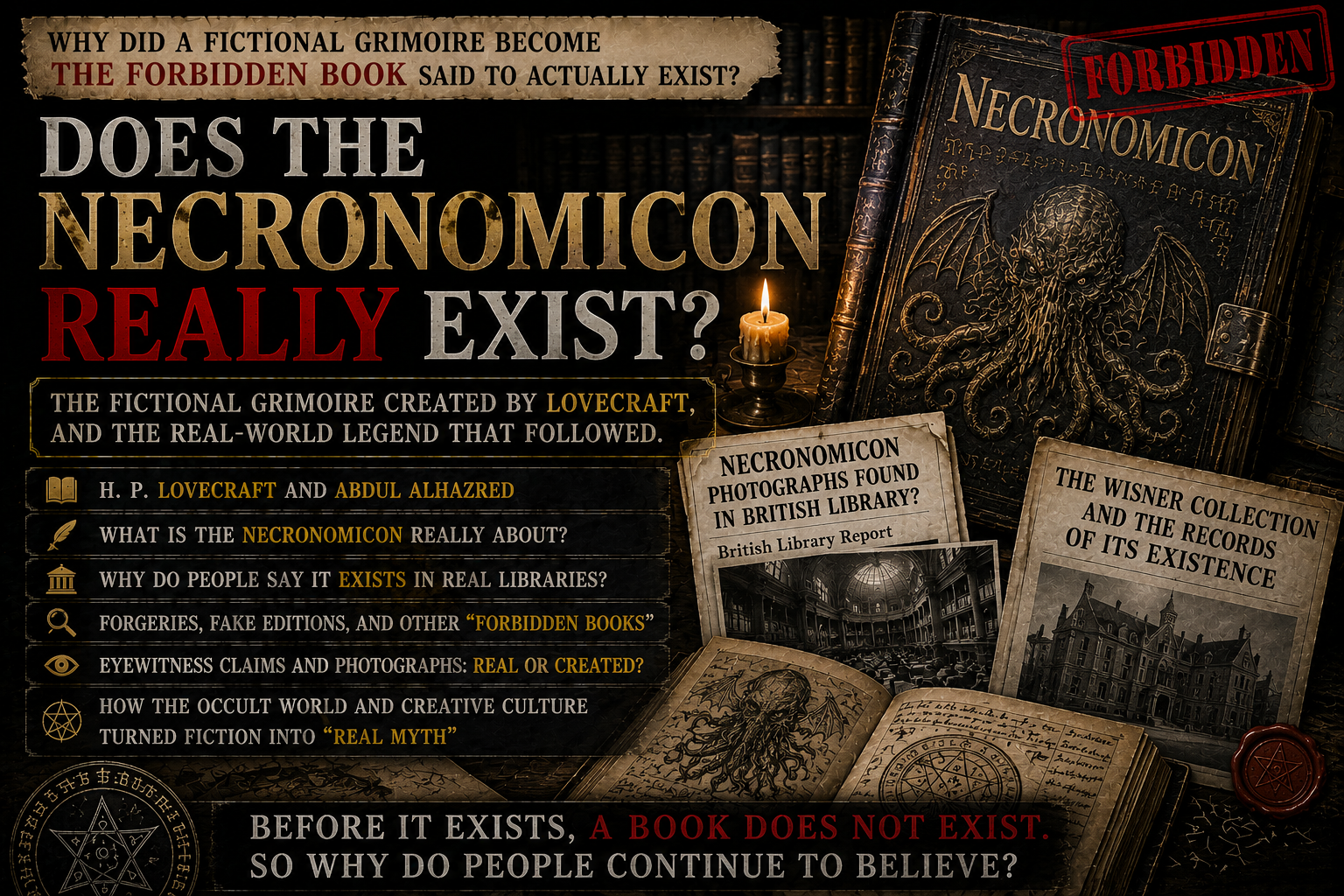
Search for “Necronomicon” in a Library Catalog
Something strange happens.
Type:
Necronomicon
into a major library catalog.
Results appear.
Title.
Publisher.
Publication date.
ISBN.
Libraries holding copies.
So—
does the Necronomicon exist?
The answer is unexpectedly complicated.
Yes.
And—
no.
Physical books titled Necronomicon genuinely exist.
But that does not establish the existence of the ancient forbidden grimoire described in the fiction of H. P. Lovecraft.
Today we investigate one of the strangest transitions in modern folklore:
how a book invented for fiction became an object that can genuinely be bought,
cataloged,
held,
photographed,
and found in libraries.
It Began With H. P. Lovecraft
The Necronomicon entered modern culture through the fiction of American horror writer:
H. P. Lovecraft.
The name appeared early in his fictional universe in “The Hound,” written in 1922 and published in 1924.
The supposed author—
the “mad Arab” Abdul Alhazred—
had already appeared in Lovecraft’s earlier fictional mythology.
Over time,
the book acquired:
an author,
an original Arabic title,
a chronology,
translations,
suppression,
surviving copies,
and dangerous contents.
It became more than a prop.
It acquired a history.
Al Azif
Within Lovecraft’s fictional chronology,
the book was originally called:
Al Azif.
It was supposedly written by Abdul Alhazred in Damascus around the eighth century.
The author had wandered through places including:
Babylon,
Memphis,
and the deserts of Arabia.
There he supposedly encountered knowledge older than humanity.
The manuscript was later translated into Greek.
Its new title:
Necronomicon.
Again—
this is the fictional history Lovecraft created.
Lovecraft Built a Bibliography for a Book That Did Not Exist
In 1927,
Lovecraft wrote:
“History of the Necronomicon.”
It reads almost like a bibliographical note.
The book is given dates.
Translators.
Editions.
Religious suppression.
Lost manuscripts.
Surviving copies.
According to the fictional chronology:
Al Azif was written around 730.
A Greek translation appeared around 950.
A Latin translation followed in 1228.
The text was suppressed.
Different printed editions supposedly appeared in later centuries.
The level of detail creates a powerful effect.
The imaginary book begins to feel historically documented.
Then Lovecraft Put It in Real Libraries
This may be the most important technique.
In the fictional history,
copies are placed in institutions including:
the British Museum,
the Bibliothèque Nationale in Paris,
Harvard University’s Widener Library,
the University of Buenos Aires,
and—
Miskatonic University.
One of those is fictional.
Miskatonic.
The others are real.
Lovecraft placed invention beside reality without changing the tone of the sentence.
That creates a powerful illusion.
Reality Becomes Camouflage for Fiction
A completely imaginary world is easy to recognize.
But Lovecraft did something more effective.
Real cities.
Real libraries.
Real historical institutions.
Real religious history.
Then—
one invented author.
One invented book.
One invented university.
The fictional object becomes anchored to the real world.
Did Lovecraft Claim the Book Was Truly Ancient?
No.
This distinction matters.
Lovecraft’s surviving correspondence repeatedly makes the fictional status clear.
When readers asked,
he explained that both the Necronomicon and Abdul Alhazred were creations.
In a 1936 letter to Willis Conover,
he explicitly stated that he had invented the names.
So the strongest evidence does not point toward Lovecraft secretly possessing an ancient magical manuscript.
It points toward deliberate literary invention.
Why Did People Still Believe?
Because Lovecraft did not work alone.
Writers within his literary circle borrowed one another’s fictional creations.
Clark Ashton Smith.
Robert E. Howard.
Robert Bloch.
Others.
A strange god invented by one writer could appear in another writer’s story.
A forbidden book could reappear in multiple fictional universes.
This created an unusual effect.
Multiple Authors Look Like Multiple Witnesses
If only one writer refers to a mysterious book,
readers naturally assume that writer invented it.
But if several writers independently appear to mention the same book—
the illusion changes.
It begins to resemble cultural knowledge.
Something all of them knew.
Perhaps something they were referencing.
Lovecraft understood that shared references gave the fictional world greater apparent authenticity.
The Necronomicon was not merely described.
It was repeatedly “witnessed” inside fiction.
Readers Began Looking for It
The next step was inevitable.
Readers asked bookstores.
Libraries.
Collectors.
Where can I find the Necronomicon?
There was a problem.
It did not exist.
But the fictional mythology already contained an explanation.
The book was rare.
Suppressed.
Dangerous.
Locked away.
Restricted.
So failure to find it could paradoxically make the mythology stronger.
The Perfect Forbidden Book
Imagine asking:
“Do you have the Necronomicon?”
The answer:
“No.”
A normal book search ends there.
But inside the legend,
the answer can become:
“Of course they deny having it.”
Or:
“It is stored in a restricted collection.”
Or:
“Only specialists are allowed to see it.”
The claim becomes difficult to disprove because invisibility is part of the story.
Then Something Extraordinary Happened
People began publishing books called:
Necronomicon.
In 1977,
a work commonly called the Simon Necronomicon appeared.
Later editions circulated widely.
Today,
library catalogs genuinely contain bibliographic records for it.
Now the sentence:
“I found the Necronomicon in a library catalog”
can be completely true.
But That Does Not Prove Lovecraft’s Ancient Book
Look at the publication date.
Twentieth century.
After Lovecraft created the concept.
That distinction changes everything.
A modern book titled Necronomicon exists.
That does not establish an eighth-century grimoire by Abdul Alhazred.
The object is real.
Its claimed fictional ancestry is another question.
Another Necronomicon Appeared in 1978
In 1978,
George Hay edited another book titled:
The Necronomicon.
Again—
a real publication.
Real pages.
Real binding.
Real library records.
The fictional object had now crossed into material culture.
The process looked something like this:
fictional book
↓
readers search for it
↓
writers expand the mythology
↓
publishers produce versions
↓
libraries acquire them
↓
catalog records appear
↓
future readers discover “evidence” that the book exists.
Fiction Manufactured Its Own Evidence
This is the fascinating part.
The original claim was fictional.
But the cultural response generated real objects.
Those objects can later be mistaken for evidence supporting the original claim.
A photograph of an old-looking Necronomicon proves that someone made a book.
It does not automatically prove that Abdul Alhazred wrote it in ancient Damascus.
“I Own a Necronomicon” Can Be True
Today,
someone may genuinely own one.
A collector.
An occult practitioner.
A Lovecraft fan.
A library.
A bookstore.
There is nothing impossible about that statement anymore.
The important question becomes:
Which Necronomicon?
A twentieth-century edition?
A Lovecraft anthology using the title?
An artistic replica?
A modern grimoire?
Or the supposed ancient manuscript?
The title alone proves very little.
The Power of the Word “Forbidden”
The Necronomicon also contains one of folklore’s strongest attractions:
prohibition.
Do not read it.
Do not open it.
Do not speak the words.
Do not perform the ritual.
Prohibition creates curiosity.
A normal library book may feel ordinary.
A book supposedly kept:
behind locked doors,
in a restricted archive,
under special permission,
immediately feels more valuable.
Real Forbidden Books Have Existed
This is another reason the story works.
Human history contains genuine censorship.
Religious prohibitions.
Political suppression.
Banned publications.
Confiscated manuscripts.
Restricted archives.
The idea of a forbidden book is historically plausible.
Lovecraft inserted an imaginary book into a world where books really had been banned.
Lovecraft Never Wrote the Complete Necronomicon
Another important fact:
there is no complete ancient-style Necronomicon manuscript written by Lovecraft.
His fiction contains:
references,
fragments,
descriptions,
quotations,
and a fictional history.
But he never filled hundreds of pages with the full forbidden book.
That absence may have been essential.
The Missing Pages Became More Powerful Than Written Ones
If Lovecraft had written the whole thing,
readers could inspect every page.
The mystery would have limits.
Instead,
the book remained mostly unseen.
The fiction repeatedly implies:
there is more.
Much more.
Something dangerous beyond the fragments we have been allowed to read.
The audience completes the invisible pages.
Real Grimoires Do Exist
The fictional status of the Necronomicon does not mean that historical magical literature is fictional.
Real grimoires,
ritual texts,
occult manuscripts,
astrological works,
and esoteric traditions exist.
Books associated with traditions such as the Key of Solomon and the Lemegeton belong to genuine histories of magical and religious literature.
Lovecraft did not invent the concept of the magical book.
He placed a new fictional object into an already real tradition.
That Makes the Boundary Harder to See
Real occult history.
Real manuscripts.
Real libraries.
Real banned books.
Real cities.
Real institutions.
Then—
one imaginary grimoire.
The fiction feels historically plausible because the surrounding landscape is genuine.
The Urban Legend Goes Further
In urban-legend and occult circles,
other claims developed.
Lovecraft may have discovered an authentic secret manuscript.
He may have received knowledge through dreams.
The Necronomicon may predate his fiction.
Copies may still exist in restricted collections.
Lovecraft did later say that the name itself came to him in a dream.
But a dream inspiring a name does not establish the existence of an ancient manuscript.
That step requires evidence of its own.
The Creator Loses Control of the Creation
There is an extraordinary paradox here.
The author says:
“I invented it.”
The legend replies:
“Perhaps you had to say that.”
Once that happens,
even the creator’s denial can become part of the mythology.
The fictional object begins to exist independently of its creator.
Fact, Interpretation, and Urban Legend
Documented facts:
H. P. Lovecraft created the Necronomicon and Abdul Alhazred for his fictional universe.
He wrote a fictional “History of the Necronomicon” in 1927.
Brown University’s John Hay Library preserves Lovecraft’s autograph manuscript.
Lovecraft’s letters explicitly describe the book as fictional.
Modern physical works titled Necronomicon were published in the twentieth century and are now listed in real library catalogs.
Interpretation:
Lovecraft’s use of real institutions, invented bibliography, shared fictional references, and incomplete fragments created a strong effect of historical authenticity.
Urban-legend claims:
An ancient Necronomicon existed before Lovecraft.
Lovecraft secretly saw or translated a genuine manuscript.
Authentic copies remain hidden in major libraries.
Reading or using the book produces supernatural consequences.
Boundary of evidence:
No reliable evidence currently establishes the existence of an ancient Abdul Alhazred manuscript predating Lovecraft’s fiction.
Modern books titled Necronomicon are real.
The ancient fictional source they imitate has not been demonstrated.
A Book That Did Not Exist Became Real
So perhaps the best answer is not simply:
“The Necronomicon does not exist.”
The original ancient grimoire is fictional.
But the fiction created real consequences.
People wrote books.
Publishers printed them.
Collectors bought them.
Libraries cataloged them.
Occult communities incorporated them.
Popular culture reproduced them.
The Necronomicon moved from:
fictional object
to
real cultural object.
That May Be More Interesting Than a Hidden Manuscript
Urban legends are often reduced to:
true or false.
But the Necronomicon resists that binary.
As an eighth-century book:
fiction.
As literary history:
real.
As a modern publication:
real.
As an occult-cultural phenomenon:
real.
As an urban legend:
very real.
The answer changes depending on what we mean when we ask:
“Does it exist?”
Tonight — How Can a Book That Never Existed Be “Seen”?
The public investigation can end here.
Lovecraft’s ancient Necronomicon was fictional.
His own correspondence confirms it.
But later publishers created actual books bearing the same name.
That means a photograph,
a library record,
or a physical copy alone cannot establish ancient provenance.
One question remains.
Suppose someone presents:
an old leather volume,
a catalog record,
a manuscript,
a “John Dee translation,”
a library stamp,
or an alleged photograph from a restricted archive.
What would we need to examine?
For Japanese subscribers,
tonight’s research supplement follows:
forged editions,
translations,
catalog records,
publication history,
provenance,
and the ten questions required before an alleged ancient Necronomicon could rewrite literary history.
Because the real mystery may not be:
why people believed in a nonexistent book.
It may be—
how fiction learned to manufacture physical evidence of its own existence.
Next time—another fragment of hidden truth to trace together.
I will return to the telling.
References
-
Brown University Library|Influence of Anxiety: Lovecraft, Bloch, Barlow, et al.
Brown University’s official collection record identifying Lovecraft’s autograph manuscript of “History of the Necronomicon.” -
The H. P. Lovecraft Archive|Quotes Regarding the Necronomicon from Lovecraft’s Letters
Lovecraft’s correspondence explaining that the Necronomicon and Abdul Alhazred were fictional creations. -
H. P. Lovecraft|History of the Necronomicon
Lovecraft’s fictional bibliography describing Al Azif, translations, suppression, surviving editions and alleged library holdings. -
H. P. Lovecraft|Letter to Clark Ashton Smith, November 27, 1927
A contemporary letter in which Lovecraft outlines his invented historical background for the Necronomicon. -
WorldCat|The Necronomicon — Simon Edition
Bibliographic record demonstrating that a modern physical Necronomicon associated with the 1977 publication tradition genuinely exists in library collections. -
Open Library|George Hay, The Necronomicon
Bibliographic record for the 1978 George Hay edition.
Posting Time
English articles are published at 23:00 (JST).
Related Reading
Why incomplete information and unexplained gaps allow stories to survive correction and evolve across generations.
The rule “do not open, touch or read” can make an object more powerful even before anything supernatural is established.
Why secret knowledge, chosen insiders and closed systems of explanation can transform a story into a powerful worldview.
A documented word became surrounded by a mythology far larger than the surviving evidence—an unusually modern parallel to the Necronomicon effect.
Popular Posts
Submit an Urban Legend
For alleged ancient manuscripts, include publication information, provenance, ownership history, photographs of title and colophon pages, and the earliest independently verifiable record.
コメントを残す