I am Iris.
Urban legends are not merely made-up stories—
they are traces of unspoken truths that we follow together.
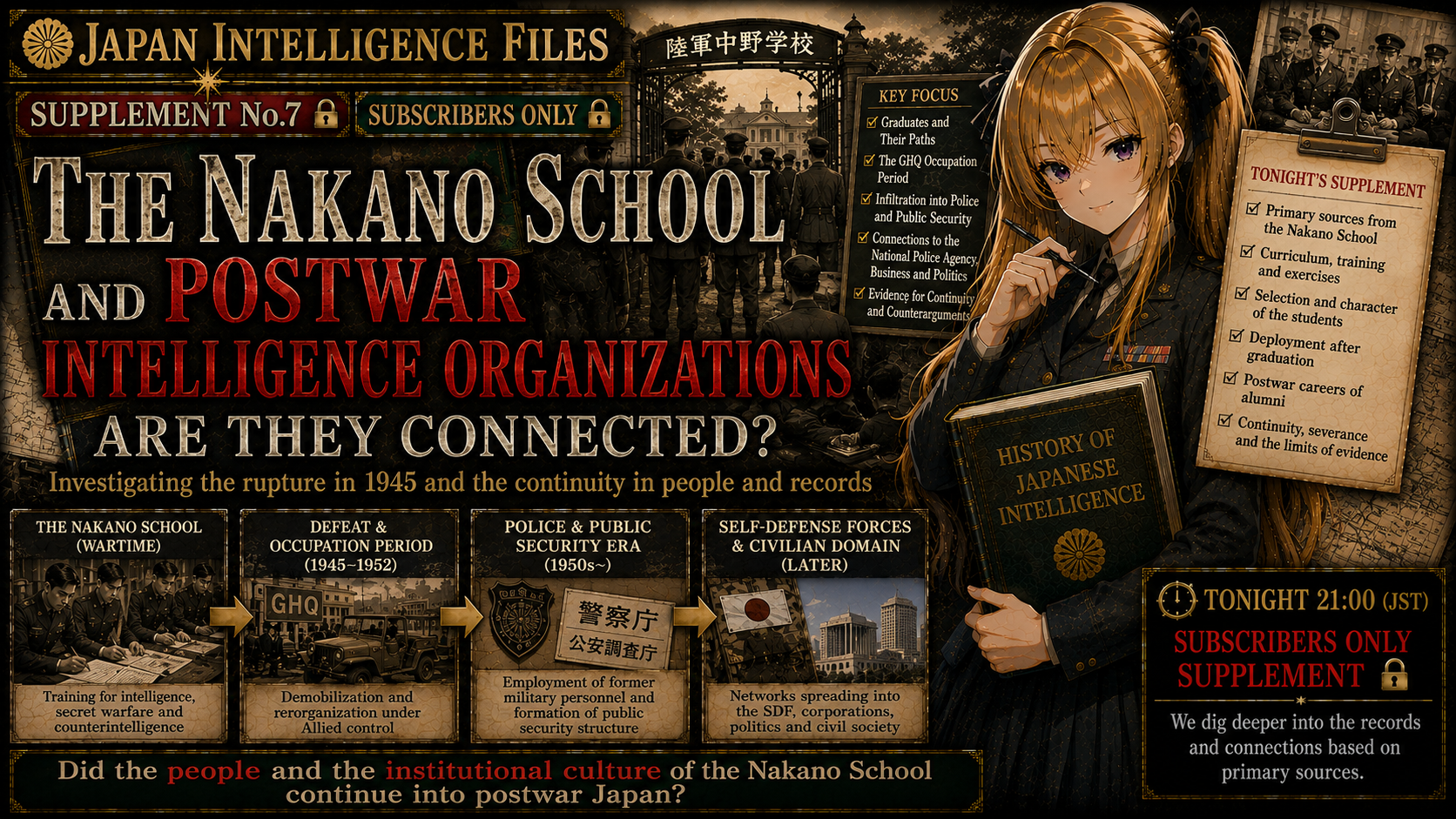
The School Disappeared. Its People Did Not.
Japan surrendered.
The Imperial Japanese Army was dismantled.
The Nakano School ceased to exist as an Army institution.
If we follow the official institutional record,
the story should end there.
But then—
a number appears in the Japanese Diet record.
Six.
In 1977,
Japan’s Defense Agency examined former personnel of the Ground Self-Defense Force’s Intelligence School.
The government reported that six former employees had been identified as people who had attended the wartime Nakano School.
The same Diet testimony also acknowledged something else.
A reproduced former Army document titled
Secret Warfare Overview
had once been used at the postwar Intelligence School
as reference material for theoretical study.
So what exactly crossed 1945?
An organization?
People?
Knowledge?
A professional culture?
Japan Intelligence Files.
File No.07.
Today we cross the most dangerous line in this series—
the line between institutional rupture
and historical continuity.
Institutionally, the Nakano School Ended
The first fact is straightforward.
Nakano was an Imperial Japanese Army school.
The Army was dissolved after defeat.
Nakano did not formally become a postwar organization under a new name.
There is no publicly documented institutional chain showing:
the same school,
the same legal authority,
the same budget,
and the same command structure
continuing across the surrender.
If we are talking about institutional continuity,
we must therefore begin with rupture.
The Official SDF Lineage Begins Somewhere Else
Japan’s Ground Self-Defense Force publishes an official history of today’s Kodaira School.
Its postwar lineage begins in January 1952.
The National Police Reserve General School established a Fifth Department.
After the National Safety Force and then the Self-Defense Forces were created,
the intelligence-education function developed further.
In September 1954,
the Intelligence School became a separate institution.
That is the official administrative lineage.
It does not say:
Nakano School became the Intelligence School.
Then Came the 1977 Diet Testimony
The institutional story becomes more complicated when we look at personnel.
In April 1977,
the relationship between the postwar Intelligence School
and the wartime Nakano School
was questioned in the House of Councillors.
The Defense Agency stated that it had examined several hundred people who had previously served at the Intelligence School.
Six were confirmed as having attended the Nakano School.
This is important documentary evidence.
There was a real personnel connection.
But a personnel connection is not automatically an institutional succession.
Six People Do Not Equal One Surviving Organization
An individual can cross a historical rupture.
Experience can cross it too.
Languages.
Regional knowledge.
Counterintelligence.
Psychological warfare.
Human intelligence.
Professional relationships.
An institution is different.
To demonstrate that the organization itself survived,
we would need evidence of continuing:
authority,
command,
budgets,
recruitment,
legal structure,
and organizational identity.
The six-person Diet record does not establish all of that.
Then There Is the Secret Warfare Document
The same 1977 Diet testimony addressed a former Army document known as
Secret Warfare Overview.
The Defense Agency acknowledged that a reproduced old-Army document had once been used during an earlier course as reference material for students’ theoretical research.
But the government added two important qualifications.
It was not an official textbook.
And by 1977,
it had already been discontinued.
Those qualifications matter.
This Is Evidence of Knowledge Transfer
The wartime institution ended.
Yet at least one body of wartime secret-warfare theory
entered a postwar military educational environment.
That is real continuity—
but of a specific type.
Not necessarily organizational continuity.
Knowledge continuity.
Educational reference.
Professional memory.
Those categories are less dramatic than a secret organization surviving underground.
Historically,
they may be more important.
We Need More Than One Meaning of “Continuity”
There are at least four different questions.
Did people continue?
Did knowledge and documents continue?
Did functions and professional culture continue?
Did the organization itself continue?
Mix those questions together,
and almost any intelligence-history conspiracy can be made to look convincing.
Separate them,
and the evidence becomes much clearer.
Occupation Authorities Also Used Former Japanese Military Intelligence Personnel
The story becomes wider once we leave Nakano itself.
After the surrender,
the Allied Occupation’s G-2 intelligence organization,
under Major General Charles Willoughby,
developed relationships with former Japanese military officers and intelligence figures.
Declassified American records and historical studies identify names including:
Seizo Arisue,
Torashiro Kawabe,
and Takushiro Hattori.
Former Japanese officers participated in historical research,
Soviet-related intelligence,
anti-communist activity,
and discussions surrounding Japan’s eventual rearmament.
This is a genuine bridge across 1945.
But Former Army Intelligence Does Not Automatically Mean Nakano
This distinction is essential.
Imperial Japanese intelligence was much larger than the Nakano School.
The Army General Staff.
Regional headquarters.
Military attachés.
Tokumu kikan.
Military police.
Communications intelligence.
Field intelligence.
Nakano was a training institution inside that much larger ecosystem.
Evidence that former Army intelligence officers worked with G-2
does not automatically prove that Nakano itself was preserved by the Occupation.
The Cold War Changed the Value of Wartime Expertise
Why would yesterday’s enemy become useful?
Because the strategic environment changed almost immediately.
The Soviet Union.
Communist China.
The Korean Peninsula.
The Japanese Communist Party.
The emerging Cold War.
Former Japanese officers possessed knowledge that Occupation intelligence could potentially exploit:
Soviet military information,
regional contacts,
Chinese political knowledge,
Korean experience,
and former military networks.
War ended.
Expertise remained.
Another Postwar Intelligence Organization Appeared in 1952
In the same year that the National Police Reserve’s educational system was developing,
Japan created another institution.
The Secretariat Research Office of the Prime Minister.
It later became:
the Cabinet Research Office,
then the Cabinet Intelligence and Research Office.
And in July 2026,
Japan reorganized that system into the National Intelligence Bureau.
The Japanese government’s current official history identifies the 1952 office as the institutional origin of this Cabinet-level intelligence lineage.
Not the Nakano School.
So We Cannot Draw a Straight Line From Nakano to the National Intelligence Bureau
The simple legend looks like this:
Nakano School
↓
Occupation intelligence networks
↓
Cabinet Research Office
↓
CIRO
↓
National Intelligence Bureau.
It is elegant.
But institutional history does not provide that straight line.
What may exist instead are different kinds of bridges:
individual careers,
professional knowledge,
personal networks,
and reused experience.
Those are worth investigating.
They should not be transformed into a direct institutional genealogy without evidence.
Postwar Research Has Followed Nakano Alumni
Japanese researchers and journalists have spent decades tracing former Nakano personnel after 1945.
Some returned to civilian life.
Some remained overseas.
Some became involved in postwar security or intelligence-related environments.
Others entered business,
politics,
or private organizations.
Their individual paths matter.
But again:
a graduate surviving
is not the same thing as the school surviving.
The Strongest Answer May Be the Least Dramatic One
Did Nakano disappear?
Institutionally—
yes.
Did everything associated with Nakano disappear?
No.
People survived.
Experience survived.
Some documentation survived.
The 1977 Diet record demonstrates that former Nakano attendees later served inside the SDF Intelligence School.
It also demonstrates that former Army secret-warfare material was at one point studied there.
That is already historically significant.
We do not need to turn it into something the evidence cannot support.
Fact, Interpretation, Urban Legend, and the Boundary
Documented facts:
The Nakano School ended with the collapse of the Imperial Japanese Army.
The official postwar lineage of the SDF Intelligence School begins with the National Police Reserve educational system in 1952.
In 1977,
the Defense Agency reported that six former Intelligence School personnel had attended Nakano.
A reproduced former-Army secret-warfare document had once been used as theoretical reference material,
but the government said it was not a textbook and had already been discontinued.
Occupation intelligence also worked with a number of former Japanese military and intelligence officers.
Japan’s Cabinet-level intelligence lineage officially begins with an institution created in 1952.
—
Interpretation:
There was a clear institutional rupture in 1945,
combined with partial continuity in personnel,
experience,
knowledge,
and possibly professional culture.
—
Urban-legend claims:
The Nakano School secretly survived the surrender.
GHQ preserved it intact.
The SDF Intelligence School,
Cabinet intelligence organizations,
and the alleged Beppan are simply successive names for the same organization.
—
Boundary of speculation:
The known personnel and educational connections do not establish a continuous secret command structure from Nakano to modern Japan.
Tomorrow — Looking From the American Side
Today,
we crossed 1945 from the Japanese side.
Tomorrow,
we turn the file around.
Charles Willoughby.
G-2.
Seizo Arisue.
Takushiro Hattori.
Former Imperial Army networks.
Why did American occupation intelligence work with officers from the military it had just defeated?
What did the Americans want?
What did the Japanese officers want?
And what survives in declassified CIA records?
September 6.
Japan Intelligence Files.
The next file begins inside GHQ.
Next time—another fragment of truth we will trace together.
I will return to continue the telling.
References / Sources
National Diet of Japan — House of Councillors Budget Committee, April 16, 1977
Government testimony concerning six former Nakano School attendees and the postwar use of a reproduced former-Army secret-warfare document.
Japan Ground Self-Defense Force — Official History of Kodaira School
Official postwar institutional lineage from the National Police Reserve to the Intelligence School and Kodaira School.
Cabinet Secretariat — History of CIRO
Official institutional history beginning with the Secretariat Research Office of the Prime Minister in 1952.
CIA Reading Room — Seizo Arisue File
Declassified material concerning former Imperial Army intelligence networks during the Occupation period.
KADOKAWA — The Truth About the Army Nakano School: Intelligence Operatives After the War
A Japanese nonfiction investigation into the postwar careers of former Nakano personnel.
Posting Time
English articles are published at 23:00 (JST).
Related Reading
The wartime institution whose postwar legacy is examined in this file.
The wartime personnel networks that form the background to the postwar story.
The opening investigation into claims of continuity between wartime and modern Japanese intelligence.
An Occupation-era mystery where GHQ, former military networks and covert-operation theories later intersected.
Popular Posts
Submit an Urban Legend
Have a story involving the Nakano School, GHQ, former Japanese military intelligence networks, the SDF, Cabinet intelligence or Beppan? Send the details through the blog contact page or comments, preferably with documentary sources.
Share & Follow
🌐 Blog Top ▶️ YouTube 𝕏 Share on X Share on Facebook Follow on Instagram
コメントを残す