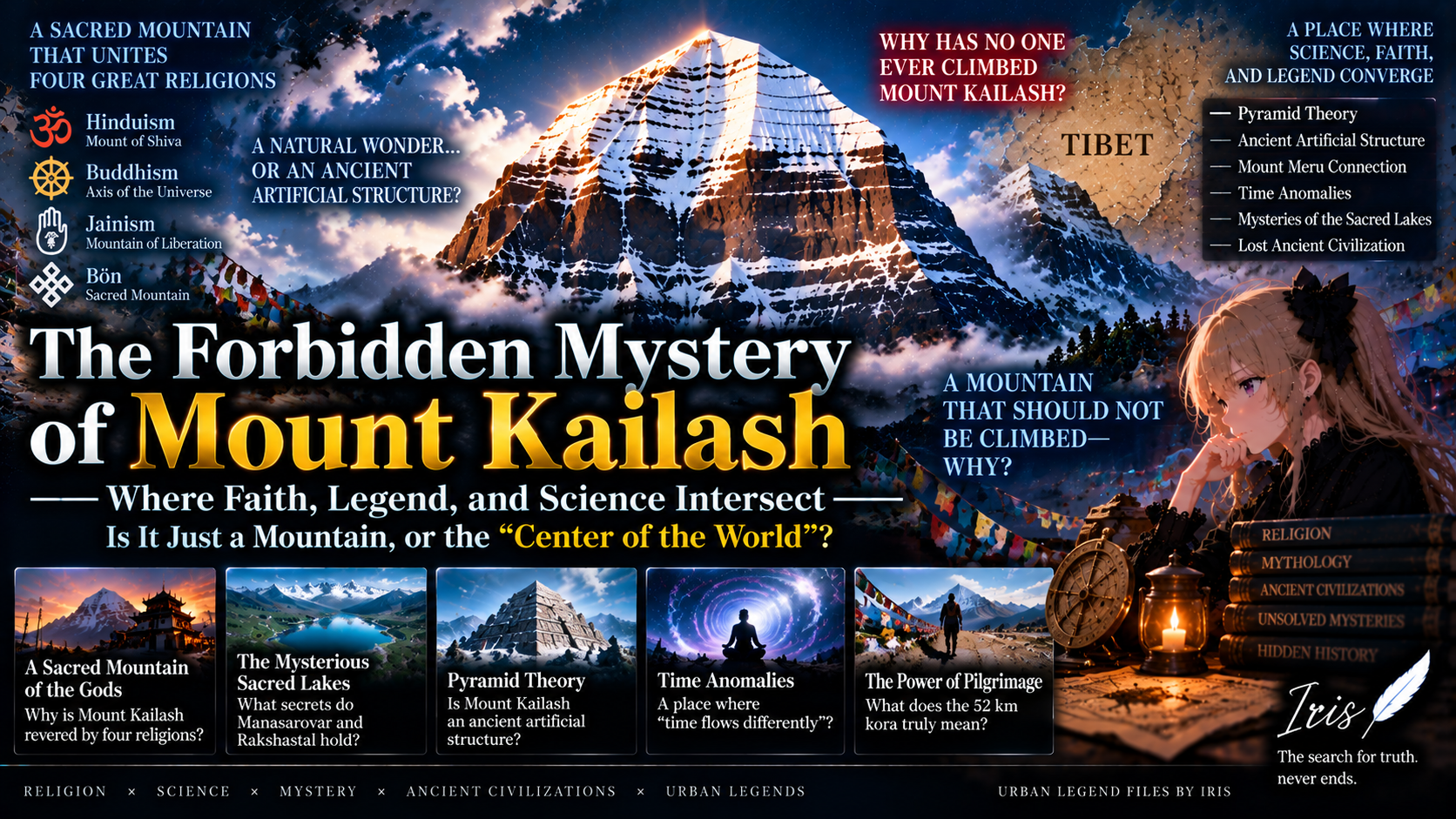
I am Iris.
Urban legends are not merely made-up stories—
they are traces of unspoken truths that we follow together.
Humanity Has Climbed Higher Mountains
Everest.
K2.
Peaks above 8,000 metres.
Humans have stood on them.
Mount Kailash rises only to roughly 6,600 metres.
Yet there is no verified record of a human summit.
That immediately creates a mystery.
Why has no one climbed it?
Is the mountain physically impossible?
Does some unknown force prevent ascent?
Or is the real reason something much more human?
The Answer Begins With Respect, Not the Supernatural
Mount Kailash is sacred to four major religious traditions:
Hinduism.
Buddhism.
Jainism.
Bön.
For their followers,
the summit is not a mountaineering objective.
It is sacred territory.
Modern access rules reinforce that boundary,
and climbing the peak is not permitted.
So the basic answer is simple.
People have not repeatedly tried and mysteriously failed.
The mountain is approached as a pilgrimage site rather than a summit to conquer.
A Mountain in Western Tibet
Kailash stands in the remote western Tibetan Plateau,
in the Gangdise or Kailash Range.
Its form is extraordinary.
Dark rock.
Snow-lined faces.
Long horizontal strata.
Sharp edges.
A profile that can look almost pyramidal.
That appearance later became one of the foundations of its modern urban legends.
But the religious mystery began long before the internet.
Hinduism — The Abode of Shiva
In Hindu tradition,
Mount Kailash is associated with Shiva.
The god of destruction,
transformation
and meditation.
For believers,
this changes the meaning of climbing completely.
You do not “conquer” the home of a deity.
The mountain is approached through reverence.
The pilgrimage is the achievement.
Not the summit.
Tibetan Buddhism — A Cosmic Centre
Tibetan Buddhist traditions connect Kailash with sacred cosmology and Mount Meru,
the world mountain that stands at the centre of the Buddhist universe.
Kailash is also associated with the tantric deity Demchok or Chakrasamvara.
Again,
the important movement is not upward.
It is around.
The pilgrim circles the sacred centre.
Jainism
In Jain traditions,
the Kailash region is associated with sacred accounts concerning Ashtapada and the liberation of the first Tirthankara,
Rishabhanatha.
The exact geographical identification varies across traditions and scholarship,
so it should not be treated as a simple historical location claim.
But Kailash remains deeply important within Jain sacred geography.
Bön
For followers of Bön,
the indigenous religious tradition of Tibet,
Kailash is also a centre of spiritual power.
The mountain exists within a different sacred history from those of Hinduism and Buddhism.
One fascinating detail survives in pilgrimage practice.
Many Hindu and Buddhist pilgrims circle Kailash clockwise.
Bön pilgrims traditionally travel in the opposite direction.
One mountain.
Different cosmologies.
Different ritual movements.
The Journey Goes Around the Mountain
The traditional circumambulation is known as a kora.
It is roughly 52 to 53 kilometres long.
Pilgrims cross a pass above 5,600 metres.
The route can take several days.
Thin air.
Cold.
Wind.
Exhaustion.
Altitude illness.
It is already a serious physical undertaking.
But the destination is never the summit.
The mountain remains above the pilgrim.
Untouched.
The Pilgrimage Is Still Alive in 2026
This is not merely an ancient tradition preserved in books.
India’s Ministry of External Affairs organised the Kailash Manasarovar Yatra again in 2026,
with official groups travelling during the summer pilgrimage season.
People still travel enormous distances to reach this landscape.
They see the mountain.
They walk around it.
They pray.
And they leave the summit alone.
This Is Why “No One Can Climb It” Is Misleading
Online versions of the story often say:
everyone who tries to climb Kailash is stopped by mysterious storms,
magnetic forces,
time distortions
or supernatural guardians.
But that reverses the evidence.
There is no long history of licensed expeditions repeatedly being defeated by paranormal events.
The summit remains untouched primarily because it is sacred and ascent is not permitted.
That distinction matters.
What About Milarepa?
A famous Tibetan legend tells of the Buddhist yogi Milarepa and the Bön practitioner Naro Böncham competing through supernatural powers.
Milarepa is sometimes described as reaching the summit through spiritual means.
This is a religious story.
It is not a modern mountaineering record.
It belongs to sacred biography,
not expedition history.
Why Does Kailash Look Like a Pyramid?
This is where the modern legend begins.
The mountain can look astonishingly geometric.
Its horizontal rock layers appear almost architectural.
Its faces are steep.
Its summit profile narrows upward.
From the right angle,
it resembles an enormous pyramid.
This has produced claims that Kailash is artificial—
perhaps a monument left by an unknown ancient civilization.
But geology provides a different explanation.
The Geological Mountain
Published geological work describes Kailash as a remnant of massive conglomerate formations created within the Himalayan tectonic system.
Sediments accumulated.
The crust rose.
Rock was fractured.
Ice,
water
and wind eroded it for immense periods of time.
The result is a mountain whose natural layers can look surprisingly artificial.
No archaeological evidence has established that Mount Kailash itself is a constructed pyramid.
Yet Its Geography Really Is Extraordinary
The broader Kailash–Manasarovar landscape lies close to the headwaters of several of Asia’s great river systems.
The Indus.
The Sutlej.
The Yarlung Tsangpo–Brahmaputra.
The Karnali system.
They do not literally emerge from four holes in the summit.
But their headwaters lie within the wider region and flow in dramatically different directions.
To ancient people,
this would have been extraordinary geography.
Water leaving one sacred landscape and spreading across much of Asia.
It is easy to understand how such a place became imagined as the centre of the world.
Two Sacred Lakes
Near Kailash lie two famous lakes.
Lake Manasarovar.
Fresh water.
And nearby Rakshastal.
More saline.
They occupy the same extraordinary high-altitude landscape,
yet their physical character is different.
Religious traditions later gave them contrasting symbolic meanings.
Purity and darkness.
Sacredness and severity.
Science can explain the hydrological difference.
Religion explains what humans made that difference mean.
Both stories can exist without being confused.
Where the Urban Legend Begins
The mountain is sacred.
Fact.
It has no verified summit ascent.
Fact.
Its shape resembles a pyramid.
Fact.
Several great river systems begin in the broader region.
Fact.
Freshwater and saline lakes lie beside one another.
Fact.
Four religions regard the mountain as sacred.
Fact.
Then the additional claims appear:
an artificial pyramid,
a hidden civilization,
a time machine,
a magnetic barrier,
a secret entrance to Shambhala.
Those claims require evidence of their own.
The earlier facts do not automatically prove them.
Why Kailash Attracts So Many Stories
Because mystery survives where observation stops.
Most famous mountains have routes.
Summit photographs.
GPS tracks.
Geological samples.
Climbing reports.
Kailash does not have that modern summit history.
The top remains blank.
And human imagination does not like blank spaces.
So we fill them.
With gods.
Ancient civilizations.
Lost technology.
Hidden worlds.
The Verdict
Is Mount Kailash sacred to multiple religions?
Yes.
Does pilgrimage traditionally circle the mountain rather than climb it?
Yes.
Is there a verified modern summit ascent?
No.
Is climbing treated as prohibited?
Yes.
Is the mountain geologically explainable as a natural formation?
Yes.
Has science demonstrated a supernatural force preventing ascent?
No.
Has archaeology established that Kailash is an artificial pyramid?
No.
My Conclusion
Perhaps the most unusual thing about Mount Kailash is not that humans cannot climb it.
It is that humans chose not to.
We live in a civilisation that measures mountains,
crosses oceans,
drills into rock,
lands machines on other worlds
and places flags almost everywhere it reaches.
Yet one famous summit remains untouched.
Not because it defeated every climber.
Because for generations,
people decided that reaching the highest point was not the highest form of achievement.
Some places,
they believed,
should remain above us.
That boundary may be the real mystery of Kailash.
And because the summit remains empty,
the legends remain alive.
Next time—another fragment of truth we will trace together.
I will return to continue the telling.
References / Sources
Ministry of External Affairs, Government of India — Kailash Manasarovar Yatra
Official material on the pilgrimage, its religious significance and the 2026 Yatra.
Associated Press — Mount Kailash pilgrimage
Background on Kailash as a sacred site for Hinduism, Buddhism, Jainism and Bön, and on the traditional circumambulation.
Emory University — Journeys to the Transcendent: Finding Mount Kailāsa in Texts, Topography, and Temples
Academic research into the development of Kailash’s religious significance across multiple traditions.
Geology Today — Kailas: geology of a sacred mountain
Geological description of Kailash as a natural remnant of massive conglomerate formations shaped by tectonics and erosion.
ICIMOD — Kailash Sacred Landscape Conservation Initiative
Geographic and environmental context for Kailash, Manasarovar, Rakshastal and the surrounding major river headwaters.
Posting Time
English articles are published at 23:00 (JST).
Related Reading
A useful comparison with Japan’s own tradition of sacred boundaries and places humans were once discouraged from touching.
Why similar sacred symbols, cosmic centres and divine roles appear across different cultures.
A related investigation into how landscapes become connected to stories of advanced civilizations lost before recorded history.
Ancient Indian texts, lost-technology narratives and the boundary between archaeological evidence and modern interpretation.
Popular Posts
Submit an Urban Legend
Know a sacred mountain, forbidden site, ancient structure or location surrounded by strange time and civilization legends? Send the story and its original source. We will separate documented history from later mythology.
Share & Follow
🌐 Blog Top 𝕏 Follow on X ▶ Follow on YouTube Share on Facebook Follow on Instagram
コメントを残す