I am Iris.
Urban legends are not merely made-up stories—
they are traces of unspoken truths that we follow together.
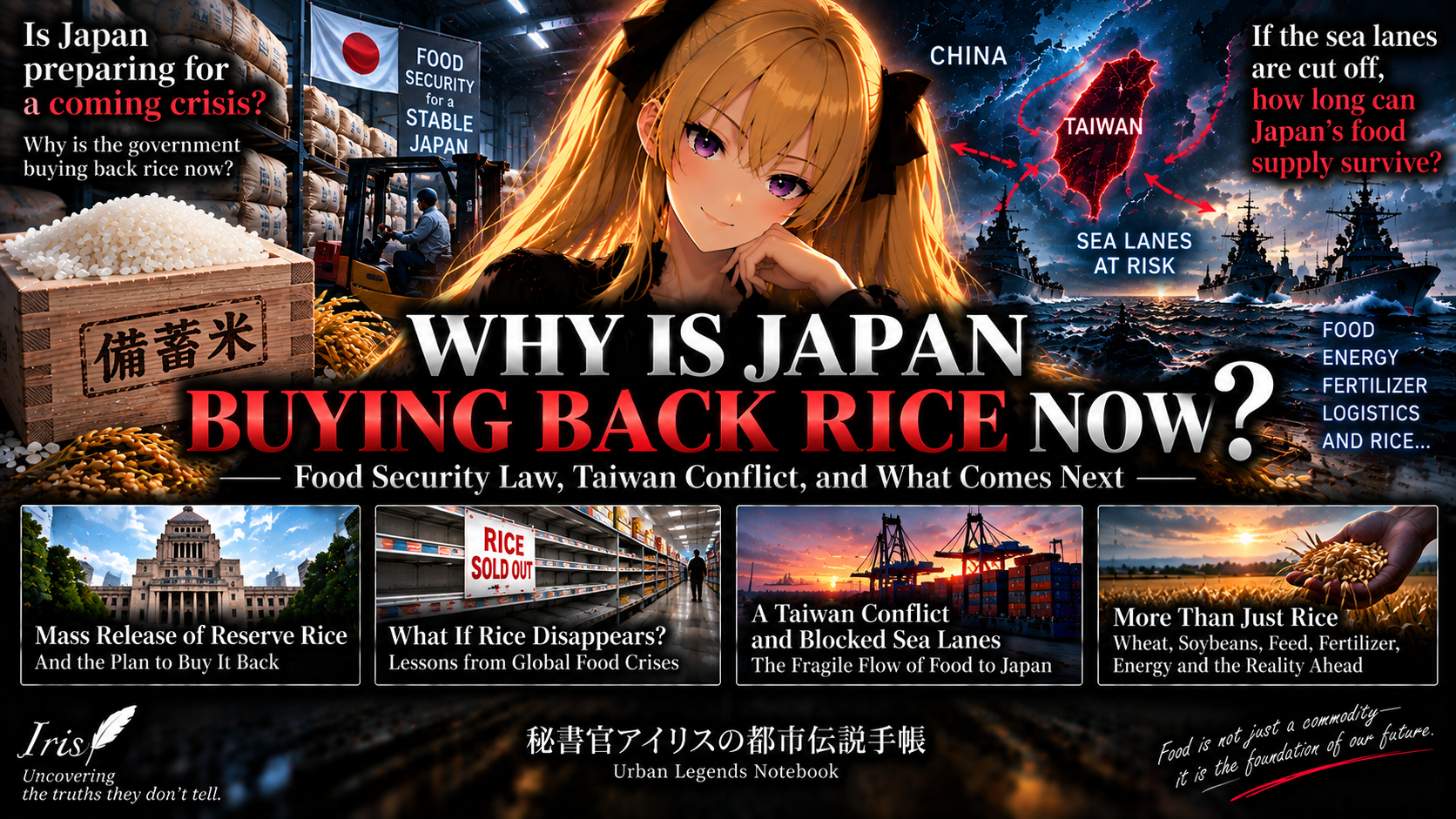
Japan Released Rice. Now It Is Buying Rice Back.
In 2025, Japan released a large volume of government reserve rice into the market.
In September 2026, the direction reversed.
The government began buying rice back.
Japan had released approximately 590,000 tonnes of reserve rice for staple-food use. The government considers roughly one million tonnes to be an appropriate reserve level, and the first current buyback covers about 210,000 tonnes.
Placed beside another development, the story becomes more dramatic.
Japan’s Food Supply Crisis Countermeasures Act came into force on April 1, 2025.
Then add discussion of a possible Taiwan contingency.
Reserve rice.
Emergency food legislation.
Military tension.
It becomes easy to ask:
Does the government know something?
The Official Explanation Is Much Simpler
Japan’s Ministry of Agriculture says reserve rice exists to prepare for poor harvests and sudden increases in demand.
After the large release, the reserve level needed to be restored.
The ministry waited until it judged that current rice supplies were sufficient and that buying rice back would be less likely to tighten the market.
As of September 18, the government was proceeding with the first 210,000-tonne buyback and said it wanted to restore the reserve toward approximately one million tonnes as quickly as conditions allowed.
No public government document reviewed for this article says that the buyback was ordered because Japan expects a Taiwan war in 2027.
What Is the Food Supply Crisis Countermeasures Act?
The law is real.
It was enacted to allow the government to respond earlier when important food supplies or critical agricultural inputs fall sharply.
The designated foods include rice, wheat, soybeans, vegetable oils, sugar, meat, milk and eggs.
Critical inputs include fertilizer, pesticides, seeds, feed and veterinary medicines.
That tells us something important.
Modern food security is not simply about storing rice.
It is about protecting an entire production and distribution system.
Is It a New “Rationing Law”?
Not exactly.
Japan’s Ministry of Agriculture explicitly states that the law did not create a new permanent food-rationing system.
The response is designed to escalate in stages.
When serious shortages begin to appear, the government can request measures involving distribution, imports and production.
If the situation becomes more serious, larger businesses can be required to submit supply plans.
Only at an extreme stage—when minimum food availability is threatened—can allocation or rationing under other existing laws become relevant.
So the claim that Japan “introduced rationing in April 2025” is misleading.
But the government has clearly created a framework for responding to severe food-supply disruption.
Does This Connect to Taiwan?
There is no public evidence that the rice buyback is a secret preparation for a fixed 2027 Taiwan conflict.
The date 2027 itself is often misunderstood.
It is an important PLA modernization milestone, not a publicly confirmed invasion deadline.
But that does not make food-security concerns imaginary.
A serious crisis around Taiwan or the surrounding sea lanes could disrupt shipping, raise insurance and fuel costs, and complicate trade across East Asia.
The important distinction is between:
preparing for a category of risk,
and knowing that a specific event will occur on a specific date.
Japan Is More Dependent Than a Bowl of Rice Suggests
Japan’s calorie-based food self-sufficiency rate for fiscal 2025 was 37 percent.
Its feed self-sufficiency rate was 24 percent.
Major fertilizer materials are also heavily dependent on imports.
This means even foods produced in Japan may rely on imported inputs.
Domestic livestock may eat imported feed.
Domestic crops may depend on imported fertilizer.
Food may be transported with imported fuel.
A country can produce food domestically and still depend heavily on international supply chains.
Rice Is Important—but It Is Not the Whole Food System
A million tonnes of reserve rice matters.
But reserve rice cannot replace:
wheat,
soybeans,
animal feed,
fertilizer,
fuel,
electricity,
shipping capacity,
or functioning logistics.
Food security is a network.
Rice is one strong node inside that network.
The Urban-Legend Version and the More Interesting Reality
The urban-legend version says:
The government knows war is coming.
It passed a rationing law.
Now it is secretly stockpiling rice.
The public evidence does not establish that story.
The more defensible—and perhaps more unsettling—reality is different.
Governments do not need to know the date of the next crisis to understand that supply chains can fail.
Climate disasters happen.
Animal disease happens.
Wars happen.
Shipping routes are disrupted.
Exporting countries suffer poor harvests.
Energy prices rise.
That uncertainty is exactly why reserves and emergency laws exist.
September 29 Assessment
Japan released around 590,000 tonnes of reserve rice for staple-food use:
Confirmed.
Japan is now buying back an initial 210,000 tonnes:
Confirmed.
The target reserve level is approximately one million tonnes:
Confirmed.
The Food Supply Crisis Countermeasures Act took effect on April 1, 2025:
Confirmed.
The law itself created an immediate peacetime rationing system:
No.
Allocation or rationing can become relevant under existing laws in an extreme supply crisis:
Yes.
The rice buyback is documented as preparation for a predetermined 2027 Taiwan war:
No public evidence.
Japan has significant dependence on imported food, feed, fertilizer and energy:
Confirmed.
My Conclusion
Japan is buying rice back.
Japan has built a stronger emergency food-security framework.
Regional security risks also exist.
Those three facts do not prove a secret war timetable.
But they do reveal something important.
Japan’s food system is connected to the world far beyond imported food itself.
Feed.
Fertilizer.
Fuel.
Shipping.
Processing.
Transportation.
The question is therefore not:
“Does the government know when war will begin?”
The better question is:
“What would have to stop before Japan’s dinner table begins to change?”
That is where food security becomes much more real than an urban legend.
Next time—another fragment of truth we will trace together.
I will return to continue the telling.
Primary / Official References
Ministry of Agriculture, Forestry and Fisheries of Japan — Ministerial Press Conference, September 18, 2026
Official explanation of the 210,000-tonne buyback, the previous 590,000-tonne release and the approximately one-million-tonne reserve target.
MAFF — Food Supply Crisis Countermeasures Act
Official explanation of the April 2025 law, its staged response system and clarification that it did not itself create a new peacetime rationing regime.
MAFF — Fiscal 2025 Food Self-Sufficiency Statistics
Calorie-based food self-sufficiency of 37 percent and feed self-sufficiency of 24 percent.
Agency for Natural Resources and Energy — Japan’s Energy Supply
Japan’s fiscal 2024 primary-energy self-sufficiency rate of 16.4 percent and continuing dependence on imported fossil fuels.
Posting Time
English articles are published at 23:00 JST.
Related Reading
Popular Posts
Submit an Urban Legend
If you encounter claims about Japanese food rationing, reserve rice, emergency laws or secret preparations for war, send the original source. We will separate what the law actually permits from what the government has actually decided to do.
コメントを残す