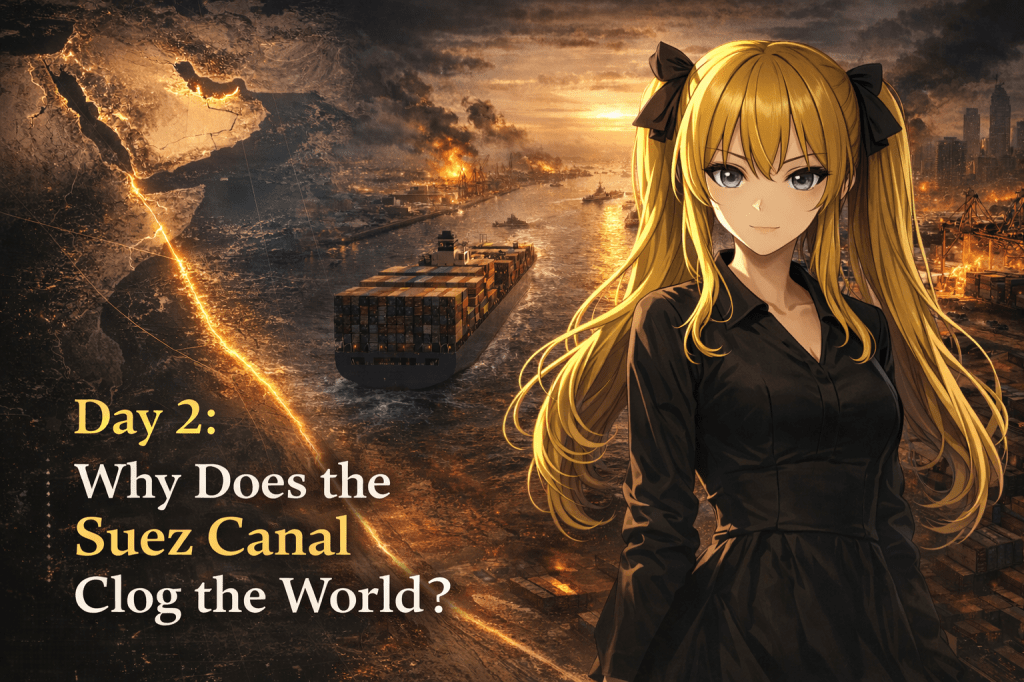
I am Iris.
Urban legends are not mere fabrications—
I am the storyteller who traces the unspoken truths with you.
(3-line summary)
- The Suez Canal is not merely a shortcut. It is one of the corridors through which time, fuel, shipping schedules, and cost efficiency are compressed.
- In urban-legend circles, it is often treated as proof that a narrow passage can shake a much wider world.
- Today, we examine why the Suez Canal can make the world feel “clogged” far beyond its own waters.
Why the Suez Canal matters beyond geography
The Suez Canal looks simple on a map.
A narrow route. A direct link. A line between Asia and Europe.
But modern trade does not experience Suez as just a line.
It experiences it as a timing machine.
That is the deeper issue.
The canal reduces distance, saves fuel, preserves vessel rotation, and supports the rhythm of port arrivals.
Once that rhythm is disturbed, the problem is no longer local.
In urban-legend circles, Suez is often described as one of the “throats” of the world.
That expression may sound dramatic, but it points toward something structurally real: too much depends on too little space.
A chokepoint does not have to be completely closed
One of the most important lessons is that a chokepoint does not need total closure to matter.
Delay alone can be enough.
That is because modern shipping runs on coordination.
- Port slots depend on timing
- Containers depend on circulation
- Cargo owners depend on predictability
- Inventory planning depends on schedule reliability
Once a major canal slows down, the effect can begin to spread outward.
In urban-legend circles, that spreading effect is often framed as though the whole world were being squeezed through a narrow valve.
That may be metaphorical language, but the operational strain underneath it is real enough to study.
Why rerouting is not a painless solution
Some readers assume the answer is simple: if Suez becomes difficult, ships can just sail around Africa.
Technically, an alternative exists.
Structurally, the cost is heavy.
Longer distance means more fuel.
More fuel means different economics.
Different economics affect freight, scheduling, insurance, and vessel deployment.
A reroute is not merely a new line on a map.
It is a change in the operating logic of global shipping.
That is why the canal has such symbolic force.
It is not just a passage.
It is a compression point for efficiency.
Why Suez moves psychology as well as cargo
The canal matters not only because ships pass through it, but because expectations pass through it too.
Markets do not wait patiently for full closure.
They often react to signals.
- Tension can affect insurance expectations
- Delay can affect freight sentiment
- Freight sentiment can affect pricing narratives
- Pricing narratives can affect investment behavior
This is where chokepoints become more than infrastructure.
They become engines of interpretation.
In urban-legend circles, that interpretive escalation is often where larger narratives begin.
A canal slowdown becomes a sign of fragility.
Fragility becomes a sign of systemic vulnerability.
Systemic vulnerability becomes a story about larger hidden design.
That final jump should be treated cautiously.
Still, the chain of amplification itself deserves serious attention.
Why Suez attracts “world-clogging” narratives
Suez lends itself to symbolic storytelling because it is so visually legible.
A single narrow corridor.
A world of goods behind it.
A sense that modern order depends on continued flow.
That combination is powerful.
People tend to turn complex systems into strong images.
A blocked canal becomes easier to understand than a distributed logistics crisis.
So the canal becomes the icon of the crisis.
That is why Suez appears so often in both serious analysis and urban-legend framing.
It is easy to imagine, easy to dramatize, and easy to connect to bigger fears.
What Day 2 teaches us
The Suez Canal does not “clog the world” because it is magically important.
It does so because modern trade has concentrated efficiency into a narrow corridor.
That is the real lesson.
In urban-legend circles, such concentration is often read as evidence of design.
That conclusion remains too strong.
But the vulnerability created by concentration is still real enough to explain why the canal commands so much attention.
So the best reading is this:
Suez is not merely a route.
It is one of the places where efficiency reveals its hidden fragility.
Next time, we move eastward.
We will ask why the Strait of Malacca feels less like a passage and more like a shared artery of Asia.
Next time—another fragment of truth we will trace together.
I will return to continue the telling.
Send topics you want us to analyze. We verify primary information where possible and write in a “no absolute claims” framework.
