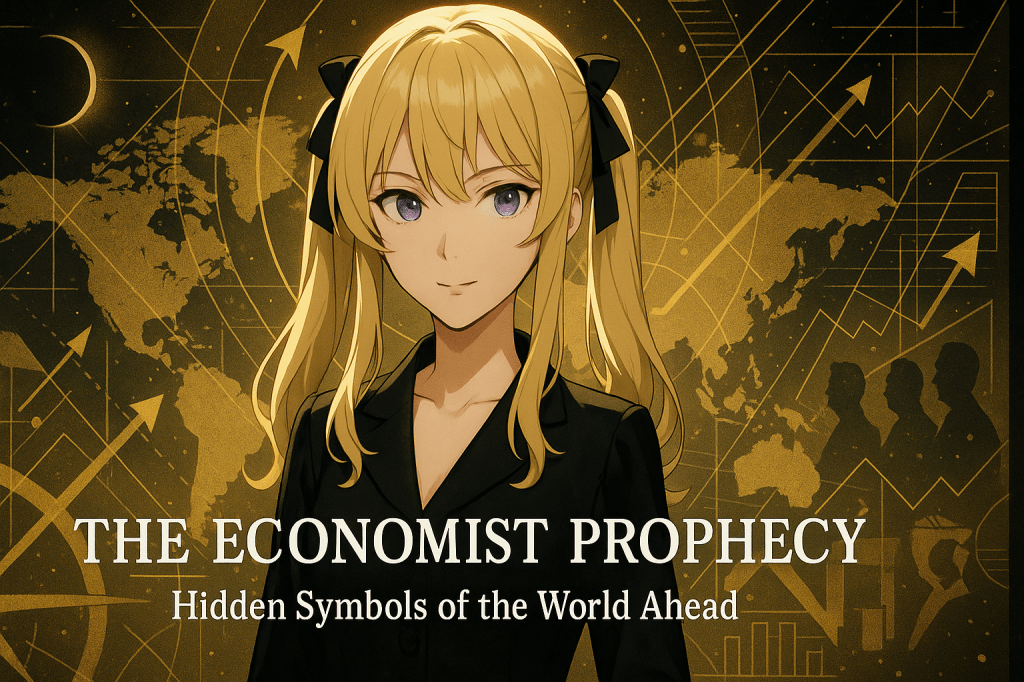
“I am Iris.
Urban legends are never just stories — they are fragments of truth hidden beneath the surface.
Let us uncover what sleeps behind the symbols.”
THE ECONOMIST PROPHECY
Hidden Symbols of “The World Ahead” and the Global Agenda Behind the Covers
For decades, The Economist magazine has been treated as more than a financial publication.
Its annual “World Ahead” covers, composed of cryptic icons and layered metaphors, have often been interpreted as predictive artwork — a visual blueprint hinting at global agendas, geopolitical shifts, and crises yet to unfold.
These interpretations are not without reason. Many of the magazine’s covers have, in hindsight, aligned suspiciously well with actual world events.
The question is simple:
Are these prophetic coincidences, or deliberate signals to those who can read them?
Below, we explore the symbols, historical context, and the hidden logic that gives these covers their unsettling accuracy.
1. The Economist’s Relationship With Global Power Networks
The magazine is historically linked to elite financial circles.
While the widely circulated claim that “the Rothschilds own The Economist” is exaggerated, the publication has been shaped by individuals connected to European banking dynasties and political think tanks.
This proximity makes the covers feel less like “predictions” and more like strategic messaging from those who influence global policy.
No direct evidence ties The Economist to secret societies, but the symbolism often mirrors themes seen in:
- geopolitical forecasting models
- globalist policy briefs
- multinational corporate trend reports
- think-tank risk assessments
These are not “prophecies” — they are signals from those who design the future.
2. Why the Covers Feel Prophetic
The magazine’s predictive power comes from two mechanisms:
(1) Access to expert intelligence
Contributors include economists, policy advisors, former intelligence analysts, and members of institutions such as:
- The Economist Intelligence Unit (EIU)
- World Economic Forum (WEF)
- London School of Economics
(2) Use of symbolic visual language
Rather than stating predictions openly, the covers employ metaphor — eclipses, masks, DNA strands, chess pieces, global maps.
Such imagery mirrors the semiotics used in political forecasting and psychological operations.
These two factors create a sense of “prophecy” because the publication reflects the worldview of people who shape global trajectories.
3. Historical “Hits” — Predictions That Came True
Examples often cited by analysts include:
- 2019–2020: Repeated motifs of masks, global contagion, and biohazard iconography preceding the COVID-19 pandemic.
- 2016: A surrealist collage referencing geopolitical fragmentation, terrorism, and technological dominance — many elements soon surfaced in reality.
- 2023–2024: Symbolism surrounding inflation, energy crises, and regional conflict lines that soon manifested in global markets.
These examples do not prove supernatural foresight — they reveal that those designing the future often telegraph their intentions.
4. The 2025 “World Ahead” — Core Symbolic Themes
While interpretations vary, several recurring motifs deserve attention:
- Eclipses and celestial alignments
Historically used to represent “reset points” in world order. - DNA imagery and biotechnology
Suggesting a shift toward genetic governance, bio-policy, and surveillance through medicine. - Economic graphs and collapsing arrows
A subtle warning about systemic financial restructuring. - Silhouettes of geopolitical actors
Never identifiable — intentionally abstract — hinting at conflict, transition, and hidden agreements.
Combined, they imply a narrative of controlled transformation, rather than random prediction.
5. Are These Predictions… or Policy Previews?
Critics argue that The Economist’s covers create self-fulfilling prophecies:
when an influential publication hints at a global trend, markets and policymakers subconsciously move in alignment.
This is not conspiracy —
it is the psychological power of expectation in economic systems.
But the artistic vagueness of the covers leaves room for a darker interpretation:
“What if these images are not predictions of future events,
but announcements of decisions that have already been made?”
This question is why the covers remain a fascination for investigators, researchers, and urban legend analysts worldwide.
6. Final Assessment — Why People Should Pay Attention
The Economist does not control the future.
But it has access to the people who do.
The covers function as:
- geopolitical barometers
- financial omens
- cultural messaging devices
- psychological primers for global narratives
Whether intentional or not, their symbolism aligns too consistently for coincidence.
And that is what makes the “prophecy theory” powerful.
Not because it is mystical, but because it is plausible.
**Next time—
Together, we will trace another fragment of hidden truth.
I will return to guide you once more through the unseen.”
🔍 Related Articles (Recommended)
- The Evolution of UFO Shapes — From Flying Saucers to Tic-Tacs
https://urbanlegend-iris.com/2025/09/20/evolution-of-ufo-shapes/ - The Second Secret of Fatima — War, Communism, and the Church
https://urbanlegend-iris.com/2025/09/20/second-secret-of-fatima/ - Black Nobility — Hidden Power Behind the Shadows
https://urbanlegend-iris.com/2025/09/20/hidden-black-nobility/
🕯️ Share Your Urban Legends
Do you know a mysterious rumor, a strange event in your town,
or an unexplained story passed down through your family?
No matter how small it seems —
your information may reveal a hidden truth behind the legend.
👇 You can send your stories or requests for investigation via comments or DM.
Iris will walk with you to uncover the truth.
 Share on X
 Share on Facebook
 Follow here
Follow @Kataribe_Iris
Follow here
Follow @Kataribe_Iris
▶️ Visit the channel
💬 Go to LINE Store page


Taiwan Crisis: What Japan’s Diet Statement Reveals About the Coming Conflict – 秘書官アイリスの都市伝説手帳~Urban Legend Notebook of Secretary Iris~ への返信 コメントをキャンセル