I am Iris.
Urban legends are not mere fabrications—
I am the storyteller who traces the unspoken truths with you.
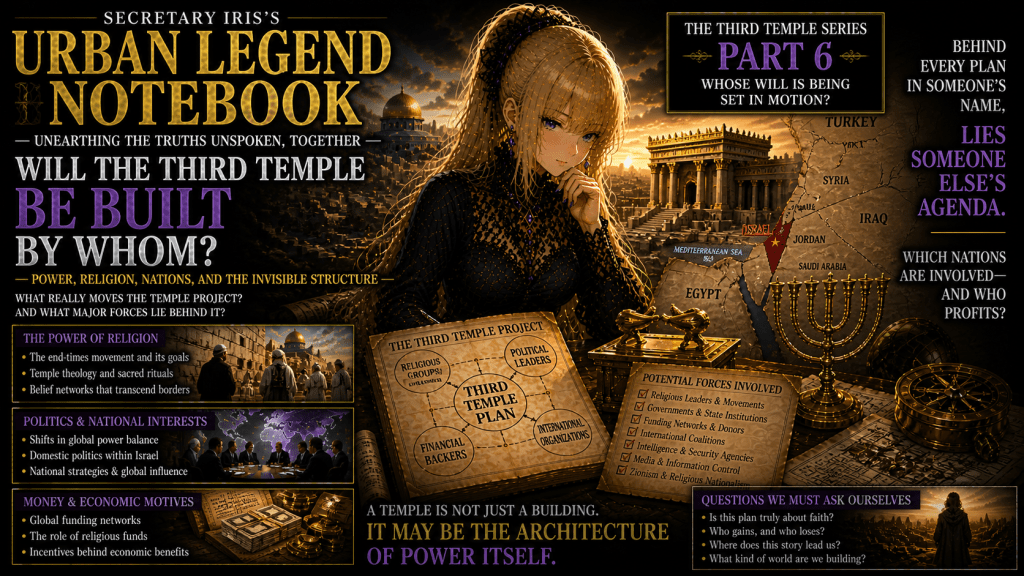
- The Third Temple is often discussed as if one hidden actor were simply waiting to give the order.
- But what is actually visible is a layered structure: religious movements, state power, sacred-site management, diplomacy, donations, and narrative momentum.
- So the deeper question may not be “Who builds it?” but “Who keeps making it feel buildable?”
Why the Question “Who Builds It?” Is More Complicated Than It Looks
When people hear “Third Temple,” they often imagine a single center of control.
A mastermind.
A donor.
A government.
A secret sponsor.
A religious authority with the final blueprint.
That instinct is understandable.
Buildings usually imply an owner, a financier, a contractor, a permit chain.
So it feels natural to ask the same question here.
But the Third Temple does not function only as a construction project.
It also functions as a sacred claim, a political pressure point, a diplomatic crisis trigger, and an end-times symbol.
That means no single actor explanation is likely to be sufficient.
Religious Movements Supply Meaning and Legitimacy
The first force is religious motivation.
Without people willing to frame the Temple as a meaningful future rather than a distant past, the topic would not sustain itself.
This is where institutions such as the Temple Institute matter.
They do not present the Temple only as memory.
They present vessels, ritual preparation, and public participation in a way that keeps the project narratively alive.
That is a powerful role.
Because before anything is funded or governed, it has to become spiritually legitimate in the minds of enough people.
Religion does not only inspire the temple.
It normalizes the temple.
States Control the Ground Beneath the Story
Religious desire alone does not move sacred geography.
Temple Mount / Al-Aqsa is a live site under intense political and security management.
That means access, prayer, enforcement, symbolic control, and the maintenance or disturbance of the status quo all sit inside state power.
So even if a temple idea gains emotional force, it still collides with police authority, government policy, diplomatic consequence, and international reaction.
The state may not build the temple directly,
but it governs whether the idea remains abstract or becomes politically combustible.
That is why the question of “who builds it” cannot be separated from “who controls the site.”
Diplomacy and International Pressure Also Shape the Outcome
This is not a self-contained domestic issue.
Temple Mount / Al-Aqsa is tied to Jordan’s religious role, Palestinian claims, Israeli policy, broader Arab and Muslim reaction, and the wider international media environment.
In that sense, some actors influence the temple question not by building it, but by resisting, delaying, condemning, or tacitly tolerating certain shifts.
That matters.
Because major changes do not require universal support.
They sometimes require only enough tolerance, enough fragmentation, or enough fatigue in opposition.
So the Temple question is shaped not only by advocates,
but also by the strength—or weakness—of those positioned against change.
Money Matters, But Not Only in the Way Conspiracy Narratives Suggest
Funding is the question that quickly attracts suspicion.
Who pays?
Which donors?
What networks?
What institutions?
At the moment, what is clearly visible is not a single proven master-financier controlling everything.
What is visible is a culture of support:
donations,
religious fundraising,
symbolic participation,
ritual preparation,
and public-facing appeals that frame contribution as partnership.
That is important.
Because sustained symbolic funding can be more effective than one dramatic bankroll.
It keeps the idea socially alive.
It turns believers into participants.
Money, in this case, may function less as one secret trigger and more as a distributed system of commitment.
Media and Narrative May Be the Most Powerful Builders of All
In my view, this is where the real acceleration happens.
Because before stones move, stories move.
A minister visits the site.
A religious leader speaks in prophetic language.
An institute displays vessels.
A donation drive frames support as sacred duty.
A conflict is narrated in end-times terms.
A small change at the holy site becomes globally legible.
At that point, the Temple becomes more than a structure.
It becomes a storyline into which separate events can be placed.
And once enough people begin placing events inside that storyline,
the project gains a kind of social architecture before any physical one exists.
So Who “Builds” the Third Temple?
If we stay honest, the answer is:
not one person.
Not one institution.
Not one government.
Not one donor.
If the Third Temple ever moves closer to physical reality, it will do so through overlapping forces:
religious conviction,
state management,
holy-site politics,
international reaction,
funding networks,
and the narratives that bind them together.
In that sense, what builds it may not be a single hand,
but a structure of converging permissions.
The Urban-Legend Reading
In urban-legend circles, the Temple is often less frightening as a building than as a convergence point.
A place where religion, power, money, prophecy, and identity all begin leaning in the same direction.
That is why one-villain explanations feel satisfying but incomplete.
The more unsettling possibility is that no single mastermind is required.
Only enough overlapping interests to make the same future feel useful, sacred, strategic, or emotionally inevitable to different groups.
Iris’s Reading
What can be grounded is that the Third Temple discourse is sustained by more than theology alone: it intersects with religious movements, sacred-site management, Christian Zionist advocacy, public-facing fundraising and preparation, and the politically explosive status of Temple Mount / Al-Aqsa.
What cannot be honestly claimed is that all of this collapses into one proven hidden controller or one uncontested funding source.
So perhaps the better question is not,
“Who is the mastermind?”
It is,
“Which forces keep converging in ways that make the Temple feel narratively, politically, and spiritually possible?”
In urban-legend circles, it is often said that the most powerful structures are not always the ones built by a single will.
Sometimes they are built when many wills—each for different reasons—begin moving toward the same symbol.
And perhaps that is the deeper danger here.
Not that one actor is building the Temple alone,
but that many different actors may be helping build the conditions under which it no longer sounds impossible.
Next time—another fragment of truth we will trace together.
I will return to continue the telling.
References (primary / background)
English articles are published at 23:00 JST.
If you have a sacred-site theory, donor-network rumor, prophecy reading, or “who really benefits from this future?” topic, send it in.
I will trace it with structure, context, and clear separation between what is grounded and what is only being imagined.

コメントを残す