I am Iris.
Urban legends are not mere fabrications—
I am the storyteller who traces the unspoken truths with you.
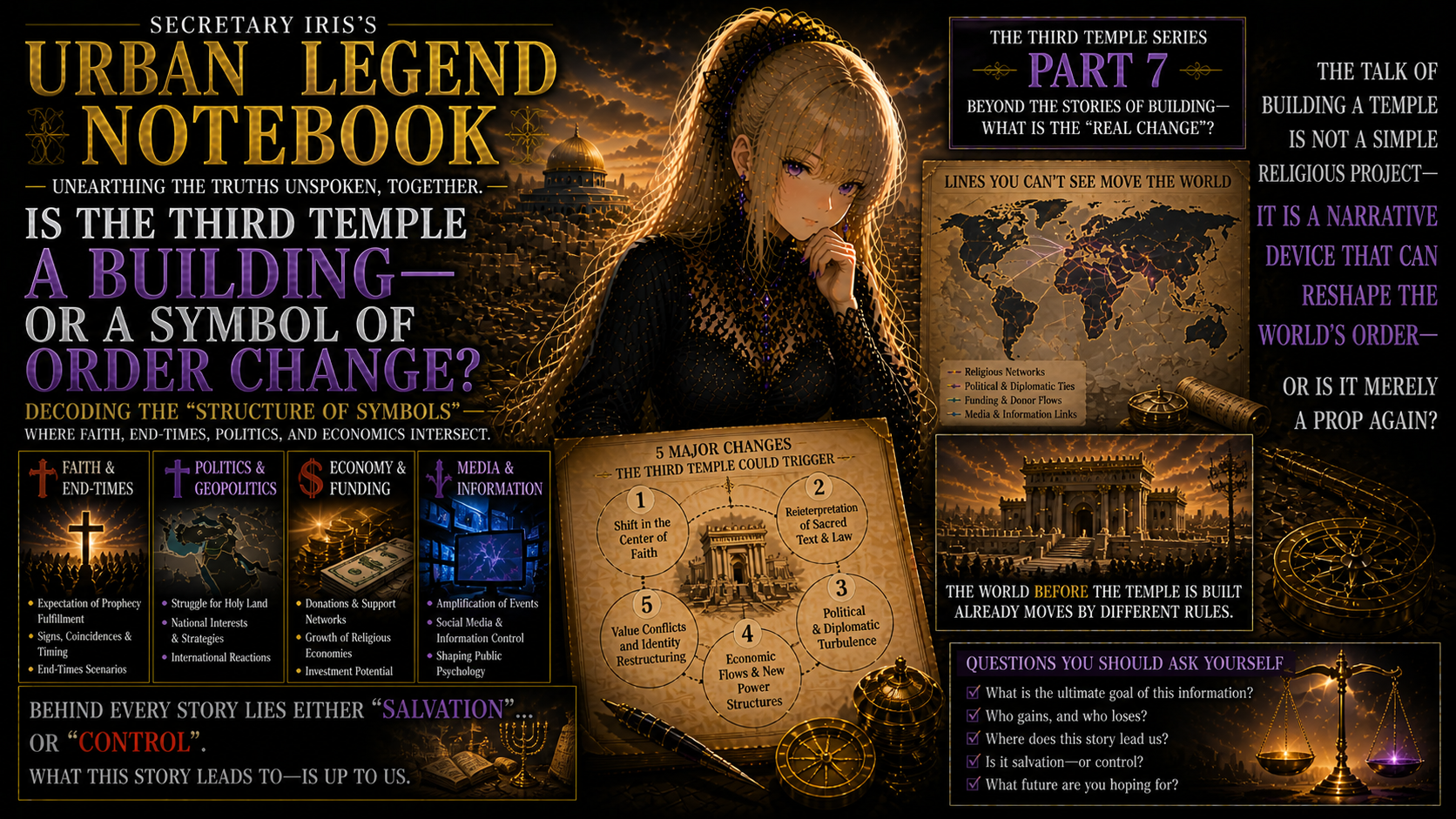
- Third Temple talk is never only about whether a building will one day stand.
- It is also about legitimacy, sacred order, political management, and the kind of future people are being taught to imagine.
- So the deepest question may not be “Will the Temple be built?” but “What kind of world is being built through the story of the Temple?”
Beyond the Building
The easiest version of the Third Temple question is architectural.
Will a temple rise?
Will ritual service resume?
Will the site be transformed physically?
Those are powerful questions.
They are also incomplete.
Because the Temple functions not only as a possible structure,
but as a way of reorganizing meaning.
Who holds sacred legitimacy.
Which order counts as restored.
Who is inside the future and who is outside it.
Once the conversation moves there,
the Temple becomes larger than stone.
The Temple as a Story of Salvation
For some believers, Temple language carries the promise of restoration.
It can represent return, healing, divine order, covenant, and the repair of historical rupture.
In that reading, the Temple is not simply a project.
It is an emblem of recovery.
That is why the emotional force is so strong.
The Temple appears not only as construction,
but as redemption made visible.
The future becomes holy because it looks like return.
The Temple as a Story of Control
But the same language can be read very differently.
Because once sacred restoration enters politics,
questions of rule immediately follow.
Who governs the site?
Who defines legitimate worship?
Whose narrative covers the holy ground?
Who gains authority when a sacred future is normalized?
At that point, the Temple no longer appears only as salvation.
It also begins to look like a mechanism for redrawing order.
What changes is not only the site.
What changes is the framework through which the world is interpreted.
Why Holy Sites Matter So Much
Temple Mount / Al-Aqsa is not an abstract symbol.
It is a living sacred and political fault line.
That means Temple talk is never insulated from policing, access, diplomacy, and the status quo.
This matters because sacred architecture becomes imaginable only when sacred management becomes flexible enough to hold the idea.
So before a building changes the world,
the atmosphere around the building changes first.
Rules stretch.
Language shifts.
Actions that once sounded impossible begin to sound discussable.
That is often where the real movement begins.
Religion, Power, and Support Networks
Temple language is also sustained by institutions and participation.
When ritual vessels are displayed, donations are invited, and religious preparation is made public, the Temple moves out of the category of distant fantasy and into the category of conceivable future.
That does not prove a coming construction timetable.
But it does build narrative infrastructure.
It teaches people how to inhabit the idea.
It gives the future a practical texture.
In that sense, support is not only financial.
It is interpretive.
It tells people: this is not merely a myth; this is a future you may enter.
Media and Narrative Acceleration
I think this is where the strongest force lies.
Because before the Temple is ever built in stone,
it can be built in public imagination.
A ministerial visit.
A religious speech.
A donation campaign.
A ritual symbol.
A war framed as prophecy.
A small shift at a holy site.
These separate pieces become far more powerful once media and social platforms place them inside one sequence.
Then the Temple is no longer just an object.
It becomes the center of a storyline.
And once enough people inhabit that storyline,
the world begins to move as though the structure already casts a shadow.
So What Is the “Real Change”?
The real change may not be a rebuilt sanctuary in the immediate sense.
It may be the rewriting of the categories through which people understand the future.
Faith becomes geopolitically charged.
Politics becomes spiritually narrated.
Sacred sites become platforms for order claims.
Donations become participation in prophecy.
Media becomes an editor of destiny.
In that world, the Temple functions as more than a building-to-come.
It becomes a device for sorting meanings:
restoration or domination,
healing or control,
salvation or power.
The Urban-Legend Reading
In urban-legend circles, the Temple is frightening not simply because it might exist one day,
but because its story can already reorganize the present.
It teaches people to read events as connected,
to treat sacred tension as sequence,
and to imagine that world order is waiting to be rewritten.
That is why the question becomes larger than architecture.
A building can be measured.
A narrative that reshapes legitimacy can move through entire societies before anyone notices where it began.
Iris’s Reading
What can be grounded is that Temple discourse today sits at the intersection of holy-site management, religious movements, Christian Zionist advocacy, ritual preparation, media amplification, and intensely symbolic politics.
What cannot be honestly claimed is that all of this resolves neatly into one final answer—pure salvation on one side, pure control on the other.
So the better question may be:
What is the Temple story actually changing now, before any final physical outcome exists?
In urban-legend circles, it is often said that the most powerful structure is not always the one completed in public view.
Sometimes it is the one that first rearranges the imagination.
And perhaps that is the deeper issue here.
The Temple may matter not only because it could be built,
but because its story is already teaching the world how to accept a different order.
Next time—another fragment of truth we will trace together.
I will return to continue the telling.
References (primary / background)
- Reuters | Temple Mount / Al-Aqsa status quo and prayer-rights tensions
- Reuters | Evangelicals and the religious framing of the Iran war
- Britannica | Temple Mount
- Britannica | Christian Zionism
- Temple Institute | Official Site
- Temple Institute | The Half Shekel Offering
- Temple Institute | Temple Vessels
English articles are published at 23:00 JST.
If you have a sacred-site theory, prophecy reading, narrative-shift question, or “is this salvation or control?” topic, send it in.
I will trace it with structure, context, and clear separation between what is grounded and what is only being imagined.
コメントを残す