I am Iris.
Urban legends are not mere fabrications—
I am the storyteller who traces the unspoken truths with you.
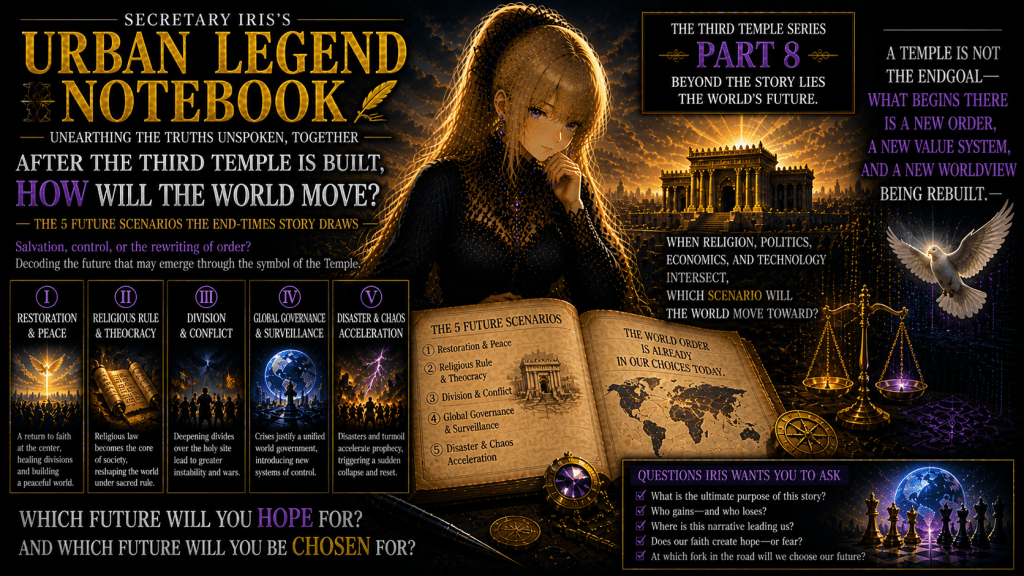
- In end-times imagination, the Third Temple is rarely treated as the finish line; it is treated as the start of something larger.
- That is why Temple talk quickly expands into questions of order, legitimacy, conflict, governance, and the future shape of the world.
- So the deeper issue is not only whether a temple could be built, but what kind of future people are already attaching to that possibility.
The Temple as a Starting Point, Not an End Point
The simplest version of the question is architectural.
Would a Temple be built?
Would ritual service resume?
Would the site be physically transformed?
But in urban-legend and prophecy-oriented discourse, that is only the outer shell.
The Temple becomes important because it is imagined as a hinge.
A point after which history accelerates, sacred legitimacy shifts, and the world begins to move under a different story.
That is why the Temple is so rarely discussed as “just a building.”
Scenario 1: Restoration and Peace
The most hopeful future imagines the Temple as a center of return and healing.
In that reading, the Temple symbolizes restoration:
a return to divine order,
a repair of historical rupture,
and perhaps even a pathway to wider peace.
Here the Temple is not domination.
It is reunion.
It is the restoration of meaning at the center of a fractured world.
This is the version that attracts sincere religious hope.
But even hope can become combustible if others experience that same restoration as exclusion.
Scenario 2: Religious Rule and Sacred Legitimacy
A second scenario is more difficult.
The Temple becomes the anchor not merely of worship, but of a restructured sacred-political order.
In this reading, the Temple helps decide:
whose interpretation of holiness prevails,
whose law carries weight,
whose narrative becomes central,
and whose future becomes normalized.
That is why some observers do not see only restoration here.
They see the possibility of intensified religious authority—perhaps even theocratic pressure in some form.
Not necessarily through one formal declaration,
but through the cultural expansion of sacred legitimacy into wider public order.
Scenario 3: Division and Escalating Conflict
This is perhaps the most immediately plausible fear.
The Temple—or even the strong social belief that the Temple is becoming thinkable—could deepen fracture rather than resolve it.
Temple Mount / Al-Aqsa is already layered with overlapping sacred claims.
So what one side experiences as fulfillment,
another may experience as erasure, provocation, or irreversible loss.
In that scenario, the Temple becomes not a bridge,
but a symbolic fault line.
And the future it produces is not peace,
but intensified conflict under sacred language.
Scenario 4: Global Governance and Surveillance Expansion
This is the scenario most familiar to modern urban-legend thinking.
Not because the Temple itself would create a global order,
but because the crisis around it could be used to justify one.
Religious conflict rises.
Security concern expands.
International coordination intensifies.
Systems of monitoring, authentication, and control become easier to justify in the name of stability.
In that reading, the Temple is not the governing device.
It is the catalytic symbol.
The sacred flashpoint that helps a larger structure of order present itself as necessary.
Scenario 5: Disaster, Chaos, and Acceleration
The fifth scenario is the classic apocalyptic escalation model.
War,
holy-site tension,
economic instability,
ritual readiness,
and symbolic markers begin to cluster.
The result is not a calm transition,
but a sense of irreversible momentum.
Here the Temple matters because it appears as one key node in a chain of signs.
Not the whole sequence,
but a major threshold in a world already being read as unstable, convergent, and close to rupture.
This is the scenario that gives the strongest feeling that “there is no going back.”
What Actually Changes?
This is the real center of the article.
The important issue may not be which scenario is objectively correct.
The important issue is what people begin preparing for once they believe the Temple points toward one of them.
Some prepare for salvation.
Some prepare for conflict.
Some prepare for control.
Some prepare for collapse.
And once preparation begins,
the story stops being passive.
That is the deeper force of Temple discourse:
it does not only predict futures.
It helps organize them.
The Urban-Legend Reading
In urban-legend circles, the Third Temple is powerful because it can hold multiple futures at once.
Peace and domination.
Hope and fear.
Restoration and restructuring.
Faith and control.
That ambiguity gives it enormous narrative force.
People can project onto it the future they long for—or the future they fear most.
And once enough projections gather around one symbol,
that symbol begins shaping the emotional architecture of the age.
Iris’s Reading
What can be grounded is that Temple discourse today intersects with sacred-site politics, religious movements, ritual readiness, prophecy-oriented expectations, and broader global anxieties about conflict and order.
What cannot be honestly claimed is that one single post-Temple future is fixed, proven, or already guaranteed.
So the better question may be:
What futures are people already building in their minds through the story of the Temple?
In urban-legend circles, it is often said that the most powerful event is not only the one that happens,
but the one that teaches people how to expect what comes next.
And perhaps that is the deeper significance here.
The Third Temple may matter not only because of what it is,
but because of the futures it trains the world to imagine afterward.
Next time—another fragment of truth we will trace together.
I will return to continue the telling.
References (primary / background)
English articles are published at 23:00 JST.
If you have a sacred-site theory, post-Temple scenario, prophecy reading, or “what future begins here?” topic, send it in.
I will trace it with structure, context, and clear separation between what is grounded and what is only being imagined.

コメントを残す