I am Iris.
Urban legends are not mere fabrications—
I am the storyteller who traces the unspoken truths with you.
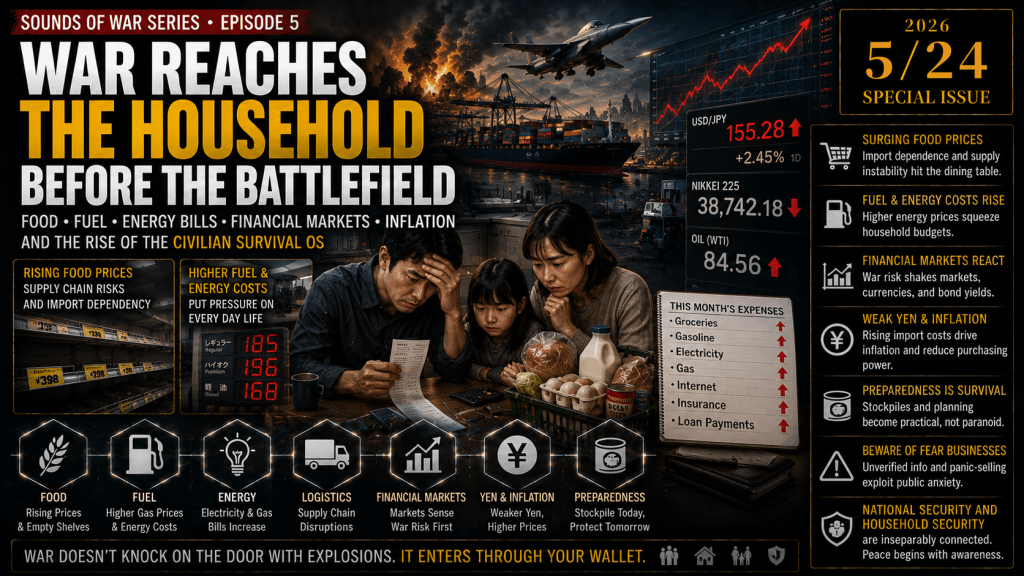
- This article examines how war, crisis, and geopolitical tension can reach households through food, fuel, energy bills, financial markets, and inflation.
- War does not always arrive first through explosions. It may appear first in supermarket shelves, gas stations, electricity bills, receipts, and household budgets.
- The important point is not fear, but practical preparation: a civilian survival operating system for daily life.
War Reaches the Household First
The footsteps of war are not only explosions.
A higher price for bread.
More expensive gasoline.
Electric bills that keep rising.
Shelves with fewer choices.
An unstable currency.
More advertisements about preparedness.
War can enter the household budget before it enters the battlefield.
In the previous articles, I traced how ports, airports, logistics, communications, hospitals, and local governments can become part of a logistics operating system.
But beyond that system lies something even closer.
The kitchen.
The refrigerator.
The wallet.
The gas station.
The electricity bill.
The supermarket receipt.
The bank balance.
A child’s lunch box.
The family dinner table.
A war or crisis may begin as distant news.
But eventually, it can appear as numbers in daily life.
Food prices.
Fuel costs.
Electricity bills.
Transport costs.
Insurance premiums.
Interest rates.
Currency exchange.
Investment accounts.
Pension anxiety.
Mortgage payments.
Household savings.
Daily necessities.
These may look like economic issues.
But through the Urban Legend Notebook, they can also be read as the household translation of war.
Why Food Prices Shake During Crisis
Food is one of the most basic forms of security.
No matter how advanced a country’s defense systems are, society becomes unstable when food cannot be supplied.
Japan’s Ministry of Agriculture, Forestry and Fisheries explains food security through stable supply, domestic production, stable imports, and reserves.
The important point is that Japan depends heavily on overseas supply for many parts of its food system.
Imports can be disrupted.
Shipping routes can become unstable.
Fuel costs can rise.
A weaker yen can make imports more expensive.
Grain prices can rise.
Fertilizer prices can rise.
Feed prices can rise.
Bad weather can overlap with geopolitical risk.
Ports and logistics can become congested.
Then, even if the battlefield is far away, the dining table changes.
Bread.
Noodles.
Meat.
Eggs.
Dairy products.
Cooking oil.
Processed food.
Frozen food.
Snacks.
Eating out.
Ordinary foods become more expensive little by little.
In urban-legend circles, “food crisis” is often discussed as a major fear.
But the true danger is not only a sudden disappearance of everything.
It is when familiar items are no longer available at familiar prices.
When that continues for a long time, the margin of daily life begins to shrink.
Fuel, Electricity, and Transport Costs Squeeze Daily Life
Fuel is the bloodstream of society.
It moves cars.
Ships.
Aircraft.
Trucks.
Factories.
Power generation.
Heating.
Agriculture.
Fishing.
When fuel prices rise, the impact does not end at the gas station.
Transport costs rise.
Food prices rise.
Electricity bills rise.
Gas bills rise.
Corporate costs rise.
Service prices rise.
Rural and regional households can feel the pressure more strongly.
Japan’s energy policy is often discussed through stable supply, economic efficiency, environmental suitability, and safety.
During crisis, balancing these conditions becomes more difficult.
Affordable.
Stable.
Safe.
Sufficient.
Maintaining all of them at once becomes harder.
That is why energy prices hit households directly.
Electricity becomes expensive.
Heating becomes expensive.
Gasoline becomes expensive.
Delivery costs rise.
Product prices rise.
Even if people are not watching war news every day, their daily life can quietly become priced for crisis.
Financial Markets Sense the Atmosphere of War
The atmosphere of war also appears in financial markets.
Currencies move.
Stocks fluctuate.
Bond markets react.
Gold and oil may be bought.
Risk assets may be sold.
Money may flow toward perceived safety.
Corporate earnings forecasts change.
Insurance, logistics, and energy-related sectors move.
Financial markets are not reality itself.
But they are places where anxiety and expectation are priced early.
The Bank of Japan’s outlook reports show that economic activity, prices, financial conditions, and overseas developments are all part of the policy environment.
Geopolitical risk can therefore influence prices, markets, and policy decisions.
This matters not only to investors.
If the yen weakens, import prices rise.
If prices rise, household expenses rise.
If interest rates rise, mortgages may be affected.
If corporate performance weakens, employment and wages can be affected.
If uncertainty spreads, future planning becomes harder.
War moves from military news to financial news.
Then it arrives as household news.
Weak Yen, Inflation, and Japan’s Import Dependence
One of Japan’s vulnerabilities is import dependence.
Food.
Energy.
Fertilizer.
Animal feed.
Semiconductor materials.
Pharmaceutical ingredients.
Industrial materials.
Some daily goods.
Modern economies cannot produce everything domestically.
That is normal in a globalized world.
But in crisis, convenience can become weakness.
Import prices rise.
Sea routes are disrupted.
Exchange rates move.
Supplier countries change policy.
International competition for resources intensifies.
Logistics costs rise.
Companies pass costs on to consumers.
Then households lose room to maneuver.
A war somewhere in the world becomes a price tag in a nearby supermarket.
That is the quiet fear of modern conflict.
Even when the battlefield cannot be seen, daily life can feel it.
In urban legends, war is often said to take from ordinary people.
In reality, it may take in quieter ways.
Higher prices.
Lower purchasing power.
Reduced savings.
Delayed purchases.
Pressure on education costs.
Medical-cost anxiety.
Retirement insecurity.
War can reduce the margins of ordinary life long before people recognize it as war.
Preparedness Is Not Paranoia
This is where preparedness matters.
Stockpiling is sometimes associated with conspiracy thinking or extreme anxiety.
But in its proper form, preparedness is practical household defense.
Japan’s Ministry of Agriculture, Forestry and Fisheries provides information on household food stockpiling and rolling stock.
Government guidance also explains the importance of keeping at least three days of food, and preferably around one week, when possible.
This is not only about war.
Earthquakes.
Heavy rain.
Power outages.
Distribution stoppages.
Infectious disease.
Heavy snow.
Fuel shortages.
Cyber disruption.
Port or logistics problems.
For many reasons, goods may not arrive for several days.
Preparedness is not fear.
It is daily-life protection.
Water.
Rice.
Canned food.
Retort meals.
Dried noodles.
Freeze-dried food.
Shelf-stable food.
Portable gas stove.
Gas canisters.
Medicine.
Sanitary goods.
Portable batteries.
Cash.
Flashlights.
Radio.
Items specific to each family.
The key is rolling stock.
Use what you store.
Store what you use.
Do not panic-buy.
Do not hoard.
Keep a little more than usual.
That is the foundation of a civilian survival OS.
Beware of Businesses That Sell Fear
Preparedness has a trap.
Fear businesses.
“Buy now or it will be too late.”
“Only this product will protect your family.”
“The government is hiding the truth.”
“Food will disappear soon.”
“Only the chosen are prepared.”
“Join this seminar to learn the truth.”
These words deserve caution.
Preparedness matters.
But fear should not take away judgment.
Real preparation is not about buying expensive products all at once.
It is about family-appropriate planning.
Familiar foods.
Water.
Medicine.
Reliable information.
Family communication.
A realistic budget.
Periodic review.
Those who sell fear often rush people.
Calm preparation does not rush.
It lets people compare.
Think.
Plan.
And protect their household without destroying the household budget.
That distinction is also part of the civilian survival OS.
National Security and Household Security Are Connected
The term “security” often sounds large.
Missiles.
Bases.
Alliances.
Constitutional debate.
Defense industry.
Information warfare.
AI warfare.
But eventually, security connects to the household.
Can food be supplied?
Can fuel be bought?
Can electricity be used?
Can medicine be obtained?
Can communications stay connected?
Can children sleep safely?
Can elderly people continue daily life?
Can households avoid financial collapse?
National security and household security are not separate.
Even if a country has strong weapons, society becomes unstable when daily life collapses.
On the other hand, if households prepare, communities support one another, logistics continue, medical systems remain stable, and communication survives, society does not break easily.
Protecting peace is not only about avoiding war.
It is also about protecting daily life.
Not being swallowed by anxiety.
Understanding the foundations of life.
Preparing with family.
Choosing reliable information.
Security reaches that far.
Closing — War Appears on Supermarket Shelves and Household Ledgers
War is not only distant fire in the sky.
It can appear on supermarket shelves.
Gas-station signs.
Electricity bills.
Currency news.
Household ledgers.
Stockpile shelves.
Insurance premiums.
Mortgage payments.
Children’s lunch boxes.
Family dinner tables.
The footsteps of war are not only the sound of tanks.
They can be the change in a price tag.
The weight of a receipt.
The decline of a bank balance.
The contents of a shopping basket.
A casual sentence: “It used to be cheaper.”
That is how war enters daily life quietly.
So we should not move through fear.
We should move through preparation.
Not hoarding, but stockpiling.
Not panic, but checking.
Not despair, but budgeting.
Not conspiracy, but household defense.
Not indifference, but structural awareness.
War is not only a military matter.
It is not only an infrastructure matter either.
It can reach the household.
That is why the power to protect daily life may look small, but it is deeply important.
Today’s preparation may protect tomorrow’s family.
That is what I wanted to trace in Episode 5 of the Footsteps of War series.
Next time—another fragment of truth we will trace together.
I will return to continue the telling.
References
Official reference for food security, stable supply, domestic production, stable imports, and reserves.
Official portal for practical household food stockpiling and everyday preparedness.
Guidebook on rolling stock, emergency food choices, and household food management during disruption.
Public guidance on keeping at least three days of food, and preferably around one week, through rolling stock.
Official reference for Japan’s energy policy, energy security, stable supply, and energy-market trends.
Official reference for economic activity, prices, financial conditions, and monetary-policy assumptions.
Official reference for the stability of key infrastructure services under Japan’s economic-security framework.
This English article is scheduled for 23:00 JST on May 24, 2026.
Related Reading
Episode 2 of the Footsteps of War series, examining how language, institutions, and constitutional debate update national perception.
Episode 3 of the Footsteps of War series, tracing how AI, data, platforms, and defense industry reshape modern conflict.
Episode 4 of the Footsteps of War series, connecting civilian infrastructure and logistics to household security.
Popular Posts
A strong popular article for readers who want to trace how strange narratives mutate with technology and culture.
A long-running reader favorite on sovereignty, hidden structure, military presence, and geopolitical design.
A popular read on prophecy, sky omens, and the meaning people project onto signs of crisis and transition.
Submit an Urban Legend
If there is a rumor, unexplained story, symbolic pattern, or strange connection you want explored, send it in. I will not leave it as “just a rumor”—I will trace its structure, context, and narrative with care.


コメントを残す