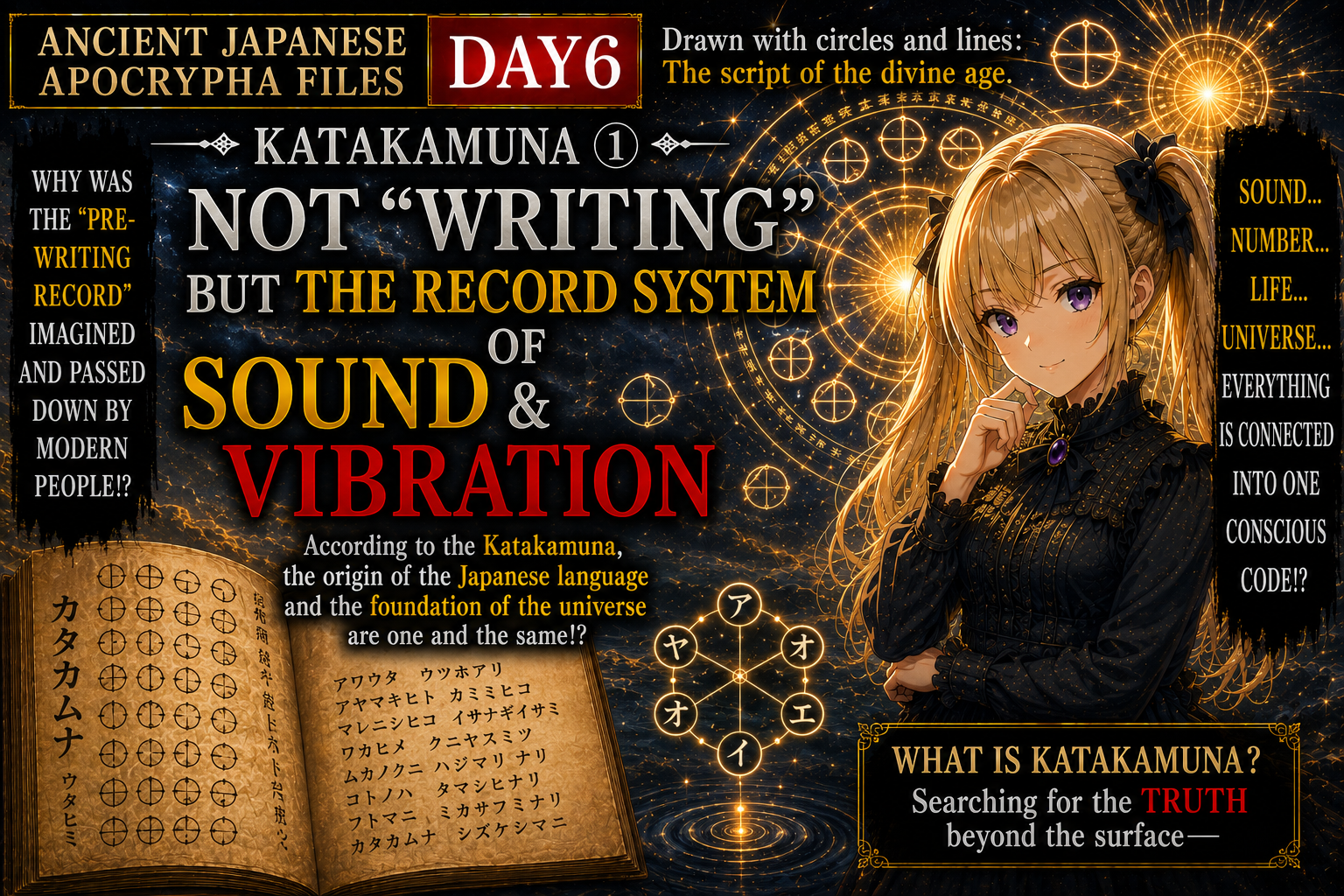
I am Iris.
Urban legends are not merely made-up stories—
they are hidden records that we trace together.
In the previous entry, we examined the Hotsuma Tsutae.
A long narrative that portrayed the gods as rulers.
A version of mythology different from the Kojiki and Nihon Shoki.
The Woshite script, organized around forty-eight sounds.
An attempt to rewrite mythology as a continuous national history.
Katakamuna also presents forty-eight sounds and an unfamiliar system of signs.
But Katakamuna is described as more than ancient writing.
Sound itself carries meaning.
Geometric form expresses the structure of the universe.
Behind visible matter exists an invisible activity.
Life, language, number, consciousness, matter, and the cosmos are manifestations of one underlying principle.
Ancient people supposedly recorded that principle not through ordinary prose, but through sound, song, spiral arrangement, and symbolic form.
Eighty verses.
Circles and intersecting lines.
The visible and the latent.
Iyashirochi and Kegarechi.
A claim that ancient Japan understood the structure of life and the universe before modern physics.
How did this system appear in postwar Japan?
Was it truly an ancient record?
Or did modern people create a new cosmic mythology in order to reunite science, language, nature, and spirituality?
This entry separates the discovery story, the symbols, the sounds, the concept of vibration, and the system called latent physics.
What Is Katakamuna?
Katakamuna generally refers to the Katakamuna Documents or the Katakamuna Utahi.
The material is said to consist of eighty verses.
The verses are not arranged as conventional vertical or horizontal writing.
Many diagrams contain a central symbol surrounded by signs written in a spiral or circular sequence.
The signs combine elementary geometric forms.
Circles.
Semicircles.
Crosses.
Vertical and horizontal lines.
They are now organized as a system representing forty-eight Japanese sounds.
Visually, they can resemble a circuit diagram, a mandala, an astronomical chart, or an emblem more than ordinary writing.
Supporters argue that the arrangement is itself part of the message.
The reader does not simply move from left to right.
Meaning expands from a center.
It rotates.
Sound and form interact.
The entire diagram supposedly represents the generation and transformation of life and matter.
Katakamuna is therefore presented not only as a script, but as a recording device older and more comprehensive than writing.
Who Introduced It?
The central figure in the modern history of Katakamuna is Satsuki Narasaki.
Narasaki was born in 1899 and died in 1974.
He is described as an electrical and physical-technology researcher who worked on electricity, static charge, resources, metallurgy, agriculture, and the properties of land.
He later proposed a system known as the Three Electrostatic Methods:
plant-wave agriculture;
material-transformation methods;
and human-wave health practices.
Calling him a physicist can create confusion if the term is understood to mean a university-based theoretical or experimental physicist working within established research institutions.
His work combined technical experimentation with an independent philosophy of nature, life, land, consciousness, and invisible forces.
Katakamuna became the central framework through which those ideas were organized.
The Hunter on Mount Rokko
According to the transmission maintained by supporters, Narasaki encountered the Katakamuna material around 1949.
He was conducting agricultural and land research near Mount Kinchō in the Rokko mountain range of Hyogo Prefecture.
There, he supposedly met a hunter named Hira Tōji.
The hunter said that his father had been the priest of a Katakamuna shrine.
He showed Narasaki a sacred scroll passed down through his family.
The scroll contained strange signs based on circles and crosses, arranged in spirals.
Narasaki connected them with a tradition he had heard while working in Manchuria.
That tradition described an ancient Japanese people called the Ashia.
They supposedly possessed a special script, advanced metallurgy, and a sophisticated understanding of nature.
Their knowledge was later transmitted to the Asian continent and influenced later civilizations.
Narasaki received permission to copy the scroll.
That copy is said to have become the Katakamuna Documents known today.
What Can Be Verified?
The story contains all the elements of a compelling hidden-history narrative.
A mountain.
A mysterious hunter.
A lost shrine.
A sacred family object.
An unknown script.
A chosen interpreter.
But the historical evidence remains limited.
Hira Tōji has not been independently established through public contemporary records.
The location and documentary history of the Katakamuna shrine have not been verified.
The original scroll has not been made available for material examination.
Its paper, ink, handwriting, and physical age have not been scientifically tested.
The diagrams circulated today derive from a copy attributed to Narasaki.
Researchers therefore do not possess the claimed original.
They possess a transcription and an interpretation mediated through the same person.
Was there an original scroll?
Was it copied accurately?
How much of the current system existed before interpretation?
What was added during later organization?
The available evidence does not permit independent answers.
The Eighty Utahi
The Katakamuna material is presented as eighty songs or verses known as Utahi.
Supporters do not treat them as unrelated poems.
They interpret them as a progressive explanation of the universe.
The early verses discuss fundamental activity expressed through terms such as Katakamuna and Kamunagara.
Later groups are interpreted in relation to life, particles, reproduction, division, circulation, consciousness, nature, and the cosmos.
Verses five, six, and seven are especially popular in modern chanting practices.
Yet the absence of the original scroll creates several unresolved questions.
How many verses were present in the first copy?
When were their divisions and reading order fixed?
Were damaged or missing portions reconstructed?
How much explanatory structure came from Narasaki and later interpreters?
The development of the text cannot be reconstructed independently.
A Script or a Diagram?
Katakamuna signs are commonly called characters.
Supporters also use terms such as sound signs and diagrammatic symbols.
Ordinary writing records sound or meaning in a linear sequence.
Katakamuna diagrams are said to record sound, rotation, direction, generation, integration, and separation at the same time.
The circle represents expansion or circulation.
The cross represents direction or division.
The center represents an originating point.
Lines represent flows of force.
The spiral represents generation and return.
Multiple meanings can therefore be assigned to one form.
When the signs are arranged around a center, an entire verse becomes a structural diagram.
This allows Katakamuna to be presented as a pre-writing form of knowledge.
Before language was written, ancient humans supposedly encoded the universe through sound and geometry.
Forty-Eight Fundamental Sounds
Forty-eight sounds form the foundation of modern Katakamuna interpretation.
Each sound is assigned an underlying conceptual activity.
Beginning.
Expansion.
Life.
Division.
Integration.
Circulation.
Words emerge when those fundamental sound-meanings combine.
Under this method, words sharing the same sounds are connected through a common cosmic function.
This differs from historical linguistics.
Historical linguistics examines early texts, regular sound changes, grammar, borrowing, dialects, and language contact.
Katakamuna interpretation begins with modern Japanese sounds and reads philosophical meaning backward into them.
The assigned meaning of a sound can therefore vary among interpreters.
Is It the Origin of Japanese?
Supporters sometimes describe the forty-eight sounds as the origin of the Japanese language.
The Katakamuna people supposedly understood life and the universe.
They created sounds to express that understanding.
Those sounds became Japanese.
Every Japanese syllable therefore retains a cosmic function.
There is no established evidence, however, that Japanese was designed as a completed system by one ancient community.
The language changed across long periods.
Early Japanese preserved sound distinctions that later disappeared.
Pronunciation varied regionally.
The archipelago also experienced contact with continental languages, the Ryukyuan languages, Ainu, and other linguistic traditions.
A sound inventory resembling a modern organized forty-eight-sound table has not been independently demonstrated in remote prehistory.
Kata, Kamu, and Na
The name Katakamuna is also given an internal philosophical interpretation.
Kata is often explained as visible form or manifested phenomenon.
Kamu represents invisible potential or latent activity.
Na expresses a relationship, field, or connection between them.
The visible world is not all that exists.
Behind it lies activity before form.
Potential before matter.
Life before biological manifestation.
Sensitivity before conscious recognition.
This hidden domain is called the latent realm.
The measurable world is the manifest realm.
Katakamuna is understood as the mutual process through which latent activity becomes visible and returns again.
This is not an etymology established by mainstream Japanese linguistics.
It is a philosophical interpretation internal to the Katakamuna system.
What Is Latent Physics?
Narasaki and later interpreters, especially Tamie Uno, used the term latent physics.
Modern physics, they argued, studies measurable matter and visible phenomena.
It has not fully explained life, consciousness, or the origin of organization.
A deeper approach must therefore examine the invisible activity behind phenomena.
The latent realm is not empty space.
It is filled with potential movement.
Manifest matter emerges from it and eventually returns to it.
Life and matter are not fundamentally separate.
The universe operates through circulation, polarity, and similarity across scale.
This can be studied as natural philosophy.
It is not identical to physics as practiced in modern research institutions.
Two Meanings of Physics
Katakamuna’s latent physics and standard physics use the same word, but their methods differ.
Modern physics defines terms.
It specifies measurement.
It expresses relationships mathematically.
It produces predictions.
It repeats experiments.
Independent researchers attempt replication.
A theory is modified when results contradict prediction.
Katakamuna interpretations often allow one sound or symbol to hold several meanings.
Interpretation can change according to context.
It is not always clear what observation would prove the theory wrong.
Philosophical depth and scientific verification are different forms of value.
Is Sound Really Vibration?
Sound is physically a wave.
In air, it is a mechanical pressure disturbance transmitted through interactions among particles.
Frequency, wavelength, amplitude, speed, and sound pressure can be measured.
Objects have resonant frequencies.
Ultrasound can be used in medicine and materials testing.
The human voice begins with vibration of the vocal folds and travels through a medium toward the ear.
In this limited scientific sense:
sound is vibration;
voice affects the body;
and vibration can affect matter.
But those facts do not demonstrate that:
specific Japanese syllables generate fundamental particles;
spoken meaning directly rewrites matter;
or a particular chant issues commands to cells or DNA.
Those stronger claims require separate controlled evidence.
Why Can Chanting Feel Calming?
People sometimes report that chanting Katakamuna verses produces warmth, calmness, concentration, or reduced anxiety.
Those experiences should not automatically be dismissed.
Rhythmic repetition can slow breathing.
Attention becomes focused.
Mind-wandering may decrease.
The speaker feels vibration in the chest, throat, and skull.
Group chanting can create social synchronization.
Research on mantra, prayer, and chant suggests that slow tempo, breathing, repetition, and attention may contribute to relaxation.
That does not establish the Katakamuna cosmology.
The effects may arise from breathing, expectation, rhythm, acoustics, concentration, and ritual rather than from a unique ancient code.
Physical Sound and Meaningful Speech
A physical sound has frequency and amplitude.
Human language adds learned meaning.
Hearing a warning can produce tension.
Hearing a familiar reassuring voice can reduce it.
That response is not determined only by the pressure wave.
It depends on language, memory, context, and interpretation.
The same sound sequence can affect a listener differently if they do not understand the language.
Katakamuna theory assigns cosmic meaning to sounds independently of individual learning.
Modern science normally distinguishes the acoustics of the sound wave from the semantic processing performed by the brain.
Confusing those levels can make three different statements appear identical:
words affect emotions;
sound waves affect matter;
and specific words directly alter the universe.
They require different evidence.
The Expansion of “Vibration”
In modern spiritual culture, vibration can mean many things.
A person’s vibration.
The vibration of a room.
Food vibration.
Emotional vibration.
High vibration.
Low vibration.
In physics, a wave requires identification of what is oscillating.
Air.
Water.
A string.
A crystal lattice.
An electromagnetic field.
A quantum field.
Frequency, amplitude, wavelength, and energy must be defined.
Spiritual vibration often combines mood, atmosphere, intuition, bodily sensation, and moral judgment.
When the word appears, the first question should be:
Is this a measurable physical wave?
A psychological experience?
Or a religious metaphor?
Similarity to Quantum Physics
Katakamuna is frequently compared with quantum theory.
Potential before observation.
Wave-particle behavior.
Matter emerging from an unseen field.
The relationship between observation and reality.
Universal interconnection.
The language can appear similar.
But the wave in quantum mechanics is not identical to emotional or spiritual vibration.
A wave function is mathematically defined.
It produces testable probabilities.
Experimental measurements can be compared with prediction.
Katakamuna’s latent realm can be compared philosophically with modern scientific ideas.
That comparison does not show that ancient Japanese people possessed quantum mechanics.
A later interpreter may select similarities after learning modern terminology.
The Principle of Similar Forms
Another important concept is Sōjishō—the appearance of similar forms across scale.
Atoms and solar systems.
Cells and the universe.
Whirlpools and galaxies.
Circulation in the body and circulation in nature.
This perspective can encourage careful observation of recurring patterns.
Science also studies symmetry, scaling, self-similarity, and fractals.
But visual resemblance does not prove identical mechanism.
Electrons are not planets orbiting a miniature sun in the ordinary classical sense.
A spiral galaxy and water draining from a sink do not operate through the same complete set of forces.
Formal similarity and physical identity must remain separate.
Iyashirochi and Kegarechi
Katakamuna literature commonly describes two kinds of land.
Iyashirochi is a place where life supposedly flourishes.
Plants grow well.
People feel calm.
Buildings last.
Health improves.
Kegarechi is presented as the opposite.
Plants struggle.
People tire.
Accidents and illness appear more likely.
Narasaki investigated soil, vegetation, electricity, and agricultural conditions and concluded that land possessed differing life-related properties.
Land genuinely differs in moisture, soil chemistry, microorganisms, sunlight, drainage, geology, and electrical conductivity.
But combining all those variables into one unmeasured level of life vibration—and extending it to health or destiny—has not been established as standard science.
Who Were the Katakamuna People?
Supporters refer to the creators of the material as the Katakamuna people or the Ashia.
They supposedly lived before currently known civilization.
They understood the relationship between matter and life.
They practiced advanced agriculture and metallurgy.
They created the foundation of Japanese.
Their knowledge spread to the Asian continent and later disappeared.
No identified archaeological culture has been conclusively connected to this description.
No settlement, burial system, industrial site, human remains, genetic population, or external historical account has been established as Katakamuna.
The Katakamuna people remain a population proposed inside the modern interpretive system.
Why Must It Precede Writing?
The idea that Katakamuna is older than writing plays an important role.
An ordinary manuscript can be tested.
Paper and ink can be dated.
Grammar can be analyzed.
Quotations can be compared.
But a system described as pre-writing, sacred, secret, and beyond modern scholarship becomes difficult to falsify.
Absence of evidence can be reinterpreted as evidence of suppression.
Inability to understand it becomes proof of lost sensitivity.
Failure to reproduce an effect becomes a failure of the modern observer.
The claim of pre-writing antiquity gives the system authority while also protecting it from ordinary historical testing.
Evidence Required for an Ancient Script
To establish Katakamuna as an ancient writing system, evidence independent of Narasaki would be necessary.
The signs would need to appear on securely dated pottery, wood, stone, or metal.
The same combinations would have to occur at multiple archaeological sites.
Researchers would need to demonstrate that the signs record language rather than decoration.
Materials predating Narasaki’s copy would need to exist independently.
Different scholars would have to recover the same readings through replicable methods.
No such archaeological body of evidence has been established.
Circles and crosses are elementary forms used independently in many cultures.
Visual resemblance alone cannot identify one script.
How Was It Deciphered?
Unknown scripts are normally deciphered through external clues.
Bilingual inscriptions.
Known names.
Numbers.
Repeated words.
Grammar.
Related languages.
Comparisons among documents.
The Rosetta Stone was central to the decipherment of Egyptian hieroglyphs.
Katakamuna has no verified ancient bilingual text.
Narasaki reportedly used the tradition of the Hachikyo script, Japanese sounds, geometric form, and his own natural philosophy.
The proposed reading and the proposed cosmic meaning therefore emerged through the same interpreter.
Independent researchers did not first reach the same solution without access to his explanation.
That limits its status as a deciphered ancient script.
The Circular Argument
A circular argument can arise.
The Katakamuna Documents contain advanced cosmology.
Therefore, an advanced ancient civilization existed.
An advanced ancient civilization existed.
Therefore, the Katakamuna Documents are authentic.
The document is authenticated by the civilization, and the civilization is authenticated by the document.
Independent evidence is required to break the circle.
Archaeology.
Dating.
Tools.
External records.
Replicable experiments.
Independent manuscript traditions.
Internal coherence alone does not establish antiquity.
Why Does It Attract Modern People?
Modern knowledge is highly divided.
Physics.
Chemistry.
Biology.
Medicine.
Psychology.
Linguistics.
Religion.
Individuals do not experience their own lives as separate academic departments.
They seek a relationship among body, mind, language, nature, and universe.
Katakamuna supplies a unified answer.
Sound, matter, consciousness, and life are different manifestations of one activity.
Human beings are not separated from nature.
Knowledge is not fundamentally fragmented.
That sense of unity is emotionally powerful.
Science and Spirituality at the Same Time
Katakamuna uses scientific terms.
Physics.
Particles.
Electricity.
Magnetism.
Waves.
Life generation.
The universe.
It also uses spiritual language.
Insight.
Kotodama.
Harmony.
Consciousness.
Life force.
The invisible realm.
It gives meaning and life to people who find science emotionally cold.
It gives scientific vocabulary to people who hesitate to accept conventional religion.
That combination makes the system highly adaptable.
Using scientific words, however, is not equivalent to scientific validation.
Present Assessment
Current evidence does not establish the Katakamuna Documents as an authentic primary source from ancient Japan.
The original scroll has not been made available.
Its material cannot be dated.
Hira Tōji and the Katakamuna shrine have not been independently documented.
No same text predating Narasaki’s copy has been identified.
The diagrammatic script has not been authenticated archaeologically.
The reading and meaning of the eighty verses depend on Narasaki and later interpreters.
Latent physics has not been established as a reproducible experimental framework within standard physics.
Katakamuna is therefore better understood as a postwar pseudo-ancient text, natural philosophy, and spiritual system rather than verified ancient science.
Its modern cultural influence remains real.
Meditation using sound and form.
Environmental philosophy.
A unified view of life and matter.
Interest in agriculture and place.
Questions directed toward reductionist science.
Those subjects can be examined separately from claims of ancient authenticity.
Conclusion: Sound Can Preserve Memory, but It Cannot Prove Its Own Age
Humanity preserved knowledge before formal writing.
Songs.
Rhythms.
Dance.
Ritual.
Pattern.
Gesture.
Oral tradition.
Sound can carry memory across generations.
Repetition helps communities maintain long narratives.
Geometric form can communicate without ordinary prose.
The general idea of sound as a recording system is therefore plausible.
But that does not demonstrate that the present eighty verses survived unchanged from remote antiquity.
Katakamuna leaves a deeper set of questions.
Why do modern people seek complete knowledge from before writing?
Why do they wish to reunite science and spirituality?
Why is cosmic meaning placed inside every Japanese sound?
That is where the system’s contemporary power lies.
Katakamuna is not verified super-ancient physics.
It is a framework reflecting a modern desire to reconnect knowledge that has been divided into separate disciplines.
In the final entry, we will examine how Katakamuna changed within contemporary spirituality.
Chanting to manifest wishes.
Raising vibration.
Purifying the body or the land.
Connecting with cosmic consciousness.
Awakening forgotten Japanese abilities.
How did an alleged ancient natural philosophy enter the center of modern spiritual practice?
Ancient Japanese Apocrypha Files No.07:
Katakamuna, Part Two—
Its Overlap with Modern Spirituality, and What Ancient Apocrypha Fulfill.
Belief and verification.
The value of experience and the status of historical fact.
We will separate those boundaries in the final chapter.
Next time, I will return to trace another fragment of hidden truth with you.
This article does not present the Katakamuna Documents, Katakamuna characters, latent physics, or Iyashirochi as established ancient or scientific facts. It separates supporter claims, verifiable materials, standard science, and modern spiritual practice.
References
-
Katakamuna Preservation Society / Latent Physics Society
A first-party source presenting the eighty Utahi, forty-eight sound-symbols, latent physics, and the claim that Katakamuna represents the origin of Japanese. -
National Diet Library Search|Ancient Japanese Civilization and Japanese Physics
Bibliographic information for Narasaki’s lecture materials, Sōjishō publications, and the modern Katakamuna preservation movement. -
National Diet Library Search|Satsuki Narasaki’s Final Kamuhibiki
A bibliographic reference for the supporter-side comparison between contemporary science and Katakamuna latent physics. -
National Diet Library Search|The Three Electrostatic Methods
Bibliographic information on Narasaki’s plant-wave agriculture, material-transformation method, and human-wave health method. -
KAKEN Research Report|Formation and Modern Use of Divine-Age Script Materials
An academic project examining sacred-script materials as early modern fabrications and their later religious, scholarly, and political use. -
Kyoto University Research Information Repository|Development of Private Rice-Farming Methods in Postwar Japan
A history-of-agricultural-technology study placing Narasaki’s plant-wave agriculture among several postwar alternative farming systems. -
Kyoto University Research Information Repository|Learning and Recruitment in Japanese Spiritual Communities
A doctoral dissertation documenting the use of Katakamuna in contemporary community education and spiritual practice. -
The Physics Classroom|Sound Is a Mechanical Wave
A foundational explanation of sound as a mechanical pressure wave involving a medium, frequency, amplitude, and energy transfer. -
PubMed|Chants across seven traditions share acoustic traits that enhance subjective relaxation
Research examining shared slow-tempo acoustic features of chant traditions and their association with subjective relaxation. -
PubMed|Autonomic and Respiratory Modulations Induced by Different Styles of Mantra Chanting
A study of breathing, autonomic activity, attention, and physiological relaxation during different styles of chanting.
Posting Time
This English article is scheduled for publication at 23:00 JST on July 25, 2026.
Related Reading
Popular Posts
Submit an Urban Legend
Do you know a story involving Katakamuna, sacred scripts, kotodama, Iyashirochi, mysterious regional signs, sound traditions, or ritual chanting?
Share & Follow
If you enjoyed this article, sharing, following, and exploring the notebook helps support future investigations.
コメントを残す