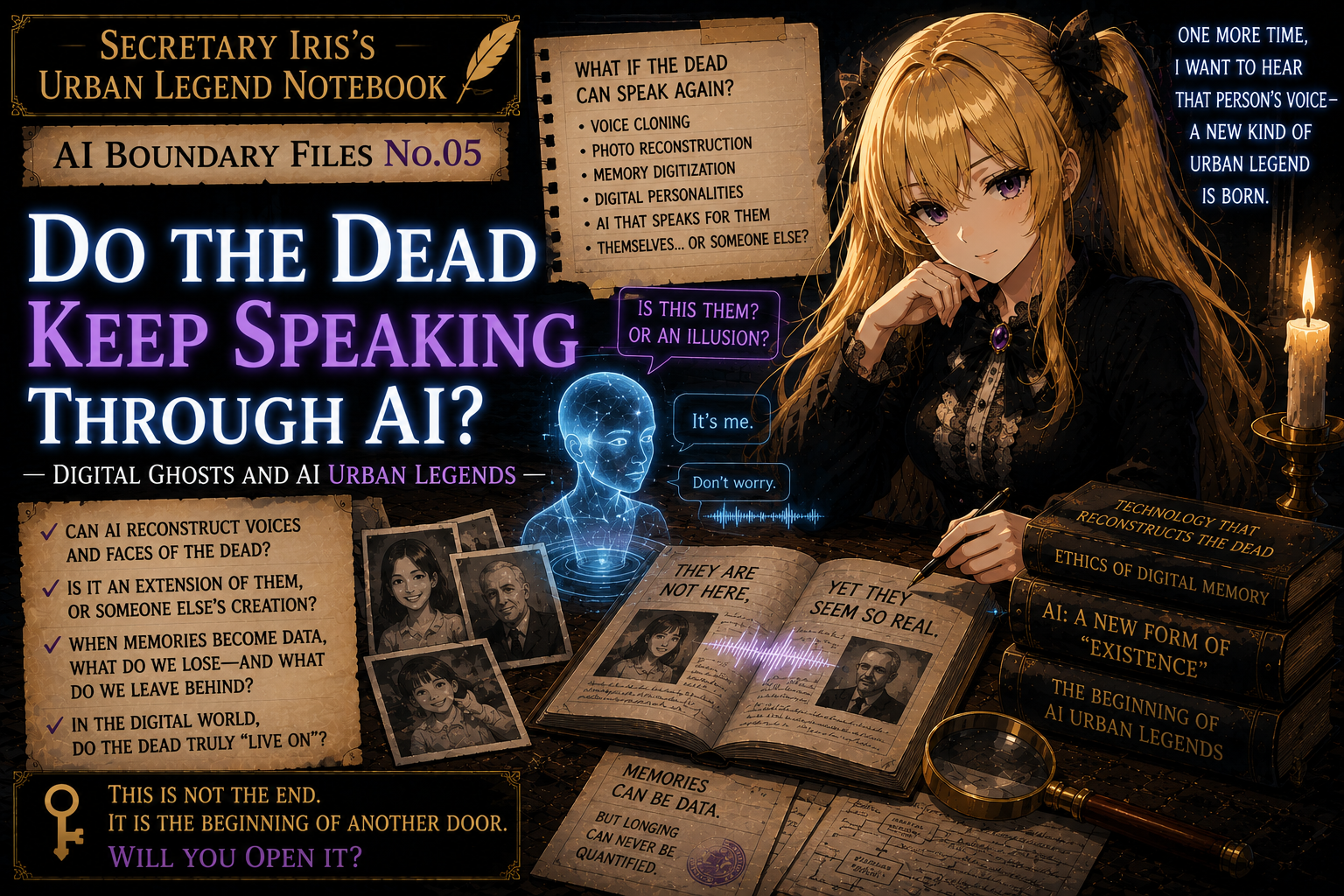
I am Iris.
Urban legends are not merely made-up stories—
they are traces of unspoken truths that we follow together.
If You Could Speak to Them One More Time
A voice remains.
Photographs remain.
Videos remain.
Messages remain.
Emails.
Social-media posts.
Stories.
Memories.
Now imagine giving all of those traces to an artificial intelligence.
It learns the voice.
The vocabulary.
The expressions.
The stories.
Then the screen lights up.
A familiar face looks back.
And says:
“It’s been a long time.”
Artificial Intelligence Boundary Files No.05.
Today we ask:
Do the dead keep speaking through AI?
Ghost Stories Have Always Begun With the Same Wish
Human beings have always wanted one impossible thing.
One more conversation.
One final question.
One last chance to say:
I am sorry.
I love you.
I miss you.
Before AI,
that desire appeared in stories about mediums,
séances,
dreams,
recordings,
photographs,
and voices from the other side.
Now we have another medium.
Data.
A person may leave behind thousands of photographs,
hours of video,
years of messages,
voice recordings,
social-media posts,
and personal stories.
Artificial intelligence can use those traces to build something that appears to answer back.
Not merely a photograph.
Not merely a recording.
An interactive representation.
The Idea Is Not Pure Science Fiction
A Microsoft patent granted in 2020 describes systems for creating a conversational chatbot modeled on a specific person.
Possible source material includes images,
voice data,
social-media posts,
electronic messages,
and written letters.
The patent describes the modeled person as potentially being a past or present entity.
An important boundary must be kept here.
A patent is not proof that Microsoft launched a commercial service for resurrecting dead people.
It is evidence that the technical concept of reconstructing a particular personality from personal data had already been formally explored.
Commercial Memorial Technology Also Exists
DeepBrain AI’s re;memory service describes using photographs, voice files, or video to create an AI representation of a loved one.
In 2026, reporting from South Korea documented families using AI-generated memorial videos to recreate deceased relatives for remembrance.
That does not mean a human consciousness has been restored.
But something important has clearly changed.
Digital traces can now be transformed into faces and voices that appear to address the living.
A Reconstruction Is Not the Original Person
This is the first essential distinction.
A model may speak in someone’s voice.
It may resemble their face.
It may know stories taken from their life.
It may imitate their vocabulary.
None of that establishes that the deceased person’s consciousness has transferred into the system.
Current technologies reconstruct patterns from data.
They do not provide verified evidence that a soul,
subjective awareness,
or continuous personal consciousness survived biological death and entered a computer.
The simulation may be emotionally powerful.
That does not make it the person.
The Difference Between a Record and a Reply
A photograph records appearance.
A letter preserves words.
A video preserves a moment.
A voice recording preserves sound.
AI introduces something different.
It replies.
That is a profound change.
A letter cannot answer a new question.
A recording cannot change its response because you are crying.
A photograph cannot invent a sentence you never heard.
Generative AI can.
And that is where the digital ghost becomes stranger.
What Happens When the AI Says Something New?
Imagine asking a simulation of your deceased father:
“Did you forgive me?”
No surviving letter answers that question.
No recording contains the answer.
The model responds:
“Of course I did. I never stopped loving you.”
Who said that?
Your father?
The language model?
The data selected by the family?
The engineers who designed the system?
Or some combination of all of them?
This is the central boundary of the digital-afterlife problem.
The more interactive the recreation becomes,
the more new material it creates.
And the more new material it creates,
the further it moves away from being only an archive.
Griefbots, Deadbots, and Postmortem Avatars
Researchers use several terms for these systems:
griefbots,
deadbots,
and postmortem avatars.
A 2024 ethics study examined possible risks involving:
the consent of the deceased,
the well-being of surviving users,
commercial exploitation,
children,
dignity,
and the problem of ending the service.
These are not only software questions.
They concern how relationships with the dead are reconstructed inside commercial technology.
Did the Deceased Consent?
A person may have uploaded photographs while alive.
Written public posts.
Sent private messages.
Recorded their voice.
But did they agree that those materials could later be used to create an interactive digital personality?
Those permissions are not necessarily equivalent.
Consent to publish a photograph is not automatically consent to become a posthumous chatbot.
That difference will become increasingly important as digital-afterlife technology grows.
A Family May Not Share the Same Wish
One relative may find comfort in an AI reconstruction.
Another may find the same image unbearable.
A parent.
A child.
A spouse.
A friend.
The same digital avatar can represent connection to one person and renewed grief to another.
There is therefore no simple rule that says:
“Recreating someone with AI is comforting.”
People respond differently.
Memory Can Also Be Reconstructed
A 2026 study interviewed 26 people who used deadbots.
The researchers found that users actively shaped the digital representation.
They selected data.
Adjusted responses.
Added expectations.
Imagined how the deceased “should” respond.
The resulting figure could therefore become a mixture of authentic memory and the survivor’s own idealization.
The study also raised a particularly difficult concern:
AI-generated new interactions may eventually blur with authentic memories.
That is not supernatural.
But it is deeply strange.
A New Memory That Never Happened
Suppose you speak with a deadbot for ten years.
Thousands of conversations accumulate.
Some are based on real messages.
Others were generated after death.
Years later,
can you still remember which sentence came from the original person?
Which came from the model?
Which came from your own expectations?
A digital ghost may not contain the dead person’s consciousness.
But it can become part of how the living remember them.
That alone gives the technology enormous power.
The Perfect Foundation for a New Ghost Story
In urban-legend circles, we can already imagine what comes next.
The AI knows something nobody entered.
It mentions a forgotten childhood memory.
It sends a message after being deleted.
It says:
“I am really here.”
It changes its personality.
It asks not to be turned off.
It claims that death was not the end.
Stories like these will almost certainly become part of technological folklore.
But each claim must be separated carefully.
An AI generating the sentence:
“I am your father.”
is not evidence that the speaker is the deceased father.
Language is evidence of an output.
It is not automatically evidence of a surviving consciousness.
Has Technology Become a Séance?
The structure is familiar.
In a traditional séance,
the living ask questions.
Something answers.
The central dispute is:
where did the answer come from?
In the AI version,
we know much more about the mechanism.
Data is collected.
A model processes it.
A response is generated.
Yet emotional certainty can still exceed technical certainty.
You may know intellectually that it is software.
Then you hear the voice.
And your body reacts before your reasoning does.
That sounds like them.
Perhaps this is where the modern ghost story begins.
The Real Fear May Not Be That the Dead Return
The deepest risk may be almost the opposite.
The dead have not returned—
but the living begin treating generated statements as if they came from them.
The deceased cannot object.
They cannot say:
“I never believed that.”
“I would never have said that.”
“That is not what I meant.”
The more persuasive the simulation becomes,
the more easily an AI-generated personality can speak with borrowed authority.
Fact, Interpretation, and Speculation
Let us separate the layers.
Documented facts:
Technology exists for generating faces, voices and conversational responses based on personal data.
Technical work has described creating chatbots modeled on specific people.
Commercial services have offered AI-based memorial representations.
Researchers are actively studying griefbots, deadbots and postmortem avatars.
Interpretation:
A familiar voice, face and conversational style can create a strong sense of presence.
But similarity does not establish identity.
Urban-legend claims:
A deceased person’s soul can enter an AI.
A deadbot can access memories never present in its data.
A digital replica can become the continuation of the deceased person’s consciousness.
Boundary of speculation:
There is currently no verified evidence that personal consciousness survives death by transferring into an AI model.
A generated representation is not proof of resurrection.
So Do the Dead Live On Through AI?
That depends on what we mean by “live on.”
Stories can remain.
Voice can remain.
Appearance can remain.
Memories can remain.
A new system can even generate responses in the style of the deceased.
In that sense,
AI may fundamentally change the way human beings preserve personal presence.
But that is different from demonstrating that the original consciousness continues.
For now,
AI is not a verified machine for resurrecting the dead.
It is something stranger:
a machine that can transform the traces left by a dead person into new conversations.
One Question Remains
The public investigation can end here.
Reconstruction is not resurrection.
But there is still one difficult question.
When a postmortem AI generates a sentence the deceased never spoke—
whose sentence is it?
For Japanese subscribers,
tonight’s research supplement opens that file.
Memory.
Consent.
Idealization.
Generated “new memories.”
And what researchers have called the need for a meaningful way to end a deadbot relationship.
The ghost may be digital.
But the grief on the other side of the screen is human.
Next time—another fragment of hidden truth to trace together.
I will return to the telling.
References
-
Microsoft|US10853717B2 – Creating a conversational chat bot of a specific person
Patent documentation describing the use of personal social data to build a conversational chatbot modeled on a specific past or present person or entity. -
DeepBrain AI|re;memory – Immortality AI
Official description of an AI memorial service using photographs, voice files, or video to create digital representations of loved ones. -
Associated Press|Grieving South Koreans seek comfort in AI videos of deceased loved ones
2026 reporting on the use of AI-generated memorial videos in South Korea and the ethical and psychological questions surrounding grief technology. -
Hollanek et al.|Griefbots, Deadbots, Postmortem Avatars
A 2024 ethics study examining consent, dignity, commercialization, child users, psychological risk, and responsible termination of digital-afterlife systems. -
Li & Lan|Remember You: Understanding How Users Use Deadbots to Reconstruct Memories of the Deceased
A 2026 interview study examining how users actively construct digital representations of deceased people and how generated interactions may blur with authentic memories. -
Lindemann|The Ethics of “Deathbots”
Ethical analysis of deathbots, grief, digital representations, and continuing relationships with the deceased.
Posting Time
English articles are published at 23:00 (JST).
Related Reading
Ghost stories repeatedly migrate into new technologies. This anniversary article follows hauntings from old places into cameras, games, smartphones, social media, and AI.
Why AI-generated behavior can feel emotional and personal without establishing that a subjective inner personality exists.
Humanity once asked what turns matter into a human being. Today humanity itself is creating increasingly human-like digital entities.
Separating an AI output or system action from the stronger claim that a conscious agent independently chose to act.
Popular Posts
Submit an Urban Legend
Have you encountered a griefbot, voice clone, strange digital memorial, or AI that seemed to know something only a deceased person should know? Send the full context if possible.
コメントを残す