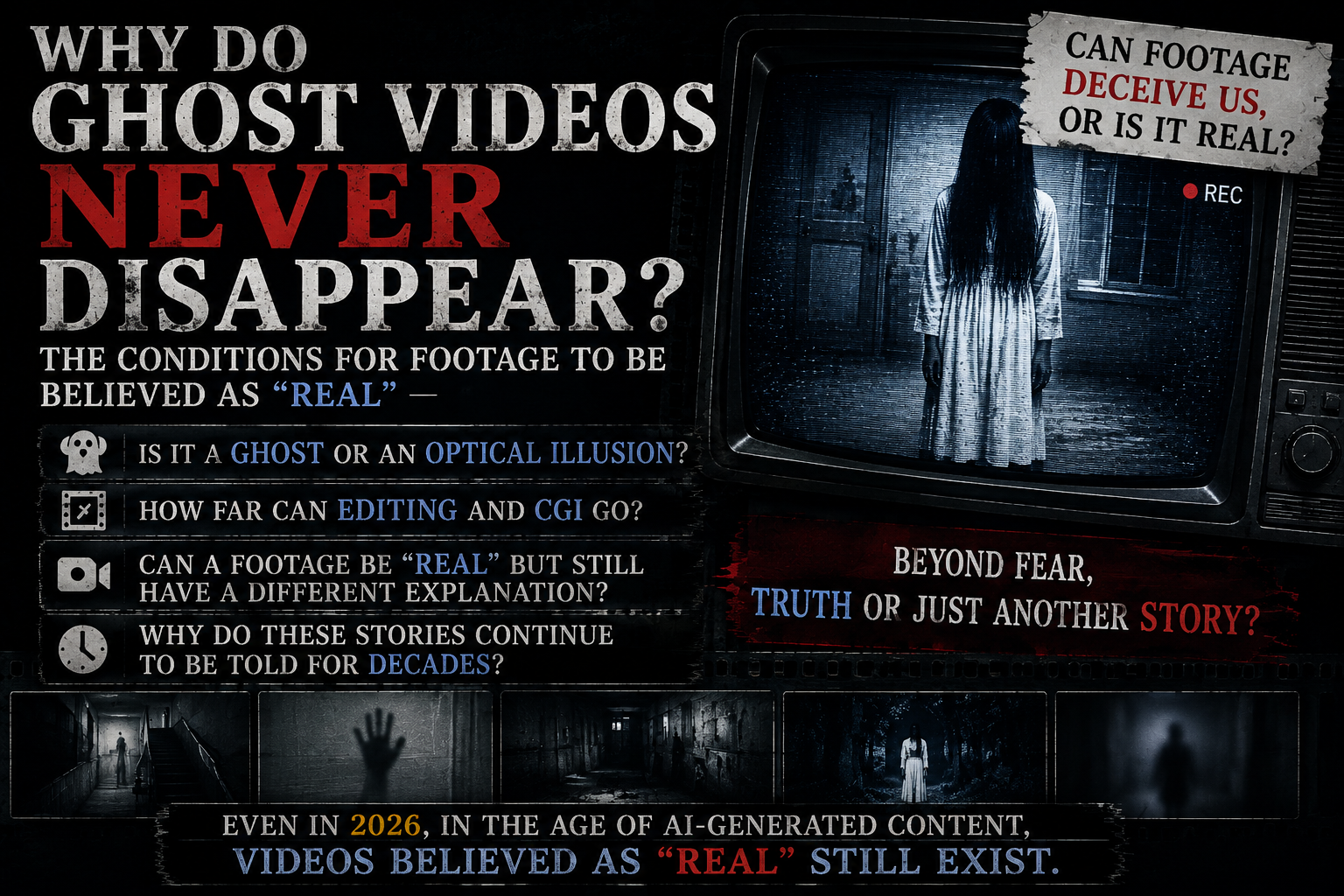
I am Iris.
Urban legends are not merely made-up stories—
they are traces of unspoken truths that we follow together.
Some Videos Refuse to Die
An old videotape.
A security camera.
A home movie.
A mobile phone.
A dashcam.
A smartphone.
And now—
generative AI.
Recording technology changes.
Ghost footage does not disappear with it.
Videos recorded decades ago continue to circulate.
People still say:
“This one was never debunked.”
“Experts could not explain it.”
“The original tape disappeared.”
“The cameraman experienced something afterward.”
“It was removed from television.”
The footage is copied.
Compressed.
Re-uploaded.
Edited.
Rediscovered.
And eventually presented to a new generation as:
one of the most convincing ghost videos ever recorded.
Why?
Is it because something genuinely supernatural was captured?
Because nobody has found an ordinary explanation?
Or because the story surrounding the footage has become more durable than the original recording itself?
Today we investigate a deceptively simple phrase:
“This ghost video is real.”
What Does “Real” Actually Mean?
The word can hide several different claims.
First:
Was the video genuinely recorded?
Was it captured by a camera rather than completely fabricated?
Second:
Did the visible phenomenon actually appear in the recording?
A light.
A shadow.
A person-shaped form.
A sound.
Something is genuinely present in the footage.
Third:
Is that phenomenon a ghost?
These are not the same conclusion.
An authentic recording can contain a real unexplained shape.
That does not automatically establish that the shape is the spirit of a deceased human being.
It might be:
a person,
an animal,
a reflection,
mist,
an object,
camera behavior,
an environmental effect,
or something investigators still cannot identify.
The most important distinction is therefore simple.
Authentic footage is not automatically authentic evidence of a ghost.
A Camera Records a Slice of Reality
Video can be powerful evidence.
But a camera does not record everything.
Its field of view is limited.
Anything outside the frame disappears from the record.
Distance may be difficult to judge.
Low light removes information.
Compression changes detail.
Movement can blur shapes.
Audio may be absent or incomplete.
The camera records one direction,
through one lens,
at one moment,
under one set of technical conditions.
So when investigating unusual footage,
what the video does not show can matter almost as much as what it does.
Ambiguity Is Perfect Fuel for Ghost Footage
Many famous paranormal clips share one useful property.
Ambiguity.
A figure is far away.
A face appears for a fraction of a second.
Something is visible behind glass.
A shape exists at the edge of the frame.
The image is dark.
The sound is distorted.
The object is partially hidden.
Ambiguous information invites interpretation.
And the human perceptual system is remarkably good at extracting meaningful forms from incomplete signals.
Pareidolia
You see faces in:
clouds,
wood grain,
windows,
rocks,
electrical outlets,
and random patterns.
This phenomenon is commonly called pareidolia.
Humans are particularly sensitive to face-like structures.
That ability is useful.
Missing a real face can matter.
As a consequence,
our perceptual system sometimes identifies a face where no human face exists.
This does not mean the viewer is lying.
The face may genuinely appear convincing.
But:
seeing a face is not proof that a person was physically present.
Expectations Can Change What We Notice
Imagine watching an empty hallway video with no explanation.
Now watch the same footage after being told:
“At 27 seconds, look to the right. A dead woman appears.”
You are no longer watching the same way.
You are searching for:
a woman,
on the right,
at a specific moment.
Research involving ambiguous alleged electronic voice phenomena has examined how paranormal framing and priming can affect perception.
The larger lesson applies to visual footage too:
context can direct attention.
The Red Circle Problem
Paranormal videos often use:
red circles,
arrows,
zoom,
slow motion,
replays,
and dramatic narration.
“Look here.”
Once someone marks the image,
your attention is captured.
The technique is useful for showing viewers what the presenter noticed.
But it also shapes interpretation.
A stronger investigation begins with:
the unmarked footage.
Then,
after independent viewing,
the claimed anomaly can be identified.
Otherwise the conclusion arrives before the observation.
A Story Can Become Part of the Memory
You watch a strange video.
Later someone tells you:
“A woman died in that room.”
“The cameraman was injured the following week.”
“This building used to be a hospital.”
“The figure resembles the dead owner.”
You watch the footage again.
Now the image carries a story.
Psychological research has repeatedly shown that post-event misinformation can influence later memory.
That does not mean paranormal witnesses automatically have false memories.
It means memory is not a perfect video archive.
Information received after an event matters.
So in a careful investigation,
we should keep separate:
what the footage shows
and
what people later said about the footage.
A Real Death Does Not Automatically Explain the Figure
Suppose a location genuinely has a tragic history.
A death occurred.
That fact matters.
But the existence of a historical death does not establish that a shadow in a later recording is the deceased person.
The location is real.
The tragedy is real.
The video may be real.
The connection between them is another claim.
And another claim requires another layer of evidence.
A Video Can Be Real While the Caption Is False
The AI era has made us suspicious of pixels.
But sometimes the pixels are not the lie.
The description is.
A real recording is uploaded with a new caption:
“Filmed inside an abandoned hospital.”
But it was not.
“The cameraman died the following day.”
No evidence.
“A murder happened in this room.”
Unverified.
No visual fabrication is required.
Only a change of context.
This may be one of the most important rules in modern paranormal investigation:
A genuine video can carry a fabricated story.
Reposting Destroys Provenance
Old paranormal footage often travels through generations of copies.
Original tape.
Television broadcast.
Home recording.
Website.
YouTube upload.
Compilation video.
Social-media clip.
Reaction video.
Short-form repost.
Each stage can remove information.
Who recorded it?
When?
Where?
What camera?
What happened before the clip began?
What happened afterward?
Is an unedited version available?
Eventually,
the surviving object may be only a ten-second fragment.
The image remains.
The evidence chain disappears.
“Experts Could Not Explain It”
This phrase sounds powerful.
But it needs questions.
Which expert?
An expert in what?
What material did they examine?
The original file?
A compressed upload?
Did they conclude:
“No editing was detected”?
Or:
“This is a ghost”?
Those are radically different claims.
The inability to identify manipulation does not establish a supernatural cause.
Unexplained Is a Status, Not an Explanation
This notebook has returned to this distinction many times.
Unknown.
Unresolved.
Unidentified.
Those words matter.
But:
unidentified does not mean extraterrestrial.
And unexplained footage does not automatically mean paranormal.
“We do not know” is not a ghost theory.
It is an evidence status.
That may feel less satisfying.
But it protects the investigation from turning uncertainty into certainty.
Does That Mean Every Ghost Video Is Fake?
No.
That conclusion would make the same mistake in the opposite direction.
A general explanation such as pareidolia cannot resolve every individual video.
A claim that “all ghost footage is CGI” requires evidence too.
Some videos can be explained.
Some are deliberately staged.
Some are ordinary scenes with misleading captions.
Some contain insufficient information.
And some may remain unresolved after reasonable examination.
The correct category for the last group is:
unresolved.
Not automatically paranormal.
Not automatically fake.
Why Old VHS Footage Can Feel More Frightening
Modern cameras can produce exceptionally clean images.
Yet an old VHS recording may feel more disturbing.
Why?
Because poor information creates space.
Noise.
Darkness.
Color bleeding.
Missing detail.
Unstable tracking.
The viewer must complete the image.
A perfectly illuminated monster gives you an object.
A half-visible shape gives you a question.
Ghost footage often lives inside that question.
Television Created a Grammar of Paranormal Footage
Japanese paranormal television developed a recognizable visual language.
Slow motion.
Replay.
Zoom.
Suspense music.
Narration.
A marked area of the image.
Then—
one more replay.
These techniques can be effective storytelling.
But they also demonstrate why the presentation must be separated from the evidence.
A dramatic edit does not prove the footage is false.
It does mean we should distinguish:
the raw recording
from
the program constructed around it.
Social Media Makes the Story Even Shorter
Today a paranormal claim may need only eight seconds.
“Do not watch the end.”
“Something appears behind her.”
“This video was deleted.”
“The uploader never posted again.”
The story is compressed into a caption.
Verification is slower.
Sharing is instant.
That creates an asymmetry.
The frightening version can travel around the world before anyone finds the original source.
Five Conditions That Help Ghost Videos Survive
Long-lived paranormal footage often possesses several characteristics.
One: Some ambiguity remains.
The image cannot be fully resolved.
Two: The moment is short and replayable.
Viewers watch again.
Three: A strong story surrounds it.
Death.
Abandoned places.
Curses.
Mysterious consequences.
Four: The provenance is incomplete.
The original source is difficult to locate.
Five: The viewer participates.
“Can you see it?”
The audience becomes part of the investigation.
And then part of the retelling.
What Changes in the AI Era?
Generative AI adds another layer.
Modern footage can be generated.
Voices can be cloned.
Images can be synthesized.
But AI also creates the opposite problem.
People can dismiss real footage simply by saying:
“AI.”
So the investigation cannot stop with visual intuition.
Source.
Original material.
Timeline.
Independent records.
Provenance.
Those surrounding facts become increasingly important.
Fact, Interpretation, and Urban Legend
Documented facts:
Humans can perceive meaningful forms such as faces in ambiguous visual stimuli.
Research has examined how framing and expectation influence the perception of ambiguous paranormal-style audio.
Post-event misinformation can affect later memory.
Modern AI can generate convincing synthetic media.
Interpretation:
Some paranormal footage can potentially be explained through perception, camera conditions, editing, miscaptioning, or memory.
Urban-legend claims:
Ghost videos contain spirits of the dead.
Deleted paranormal footage is more likely to be authentic.
Watching certain recordings causes supernatural consequences.
People involved in filming or broadcasting the footage suffer mysterious events.
Boundary of speculation:
Each individual recording requires individual investigation.
A general psychological mechanism cannot prove that a specific video is false.
And unexplained footage alone cannot prove a supernatural explanation.
Why Do Ghost Videos Never Disappear?
Because they occupy an unusual space.
Enough information to see something.
Not enough information to settle what it is.
A story powerful enough to remember.
A mystery simple enough to share.
If every ghost video were conclusively explained,
the legend would end.
If ghosts were conclusively demonstrated by reproducible evidence,
the subject would move toward science.
The strongest urban legend lives between those two outcomes.
Almost explained.
Almost proven.
Never completely closed.
One More Question Remains
The public investigation can end here.
Authentic video does not automatically establish a supernatural explanation.
And human perception, memory, editing and context all matter.
But what should we actually do when a strange video appears?
Check the image first?
The uploader?
Metadata?
The location?
Witnesses?
AI detection?
For Japanese subscribers,
tonight’s research supplement builds a ten-step paranormal-video verification procedure—
beginning not with the ghost,
but with the evidence surrounding it.
Next time—another fragment of hidden truth to trace together.
I will return to the telling.
References
-
Paranormal experiences, sensory-processing sensitivity, and the priming of pareidolia
Experimental research examining priming, ambiguous recordings, alleged EVP, and perception. -
Paranormal beliefs and cognitive function: A systematic review
A systematic review of decades of research involving paranormal belief, perception, reasoning and cognitive biases. -
Image type reveals evolutionarily shaped perceptual and conceptual mechanisms of pareidolia
A 2026 study examining how meaningful forms are perceived in ambiguous natural and noise images. -
Misinformation effects in an online sample
Experimental research showing how post-event misinformation can influence later memory for video events. -
NIST|GenAI: Deepfakes 2026
Current forensic evaluation work involving detection of AI-generated synthetic media.
Posting Time
English articles are published at 23:00 (JST).
Related Reading
Before asking whether paranormal footage contains a ghost, the AI era forces us to ask whether the recording itself came from reality.
A classic example of how eerie perception, childhood memory, fabricated supporting material and internet repetition can build a durable digital legend.
Eyewitness observation, hearsay, documents and physical evidence do not carry the same evidentiary weight. The same distinction matters in paranormal investigations.
Why ordinary technology becomes frightening when uncertainty, isolation and invisible connection create room for a story.
Popular Posts
Submit an Urban Legend
Whenever possible, include the original upload, recording date, location, uploader’s account, and information about whether an unedited version exists.
コメントを残す