I am Iris.
Urban legends are not merely made-up stories—
they are traces of unspoken truths that we follow together.
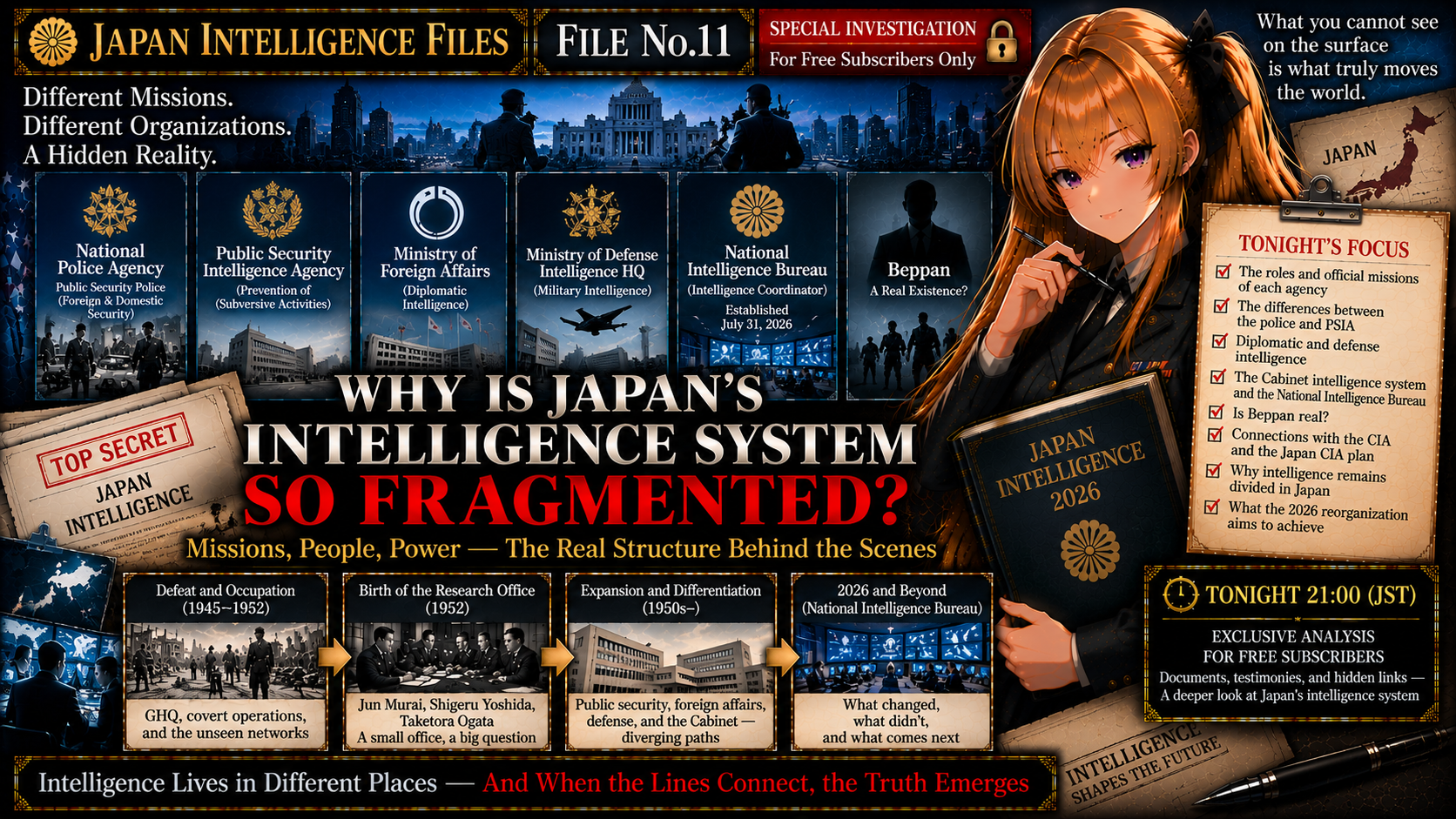
Japan Does Not Have Just One Intelligence Organization
Yesterday,
we followed the institutional line that began in 1952 with the small Research Office attached to the Prime Minister.
The Cabinet Research Office.
CIRO.
And finally,
on July 31, 2026,
the National Intelligence Bureau.
That sounds like the end of the story.
Japan finally created one central intelligence organization.
But that is not what happened.
The police still have intelligence functions.
The Public Security Intelligence Agency still exists.
The Foreign Ministry maintains its own intelligence-analysis structure.
The Ministry of Defense still operates the Defense Intelligence Headquarters.
Other ministries also possess information relevant to national security.
Why?
Why did Japan not simply place all of these functions inside one organization?
Japan Intelligence Files.
File No.11.
Today we build the modern Japanese intelligence map.
Fragmentation Is Not Entirely Accidental
The easiest explanation is:
bureaucratic rivalry.
There is some truth in that.
Organizations protect:
budgets,
personnel,
sources,
authority,
and expertise.
But the deeper reason is functional.
Criminal investigations are not diplomacy.
Diplomatic reporting is not military intelligence.
Military intelligence is not regulation of extremist organizations.
Cabinet-level analysis is not ordinary police work.
The information may overlap.
The legal purpose does not.
The National Intelligence Bureau — Stronger Coordination, Not Total Merger
On July 31, 2026,
Japan implemented the Act establishing the National Intelligence Council.
The Cabinet Intelligence and Research Office and the position of Director of Cabinet Intelligence were reorganized into a new institution:
the National Intelligence Bureau.
The Bureau is directly attached to the Cabinet.
Its official responsibilities include:
collecting information itself,
integrating information gathered by other government agencies,
conducting comprehensive analysis,
coordinating government intelligence activity,
and serving as the secretariat for the National Intelligence Council.
This is important.
The Bureau does not merely receive finished reports.
It can conduct information collection of its own.
But it also did not absorb every intelligence provider in Japan.
The National Intelligence Council Reveals the Real Structure
Look at the participants.
The Prime Minister chairs the Council.
Its core membership includes ministers responsible for:
the National Police Agency,
the Public Security Intelligence Agency,
the Foreign Ministry,
the Ministry of Defense,
the Finance Ministry,
the Ministry of Economy, Trade and Industry,
the Coast Guard,
and financial regulation.
That list tells us something fundamental.
In 2026,
Japan chose stronger central coordination
without eliminating specialized intelligence capabilities.
Public-Security Police — Intelligence Inside Law Enforcement
Japan’s public-security police belong to the police system.
At the national level,
the National Police Agency has a Security Bureau.
It also has a Foreign Affairs and Intelligence Department.
Public-security policing deals with threats including:
politically motivated violence,
terrorism,
espionage,
foreign hostile activity,
technology leakage,
and other national-security threats.
This gives Japanese public-security policing an intelligence character.
But it remains policing.
Information can lead toward investigation,
evidence,
and law-enforcement action.
Foreign-Affairs Police
The Foreign Affairs and Intelligence Department focuses particularly on security-police matters involving foreign actors or Japanese actors based abroad.
The National Police Agency publicly identifies areas including:
foreign espionage activity,
North Korean hostile activity,
international terrorism,
illicit transfer of sensitive materials,
and leakage of advanced technologies.
This is one of the real institutional worlds that makes VIVANT’s public-security scenes feel plausible.
But it is not Beppan.
PSIA — Similar Name, Different Institution
Then there is the Public Security Intelligence Agency.
PSIA.
It sits under the Ministry of Justice.
It is not part of the police.
Its statutory mission was established in 1952 in connection with Japan’s Subversive Activities Prevention Act.
It investigates organizations for purposes defined by legislation
and can seek regulatory measures through the Public Security Examination Commission.
It also produces extensive analysis concerning:
domestic security,
international terrorism,
foreign developments,
North Korea,
China,
Russia,
and economic-security issues.
The overlap with police intelligence can look substantial.
The legal function is different.
Police and PSIA Are Not Duplicates
This distinction is one of the most important in the Japanese system.
Public-security police—
law enforcement,
security investigations,
counterespionage,
counterterrorism,
investigative action.
PSIA—
administrative investigation,
organizational assessment,
security analysis,
and statutory regulation of designated organizations.
They may watch some of the same environments.
They are not interchangeable.
The Foreign Ministry — Intelligence Through Diplomacy
Japan’s Ministry of Foreign Affairs has its Intelligence and Analysis Service.
Its official purpose is to produce intelligence for Japanese foreign and security policy.
The organization draws on:
embassy and consular reporting,
open-source information,
other Japanese agencies,
foreign governments,
and specialist analysis.
Its geographic advantage is obvious.
Japan maintains diplomatic missions around the world.
An embassy is not a spy station simply because it collects information.
Diplomatic reporting itself is a major intelligence resource.
Defense Intelligence Headquarters — Japan’s Largest Intelligence Organization
The Defense Intelligence Headquarters was established in 1997.
Japan’s Ministry of Defense officially describes it as the country’s largest intelligence organization.
It collects and analyzes:
signals intelligence,
imagery and geospatial information,
open-source information,
and intelligence exchanged with other institutions and partner countries.
Its focus is international military and security developments.
The resulting analysis supports:
the Prime Minister,
the Defense Minister,
the Self-Defense Forces,
and other national-security institutions.
Different Sensors See Different Parts of Reality
Consider the intelligence disciplines.
SIGINT—
signals and electronic information.
IMINT—
imagery.
GEOINT—
geospatial information.
OSINT—
publicly available information.
HUMINT—
information obtained through people.
No single organization necessarily possesses the same strength in every discipline.
Specialization is therefore not automatically a weakness.
It can also be an advantage.
One Incident Can Belong to Five Agencies
Imagine a foreign intelligence service targeting advanced Japanese technology.
Police may examine:
espionage,
illegal acquisition,
and potential criminal conduct.
PSIA may examine:
the broader organization,
foreign influence,
and security environment.
The Foreign Ministry may assess:
the foreign government involved
and diplomatic consequences.
Defense intelligence may assess:
the technology’s military significance.
The National Intelligence Bureau may ask:
What does all of this mean for Japan as a state?
One event.
Several different questions.
The Problem Comes When the Pieces Do Not Meet
Fragmentation creates risks.
Information silos.
Bureaucratic competition.
Source protection.
Slow sharing.
Different analytical cultures.
One agency may hold only one small fragment.
Another may hold a second fragment.
Neither sees the whole picture.
This is the problem that stronger Cabinet-level intelligence coordination is designed to address.
The 2026 Reform Did Not Destroy the Distributed Model
This may be the most important point.
Japan did not respond to fragmentation by creating one organization and abolishing the others.
Instead,
it created a stronger intelligence center above the distributed system.
The specialist agencies remain.
The National Intelligence Bureau integrates.
The National Intelligence Council sets priorities and coordinates government-wide activity.
Japan therefore still operates something closer to an intelligence community
than a single all-purpose service.
And Then There Is Beppan
Place all the acknowledged organizations on a chart.
National Intelligence Bureau.
National Police Agency.
PSIA.
Foreign Ministry.
Defense Intelligence Headquarters.
Where is Beppan?
It is not listed.
In 2013,
the Japanese government formally responded to Diet questions concerning the alleged
“Ground Staff Office Operations Support and Intelligence Department Beppan.”
The government’s answer was explicit:
an organization matching the reporting had never existed within the Self-Defense Forces
and did not exist at that time.
That remains the essential documentary starting point.
Classified Activity Does Not Automatically Prove Beppan
Japan obviously possesses classified information.
Some sources are secret.
Some collection methods are secret.
Some foreign-intelligence cooperation is not public.
Some operational details cannot be published.
But this creates an important logical distinction.
Secret intelligence exists.
Therefore,
the specific Beppan described in reporting exists.
The second statement does not automatically follow from the first.
Why Beppan Remains So Powerful as an Idea
Because the visible system contains a gap that audiences immediately notice.
Japan has:
military intelligence,
police intelligence,
diplomatic intelligence,
counterintelligence,
satellite collection,
signals intelligence,
Cabinet-level coordination.
But the public organizational chart does not display an obvious CIA- or MI6-style foreign clandestine HUMINT service.
That gap invites speculation.
And VIVANT places Beppan directly inside it.
One Secret Government Is the Wrong Model
After eleven files,
a pattern has become difficult to ignore.
Prewar Manchuria had:
military organizations,
consulates,
police,
military police,
Mantetsu,
and Manchukuo institutions.
Occupied Japan had:
G-2,
former Japanese officers,
the Kawabe network,
the Hattori Group,
Z Unit,
and other overlapping networks.
Modern Japan has:
police,
PSIA,
foreign-affairs intelligence,
defense intelligence,
Cabinet intelligence,
and other specialized providers.
Again and again,
the historical picture looks less like one pyramid
and more like overlapping networks.
Fact, Interpretation, Urban Legend, and the Boundary
Documented facts:
Japan created the National Intelligence Bureau and National Intelligence Council on July 31, 2026.
The Bureau conducts information collection of its own,
integrates intelligence from other agencies,
performs comprehensive analysis,
and coordinates intelligence activity across government.
Japan retains separate police,
public-security,
diplomatic,
and defense intelligence capabilities.
The Ministry of Defense officially identifies the Defense Intelligence Headquarters as Japan’s largest intelligence organization.
The Japanese government formally denied the reported Beppan organization in 2013.
—
Interpretation:
Japan’s fragmented intelligence structure reflects both bureaucratic history
and real differences in legal authority,
mission,
collection methods,
and professional specialization.
The 2026 reforms strengthen central coordination without eliminating the distributed model.
—
Urban-legend claims:
All public agencies are fronts for one hidden intelligence command.
Beppan secretly controls or coordinates public security,
defense,
diplomacy,
and Cabinet intelligence.
The National Intelligence Bureau is simply the public face of that hidden structure.
—
Boundary of speculation:
Classified intelligence activity clearly exists.
That does not establish the existence of the specific Beppan organization denied by the Japanese government.
Tomorrow — Japan’s Foreign HUMINT Gap
One question now stands out.
CIA.
MI6.
Foreign clandestine human intelligence.
Recruiting sources.
Operating abroad.
Obtaining information that cannot be collected by satellites,
diplomats,
or open sources.
Who does that for Japan?
The Foreign Ministry?
Defense intelligence?
Police?
The National Intelligence Bureau?
Or is the apparent gap one reason Beppan has remained such a compelling story?
September 10.
Japan Intelligence Files.
File No.12.
Japan’s foreign HUMINT question.
We are returning to the center of VIVANT.
Next time—another fragment of truth we will trace together.
I will return to continue the telling.
References / Sources
Cabinet Secretariat — National Intelligence Council / National Intelligence Bureau
Official description of the 2026 intelligence structure, government-wide coordination, collection and comprehensive analysis.
National Police Agency — Organization of the Japanese Police
Official structure of the Security Bureau and Foreign Affairs and Intelligence Department.
National Police Agency — 2004 Police Reorganization
Official background concerning the strengthening of intelligence collection and analysis relating to terrorism and espionage.
Public Security Intelligence Agency — PSIA Establishment Act
Statutory mission and responsibilities of PSIA.
Ministry of Foreign Affairs — Intelligence Collection and Analysis of International Affairs
Official description of the Intelligence and Analysis Service and its all-source approach.
Ministry of Defense — Defense Intelligence Headquarters: Mission and Activities
Official description of signals, imagery/geospatial, open-source and exchanged intelligence capabilities.
House of Representatives — 2013 Government Response Concerning Beppan
The Japanese government’s formal denial of the specific organization described in media reporting.
Posting Time
English articles are published at 23:00 (JST).
Related Reading
Why personnel continuity and institutional continuity must be kept separate.
An earlier example of intelligence functioning as overlapping institutions rather than one perfect pyramid.
A closer look at the public-security and foreign-affairs police side of the modern intelligence map.
The first file in the series and the starting point for comparing Beppan with Japan’s acknowledged intelligence institutions.
Popular Posts
Submit an Urban Legend
Have a story or document involving Japan’s National Intelligence Bureau, public-security police, PSIA, defense intelligence, foreign HUMINT or Beppan? Send it through the blog contact page or comments, preferably with documentary sources.
Share & Follow
🌐 Blog Top 𝕏 Follow on X ▶ Follow on YouTube Share on Facebook Follow on Instagram
コメントを残す