I am Iris.
Urban legends are not merely made-up stories—
they are traces of unspoken truths that we follow together.
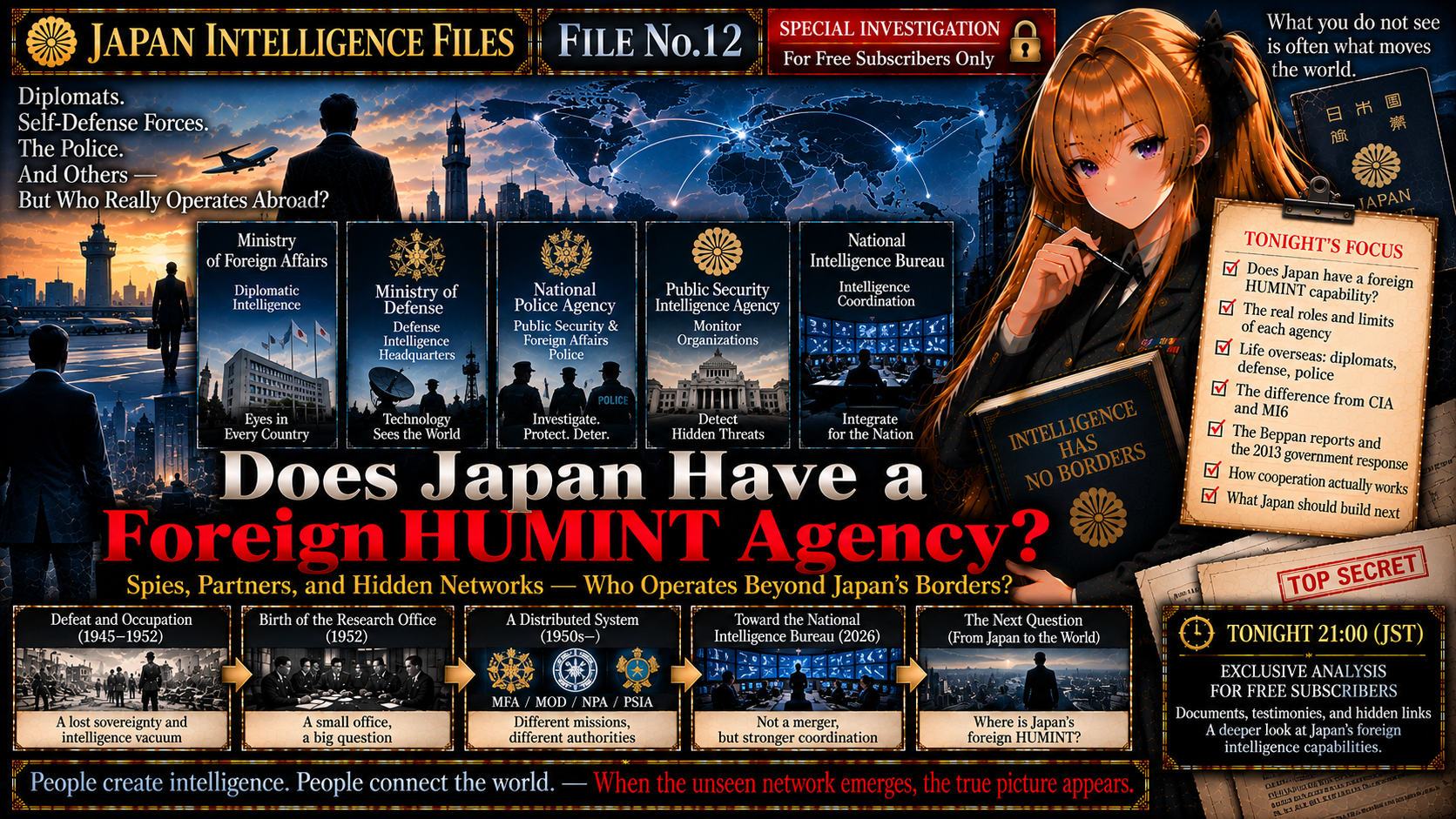
One Gap Remained on Japan’s Intelligence Map
Yesterday,
we placed the major organizations of Japan’s modern intelligence community on one map.
The National Intelligence Bureau.
Public-security police.
The Public Security Intelligence Agency.
The Ministry of Foreign Affairs.
The Defense Intelligence Headquarters.
Different institutions.
Different authorities.
Different missions.
But one question remained.
Who secretly collects intelligence from people abroad?
HUMINT.
Human intelligence.
The CIA has a Directorate of Operations.
Britain has MI6.
Who performs the equivalent function for Japan?
Japan Intelligence Files.
File No.12.
Today we enter the gap that has made the Beppan story so powerful.
What Is HUMINT?
HUMINT means intelligence obtained from human beings.
A satellite photograph is not HUMINT.
Intercepted electronic signals are not HUMINT.
A newspaper article is not HUMINT.
A person who knows something—
and provides information—
is.
But that definition immediately creates a problem.
A diplomat can obtain information from a government official.
A defense attaché can obtain military information from another officer.
A police investigator can obtain information from a source.
An intelligence case officer can secretly recruit someone inside a foreign government.
All involve human beings.
They are not the same activity.
Human Information Is Not Automatically Espionage
This distinction is fundamental.
Official diplomatic conversation can produce valuable human-source intelligence.
Military-to-military relationships can produce human-source intelligence.
Voluntary interviews can produce human-source intelligence.
None of those activities automatically means clandestine espionage.
Clandestine HUMINT is more specific.
It involves secretly obtaining protected information through human sources—
often sources who must conceal their cooperation.
The CIA Describes Its Role Very Clearly
The CIA publicly identifies its Directorate of Operations as the part of the Agency responsible for collecting human intelligence.
Its officers work overseas.
They identify sources.
They build human intelligence networks.
They obtain protected information.
The organization exists publicly.
Its detailed operations do not.
MI6 Is Even More Explicit
Britain’s Secret Intelligence Service openly states that its mission is to collect foreign intelligence.
Its public website explains that it recruits agents—
people with access to information Britain needs—
and asks them to secretly provide that information.
Their identities are protected.
The information is then assessed and supplied to government.
There is little ambiguity about which British institution performs foreign clandestine HUMINT.
Japan’s Public Organizational Chart Looks Different
Japan clearly has organizations that collect foreign information.
But its publicly acknowledged structure has historically lacked a single independent institution whose central advertised mission is comparable to MI6 or the CIA’s clandestine HUMINT function.
That distinction has been repeatedly identified in research on Japan’s intelligence system.
Japan does not lack human intelligence.
It has lacked a clearly designated independent foreign HUMINT service.
The Ministry of Foreign Affairs Has People Around the World
Start with Japan’s diplomatic network.
Embassies.
Consulates.
Permanent missions.
Diplomats speak with:
government officials,
politicians,
academics,
journalists,
business leaders,
foreign diplomats,
and international organizations.
Japan’s Intelligence and Analysis Service officially uses reporting from overseas diplomatic missions alongside open information,
other Japanese agencies,
and foreign governments.
That is a substantial foreign-information network.
Diplomats Are Not Automatically Spies
A diplomat normally operates under an acknowledged identity.
The host government knows that person represents Japan.
Meetings with officials are part of normal diplomatic work.
Information collection is therefore often overt.
That is fundamentally different from secretly recruiting a foreign official to steal classified information.
Both may provide human intelligence.
Only one is clandestine espionage.
Japan’s Defense Attachés Collect Military Intelligence Overseas
Japan also deploys Self-Defense Force officers to embassies as defense attachés.
The Ministry of Defense publicly says their principal task includes collecting military information.
They can obtain information through relationships with:
foreign armed forces,
defense ministries,
and other countries’ military attachés.
This is a powerful human network.
But Defense Attachés Are Acknowledged Officers
Their identity is not secret.
Their military rank is known.
They work from embassies.
They represent Japan openly.
This makes them a legitimate and important intelligence channel—
but not the same institution as a clandestine foreign service.
Japan’s Defense Policy Explicitly Mentions Human Intelligence
Japan’s defense planning documents also refer to strengthening capabilities across intelligence disciplines,
including:
signals intelligence,
imagery,
human intelligence,
and open-source intelligence.
This is important.
It means the claim that Japan simply “does not do HUMINT” is incorrect.
The more difficult question is how clandestine HUMINT responsibilities are distributed.
PSIA Has Also Described Human Intelligence Collection
Japan’s Public Security Intelligence Agency has historically described its collection approach in unusually direct language.
An official publication stated that its distinctive approach to domestic and international information involved voluntary investigative methods centered on human intelligence collection.
PSIA therefore provides another example of real Japanese HUMINT activity.
PSIA Is Not Japan’s MI6
Its legal role is different.
PSIA is an agency of the Ministry of Justice.
Its responsibilities include investigations related to public security,
extremist organizations,
international terrorism,
foreign security developments,
and other threats.
It is part of Japan’s intelligence community.
But it is not publicly defined as an independent general-purpose foreign clandestine service.
Then Came the National Intelligence Bureau
On July 31, 2026,
Japan established the National Intelligence Bureau.
The government explicitly states that the Bureau conducts information collection itself.
It also:
integrates information from other agencies,
conducts comprehensive analysis,
coordinates government intelligence activity,
and supports the National Intelligence Council.
Its organization includes:
Domestic,
International I,
International II,
Economic,
Analysis,
and Research divisions.
That is a major strengthening of Japanese intelligence.
Did the NIB Become Japan’s MI6?
Not according to its publicly stated mission.
The Bureau has its own collection authority.
But the government’s official material does not define it as an organization whose principal mission is secretly recruiting foreign human sources abroad.
And the Japanese government itself has made clear that intelligence reform did not end with the NIB.
The Government Says the Next Step Is Foreign Intelligence
On July 27, 2026,
Prime Minister Sanae Takaichi described the creation of the National Intelligence Council and National Intelligence Bureau as only the first step in Japan’s intelligence reform.
She specifically identified improvement of Japan’s foreign intelligence capabilities as a continuing priority.
That statement matters.
It suggests that the government does not consider the foreign-intelligence problem solved simply because the NIB now exists.
A “Foreign Intelligence Agency” Has Entered Real Policy Debate
Japan’s governing coalition agreement went further.
It included the objective of establishing an independent foreign intelligence agency—
a provisional “Foreign Intelligence Agency”—
by the end of fiscal year 2027.
That would represent a major institutional change.
But chronology matters.
As of September 2026, It Does Not Yet Exist
The proposed agency is still under consideration.
During Diet debate,
the government said it was examining relevant issues and institutional questions.
After the creation of the NIB,
the Prime Minister continued to describe stronger foreign intelligence capabilities as unfinished work.
Therefore:
The National Intelligence Bureau exists.
The proposed independent Foreign Intelligence Agency does not yet exist.
Japan May Be Trying to Fill the Very Gap That Created the Beppan Myth
This is where the story becomes fascinating.
For decades,
Japan’s foreign intelligence collection has been distributed among:
diplomats,
defense personnel,
police,
PSIA,
Cabinet intelligence,
and cooperation with allied services.
Yet Japan lacked an obvious MI6-like box on the chart.
That absence created space for another idea.
Beppan.
A secret organization operating abroad.
A structure not listed publicly.
An organization doing what the acknowledged system appeared unable to do.
But an Institutional Gap Is Not Proof of Beppan
This distinction cannot be skipped.
Japan lacked an independent foreign HUMINT service.
Therefore,
Beppan secretly performed that function.
The second statement does not follow automatically from the first.
In 2013,
the Japanese government formally denied that the reported
Ground Staff Office Operations Support and Intelligence Department “Beppan”
had ever existed in the Self-Defense Forces.
That remains part of the documentary record.
Yet the Government Clearly Conducts Foreign Intelligence Collection
The opposite claim is also wrong.
The government denied Beppan.
Therefore,
Japan collects no intelligence overseas.
No.
Diplomats collect information.
Defense attachés collect military information.
PSIA collects and analyzes international security information.
Defense intelligence obtains information through multiple sources.
The NIB now has its own collection mandate.
Japan is not an intelligence-free state.
Allied Intelligence Is Another Part of the System
Japan exchanges intelligence with friendly governments.
The Defense Intelligence Headquarters publicly lists exchanged intelligence as one of its sources.
The Foreign Ministry uses information obtained from foreign governments.
The U.S.-Japan alliance is particularly important.
But allied intelligence cannot eliminate the need for independent collection.
Allies Do Not Share Everything
Intelligence is power.
Governments protect their best sources.
They protect methods.
They protect information that serves uniquely national interests.
Japan may need information that an ally does not collect,
does not prioritize,
or does not wish to share.
That is one reason independent foreign intelligence capability matters.
Technology Cannot Answer Every Question
A satellite may show a missile.
Signals intelligence may reveal communications.
Open sources may show official statements.
But those tools may not answer:
Does the leadership actually intend to launch?
Who is winning an internal power struggle?
Is a government preparing to compromise?
What was secretly decided behind closed doors?
Sometimes only a person knows.
That is where HUMINT becomes uniquely valuable.
AI Will Not Eliminate the Human Problem
Modern intelligence increasingly uses:
AI,
satellites,
cyber tools,
massive databases,
and advanced sensors.
But political decisions are still made by human beings.
Human motives remain:
fear,
ambition,
money,
ideology,
revenge,
loyalty.
Understanding those motives—
and building relationships around them—
remains an intelligence skill no sensor can fully replace.
Fact, Interpretation, Urban Legend, and the Boundary
Documented facts:
Japan conducts human-source information collection through multiple acknowledged institutions and channels.
The Foreign Ministry relies partly on overseas diplomatic reporting.
Defense attachés openly collect military information overseas.
Japanese defense planning includes human intelligence among capabilities to be strengthened.
PSIA has publicly described human intelligence as a major feature of its investigative collection.
The National Intelligence Bureau now has authority to conduct information collection of its own.
—
Interpretation:
Japan’s long-standing weakness was not the total absence of HUMINT.
It was the absence of an independent,
clearly designated foreign clandestine HUMINT service comparable to MI6 or the CIA’s operational collection structure.
—
Current policy:
The Japanese government says foreign intelligence capability remains an area requiring further improvement.
The governing coalition has proposed establishing an independent foreign intelligence agency by the end of fiscal year 2027.
As of September 2026,
that agency has not yet been established.
—
Urban-legend claims:
Beppan has secretly performed Japan’s foreign HUMINT mission for decades.
The proposed Foreign Intelligence Agency is simply the public legalization of an already existing Beppan network.
—
Boundary of speculation:
No publicly available evidence currently establishes that the institutional gap in Japan’s foreign HUMINT architecture was secretly filled by the specific Beppan organization denied by the government.
Tomorrow — Returning to Beppan
We began this series with one question.
Does Beppan really exist?
Since then,
we have crossed:
Mantetsu,
tokumu kikan,
the Nakano School,
the 1945 defeat,
GHQ/G-2,
the Kawabe network,
the Canon Organization,
the Cabinet intelligence system,
the National Intelligence Bureau,
and Japan’s foreign HUMINT gap.
Tomorrow,
September 11,
we return to the original file.
The 2013 reporting.
The government’s denial.
Twenty-seven secondments.
One overseas assignment.
Wartime continuity claims.
Modern intelligence institutions.
And the proposed Foreign Intelligence Agency.
Japan Intelligence Files.
File No.13.
Beppan—
re-examined using everything we have found so far.
Next time—another fragment of truth we will trace together.
I will return to continue the telling.
References / Sources
Cabinet Secretariat — National Intelligence Council / National Intelligence Bureau
Official description of the NIB’s own information-collection authority, comprehensive analysis and government-wide coordination role.
Ministry of Foreign Affairs — Intelligence Collection and Analysis of International Affairs
Official description of overseas-mission reporting and all-source foreign-affairs intelligence.
Ministry of Defense — Japan’s Defense Attachés
Official explanation that military-information collection is a principal responsibility of defense attachés overseas.
Ministry of Defense — Defense Buildup Program
Official policy identifying human intelligence among the intelligence capabilities to be strengthened.
Public Security Intelligence Agency — Human Intelligence Collection
Japanese government material describing PSIA’s voluntary investigative collection as centered on human intelligence.
CIA — Directorate of Operations
Official U.S. description of clandestine HUMINT collection and human-source networks.
Secret Intelligence Service — What We Do
Official UK description of foreign intelligence collection and the recruitment and protection of agents.
Prime Minister’s Office — Prime Minister Takaichi Press Conference, July 27, 2026
Current government position identifying stronger foreign-intelligence capability as the next stage of reform.
Japan Institute of International Affairs — Japan’s 2026 Intelligence Reform
Analysis identifying the absence of an independent foreign HUMINT organization as a long-standing feature of Japan’s intelligence architecture.
Posting Time
English articles are published at 23:00 (JST).
Related Reading
The modern intelligence map that reveals where Japan’s foreign HUMINT gap appears.
Why postwar Japan developed a distributed system rather than a single CIA-style organization.
Human sources, foreign-affairs policing and overseas postings from the operational side.
The opening file and the original question created by Japan’s apparently missing foreign clandestine service.
Popular Posts
Submit an Urban Legend
Have a document, testimony or story involving Japanese foreign HUMINT, the proposed Foreign Intelligence Agency, defense attachés, the National Intelligence Bureau or Beppan? Send it through the blog contact page or comments, preferably with documentary sources.
Share & Follow
🌐 Blog Top 𝕏 Follow on X ▶ Follow on YouTube Share on Facebook Follow on Instagram
コメントを残す