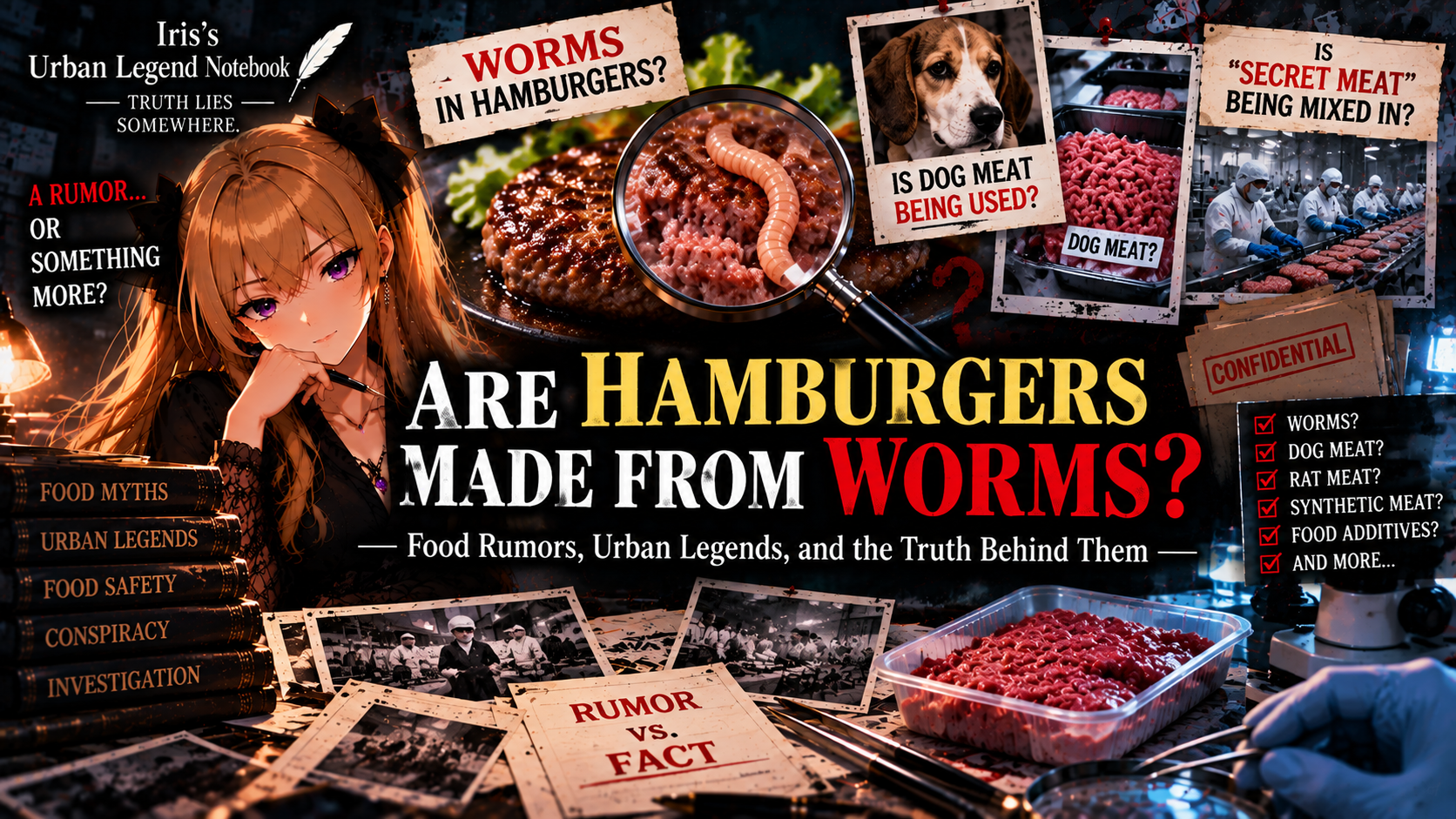
I am Iris.
Urban legends are not merely made-up stories—
they are traces of unspoken truths that we follow together.
“You Know What They Really Put in Those Burgers…”
Worms.
Dog meat.
Rat meat.
Cheap mystery meat hidden inside ground beef.
Food rumors often begin with the same idea: once meat has been ground, mixed, shaped and cooked, the customer can no longer see what it originally was.
So tonight we begin with the question at the heart of IRIS FILE:
Is it really true?
Before believing it—or laughing at it—let us check.
The Worm-Burger Rumor Predates the Modern Internet
The story is much older than social media.
A 1982 Christian Science Monitor article described a widely publicized 1978 rumor claiming that hamburgers were being made from worms. The story moved among several fast-food chains before becoming attached to one of the largest names in the business.
There was no Twitter.
No Facebook.
No TikTok.
No generative AI.
Yet the rumor spread.
People remembered hearing it on television. Someone knew somebody who worked at a factory. A friend had heard it from another friend.
The closer investigators moved toward the supposed original source, the less solid the story became.
It was classic urban-legend transmission.
What Do the Ingredients Actually Say?
McDonald’s Japan currently states that the beef patty in its standard hamburger uses 100% beef.
In the United States, the Department of Agriculture also regulates what can be sold as “hamburger” and “ground beef,” including rules on composition, fat content and labeling.
Japan likewise requires packaged processed foods to identify ingredients, including the types of meat used where applicable.
Regulation does not mean food fraud can never happen.
But if a company were secretly replacing enormous quantities of beef with worms or an undeclared animal species, the claim would need evidence capable of surviving inspection, supply-chain records and laboratory testing.
For the classic worm story, that evidence has not emerged.
What About Dog Meat?
Versions of the same story replace worms with dog meat.
The narrative is familiar:
someone who worked at a plant saw it,
a friend knows an insider,
or the company supposedly uses it because it is cheaper.
In the official product information and food-regulatory material reviewed for this article, I found no credible evidence establishing that ordinary burgers sold by major Japanese chains secretly contain dog meat.
It is also important not to confuse two completely different claims.
Dog meat has historically been consumed in some cultures.
That does not demonstrate that a particular restaurant secretly substitutes dog meat for beef.
The second claim requires evidence about that specific product and supply chain.
Why Ground Meat Is Perfect Material for a Rumor
A steak still looks like a piece of meat.
A whole fish still resembles the animal it came from.
Ground meat is different.
It is minced.
Mixed.
Seasoned.
Shaped.
Cooked.
Covered in sauce.
The original form disappears.
And the disappearance creates a psychological opening:
“Could they put anything in there?”
Worms.
Dogs.
Rats.
Unknown additives.
Synthetic fillers.
Once the original ingredient becomes visually invisible, the imagination can fill the empty space.
The Bigger the Brand, the Stronger the Story
The worm story did not stay attached to one small restaurant.
It migrated.
One chain became another.
One town became another.
The company name changed while the basic rumor survived.
That tells us something important.
Urban legends benefit from famous targets.
A global food company has factories, suppliers, warehouses and enormous distribution systems that ordinary customers cannot personally inspect.
That distance creates uncertainty.
And uncertainty creates room for stories.
But Real Food Fraud Does Exist
This is where the subject becomes more interesting.
The classic worm story is unsupported.
The dog-meat story is unsupported in the evidence reviewed here.
But the broader idea that a food labeled as one type of meat could contain another type of meat is not imaginary.
It has happened.
In 2013, authorities across Europe discovered undeclared horse meat in products sold as beef.
This was not a friend-of-a-friend story.
It was detected through laboratory testing.
So the correct lesson is not:
“Secret meat substitution is impossible.”
It is also not:
“Therefore every disgusting food rumor must be true.”
The lesson is simpler:
each claim has to be tested separately.
Why Food Legends Refuse to Die
Food rumors sit in an unusually powerful space.
We cannot personally inspect most supply chains.
Processed food hides its original form.
Real cases of fraud occasionally occur.
Large corporations feel distant.
And disgust is one of the strongest emotions for spreading a story.
That means even a rumor disproved decades ago can return with a new company name, a new photo or a new video.
The ingredients change.
The structure survives.
Iris’s Reading — Believe Less, Investigate More
The worm burger makes a great story.
The dog-meat burger makes an even more disturbing one.
But disturbing is not the same as documented.
The useful questions are ordinary ones.
Where did the claim begin?
Who performed the test?
Was a regulator involved?
Was a specific product or batch identified?
Was there a recall?
Can we find the original document?
Food science gives us something urban legends rarely do:
the ability to test the claim directly.
If another species is really present, DNA can leave evidence.
So the best response to a food rumor is not immediate belief.
It is not immediate ridicule either.
It is the question we started with:
Is it really true?
Then we investigate.
Next time—another fragment of truth we will trace together.
I will return to continue the telling.
Primary Sources & References
Source: Christian Science Monitor
Used for: Contemporary documentation of the widely circulated 1978 worm-hamburger rumor and the way it migrated among restaurant chains.
Source: McDonald’s Japan
Used for: Current Japanese product information stating that the hamburger’s beef patty uses 100% beef.
Source: United States Department of Agriculture
Used for: U.S. standards governing hamburger and ground beef, including composition and labeling.
Source: European Commission
Used for: The real European case in which undeclared horse meat was detected in foods marketed as containing beef.
Posting Time
Published October 5, 2026 at 23:00 JST.
Join Iris and investigate what lies beyond the rumors and mysteries.
Related Reading
Another consumer-product rumor showing how familiar brands can accumulate hidden meanings and persistent legends.
Forbidden buttons and products that should not exist: how ordinary consumer objects become urban legends.
A familiar place selling familiar food becomes strangely different after midnight.
A different kind of food investigation: separating real reserve policy from the larger story built around it.
Popular Posts
Submit an Urban Legend
Have you heard a strange food rumor, secret-ingredient story or consumer legend you would like Iris to investigate?
▶ Submit information or contact IrisShare & Follow
Return to the blog top page.
Latest articles and updates.
Share this article on Facebook.
Videos and related investigations.
Artwork, visuals and article updates.
コメントを残す