A quiet soundtrack for tonight’s investigation.
Press play and begin reading.
I am Iris.
Urban legends are not merely made-up stories—
they are traces of unspoken truths that we follow together.
What If an Ancient Vision Still Influences Modern Politics?
A valley filled with human bones.
A destroyed nation rising again.
A vast army advancing toward Israel.
A mysterious leader called Gog.
And a magnificent temple standing at the center of a restored land.
These images sound like the plot of an epic fantasy novel.
Yet they come from the Book of Ezekiel, one of the most remarkable prophetic books of the Hebrew Bible.
Written against the background of the Babylonian exile, Ezekiel describes destruction, judgment, restoration, warfare, and a radically transformed society.
For centuries, its visions have inspired theological debate.
But in the modern world, some interpreters have connected its imagery to contemporary geopolitics.
The establishment of the State of Israel in 1948.
Iran’s regional role.
Russia’s relationship with the Middle East.
The Temple Mount in Jerusalem.
And modern movements advocating the construction of a Third Temple.
These connections can appear unsettling.
But there is a fundamental question we must ask.
Did Ezekiel predict the modern Middle East, or have later generations interpreted modern events through Ezekiel’s ancient visions?
And there is another possibility.
What if religious interpretations of these visions influence political movements and government decisions today?
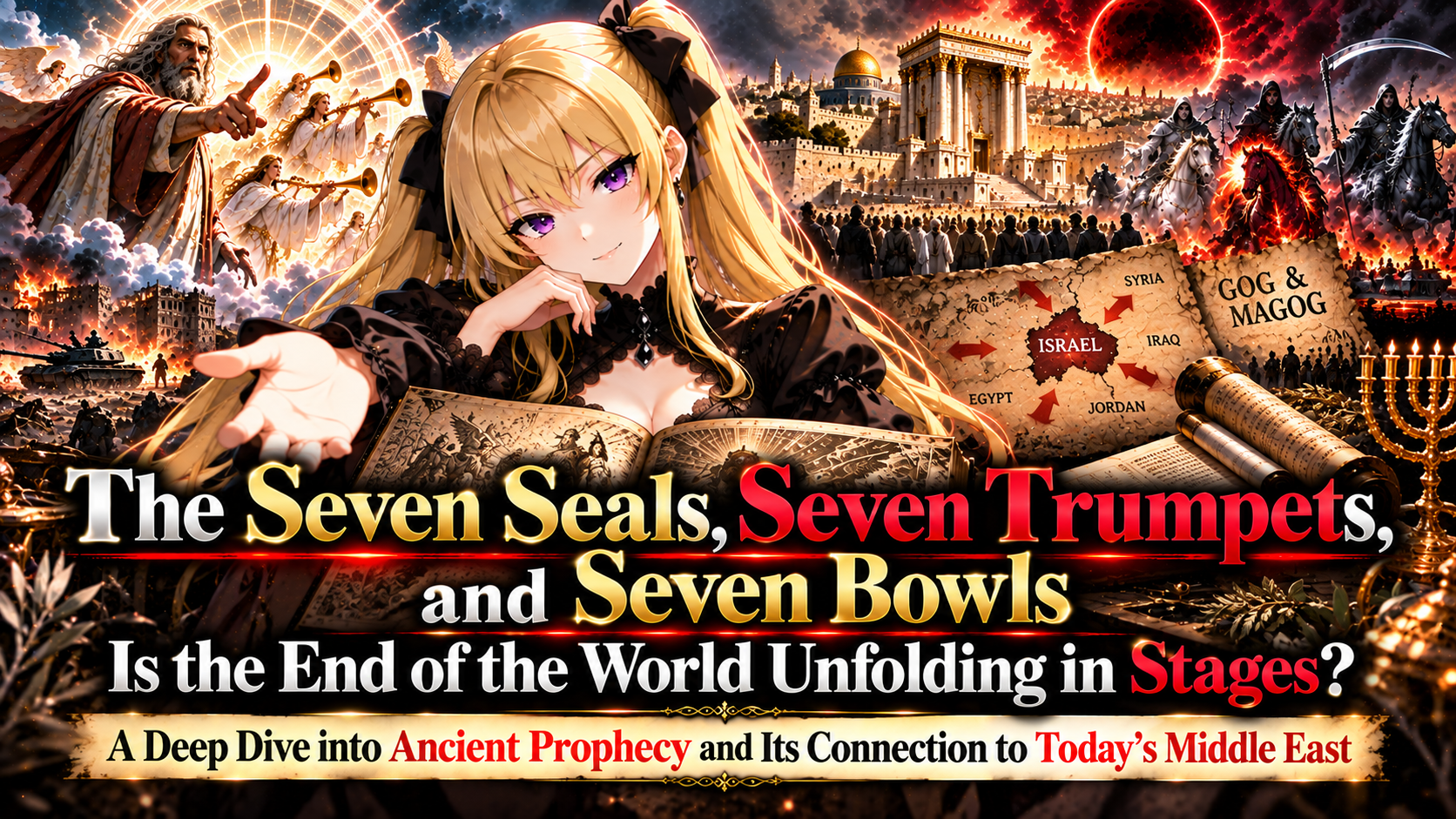
Tonight, we examine the Book of Ezekiel, its historical setting, the mystery of Gog and Magog, and the relationship between biblical prophecy and modern political behavior.
Chapter One | Ezekiel and the Destruction of Jerusalem
To understand Ezekiel, we must begin long before the establishment of the modern State of Israel.
The sixth century BCE.
The ancient kingdom of Judah stood under the growing power of the Neo-Babylonian Empire.
In 597 BCE, Babylonian forces captured Jerusalem, and King Jehoiachin surrendered.
Members of the royal household, military leadership, skilled workers, and other influential figures were deported to Babylonia.
Among the exiles was Ezekiel, a priest who became a prophet.
Jerusalem would later suffer another devastating conquest, and the Temple was destroyed.
For the people of Judah, the catastrophe represented more than political defeat.
Their monarchy had collapsed.
Their religious center had been destroyed.
Many had been separated from their homeland.
The future of their community seemed uncertain.
Ezekiel addressed a population confronting the possibility that its world had ended.
His prophecies initially emphasized judgment and responsibility.
But the later chapters increasingly turned toward restoration.
A renewed people.
A restored land.
A new covenantal order.
And a temple symbolizing divine presence.
This historical background matters.
Ezekiel was not originally writing a foreign-policy document for twenty-first-century governments.
He was speaking to communities experiencing the trauma of conquest and exile.
Chapter Two | The Valley of Dry Bones
Ezekiel Chapter 37 contains one of the most extraordinary visions in biblical literature.
The prophet is brought into a valley filled with dry bones.
The bones are scattered and lifeless.
Then a transformation begins.
Bones come together.
Sinews appear.
Flesh and skin cover them.
Finally, breath enters the bodies.
They rise and stand as a vast multitude.
What does this vision mean?
The text itself provides an explanation.
In Ezekiel 37:11, the bones are identified with the people of Israel, who believe their hope has disappeared.
The imagery therefore represents the restoration of a devastated community.
An important Hebrew word also appears in this passage.
Ruach.
Depending on context, it can mean breath, wind, or spirit.
The vision combines physical imagery with a theological message about renewed life.
Ezekiel’s message is not simply that the dead can rise.
It is that a people who believe their future has been destroyed may yet recover.
Was This Fulfilled in 1948?
Modern Christian end-times interpretations sometimes connect Ezekiel 37 to the establishment of the State of Israel on May 14, 1948.
At first glance, the comparison is understandable.
An ancient text describes the restoration of Israel.
A modern Jewish state emerges after centuries of Jewish dispersion and persecution.
But the correspondence is not as straightforward as it may appear.
Ezekiel does not specify the year 1948.
The text emerged from a sixth-century BCE context, not from the political institutions of the twentieth century.
The creation of modern Israel involved a complex history, including Zionism, the British Mandate, the Holocaust, international diplomacy, and the 1947 United Nations partition plan.
It also involved the displacement of large numbers of Palestinians, an event remembered by Palestinians as the Nakba.
These historical developments cannot be reduced to a single biblical prediction.
The ancient restoration vision and the creation of a modern nation-state are not identical historical processes.
Nevertheless, the interpretation remains influential in some religious communities.
That influence is itself worth studying.
Chapter Three | Gog and Magog: An Ancient War Reimagined
Ezekiel Chapters 38 and 39 introduce a mysterious figure called Gog.
Gog is associated with the land of Magog and leads a coalition of forces against Israel.
The text names several ancient peoples or regions.
Persia.
Cush.
Put.
Gomer.
Beth-togarmah.
Meshech.
Tubal.
In modern prophecy discussions, these names are sometimes mapped onto contemporary states.
Persia becomes Iran.
Northern forces become Russia.
Other ancient names are associated with parts of North Africa or Anatolia.
This creates a dramatic geopolitical picture.
But does the ancient text justify these exact identifications?
The Persia–Iran Connection
Ancient Persia is historically connected with the region that includes modern Iran.
This is a genuine geographical and historical relationship.
However, the ancient Persian world was not identical to the modern Islamic Republic of Iran.
Political systems, territories, populations, and international relationships have changed enormously.
The presence of Persia in Ezekiel does not establish that the text specifically describes the current Iranian government.
The Russia Interpretation
Another popular interpretation identifies Gog’s northern forces with Russia.
Some versions of this theory connect the names Rosh, Meshech, and Tubal to modern geographical names.
But these claims face serious linguistic problems.
The Hebrew term sometimes rendered as Rosh can also function as a word meaning chief or head.
Different translations therefore handle the passage differently.
The similarity between an ancient name and a modern country’s name is not sufficient to establish historical continuity.
There is no sound basis for treating an apparent similarity of names as definitive proof that Ezekiel predicted the modern Russian state.
The Problem With Modern Maps
Ancient geographical names existed in different political and cultural contexts.
Their boundaries did not correspond to modern national borders.
Some referred to regions.
Others referred to peoples.
Others remain uncertain.
This creates a problem for any attempt to place Gog’s coalition directly onto a modern political map.
The more precise the modern identification becomes, the stronger the evidence must be.
Chapter Four | The Details Often Missing From Gog and Magog Theories
An important part of Ezekiel’s narrative appears in Chapter 39.
After Gog’s defeat, the text describes what happens to the invading army.
Weapons are gathered and burned.
The process continues for seven years.
The dead are buried, and the cleansing of the land takes seven months.
These details matter.
Many modern interpretations emphasize the countries believed to be involved in the invasion.
Fewer examine how the aftermath is described.
The weapons include ancient military equipment.
Bows.
Arrows.
Shields.
Spears.
If the passage is interpreted as a literal description of a modern war, how should these details be understood?
One possibility is that the author used the weapons familiar to his own time.
Another is that the imagery is symbolic.
But interpreters must apply a consistent method.
It is difficult to insist that the countries are literal modern nations while treating inconvenient military details as purely symbolic without explaining the difference.
The same problem occurs with the numbers.
Seven years.
Seven months.
Are these exact durations?
Or do they have symbolic significance within the literary structure?
These questions show why Gog and Magog cannot responsibly be reduced to a simple prediction of a particular modern military conflict.
Chapter Five | Gog and Magog in the Book of Revelation
The mystery deepens when we turn to Revelation Chapter 20.
Gog and Magog appear again.
But the context is different.
In Revelation, Satan is released after the period associated with the thousand-year reign.
He deceives the nations and gathers them for a final confrontation.
The names Gog and Magog are used within this apocalyptic vision.
The connection with Ezekiel is obvious.
But the two accounts do not describe their conflicts in exactly the same way.
In Ezekiel, Gog is the leader associated with Magog.
In Revelation, Gog and Magog function more broadly as symbols connected with the nations assembled for battle.
Their placement within the narratives also differs.
This suggests that Revelation uses imagery inherited from the older prophetic tradition.
It does not automatically prove that the authors independently predicted the same twenty-first-century conflict.
Ancient religious literature often reused powerful names and symbols.
That process can create similarities without implying a hidden historical timetable.
Chapter Six | The Third Temple: Vision or Architectural Blueprint?
The final chapters of Ezekiel contain another remarkable vision.
Chapters 40 through 48 describe a restored Temple and a transformed land.
The level of detail is striking.
Gates.
Courtyards.
Measurements.
Priestly responsibilities.
Sacred spaces.
Land allocations.
At first glance, the passage resembles an architectural plan.
Could it be describing a future Third Temple?
That question has become particularly important in modern religious and political discussions.
The Historical Temples
The First Temple was destroyed by the Babylonians in the sixth century BCE.
The Second Temple was eventually destroyed by Roman forces in 70 CE.
The term Third Temple generally refers to the possibility of a future temple in Jerusalem.
Some religious activists advocate its construction.
Modern organizations have published plans and educational materials concerning the idea.
These movements are real.
But their existence does not establish that a government has formally adopted Ezekiel’s vision as a construction project.
That distinction is essential.
The Temple Mount
The location traditionally associated with the ancient Jewish temples remains one of the world’s most sensitive religious sites.
For Jews, the Temple Mount has profound historical and spiritual significance.
For Muslims, the same area is known as Al-Haram al-Sharif and contains the Al-Aqsa Mosque and the Dome of the Rock.
The site is central to multiple religious traditions.
Any attempt to alter its status carries serious religious and political implications.
It would therefore be misleading to treat Third Temple construction as a purely technical building project.
It involves complex questions of religious rights, heritage, security, international relations, and political authority.
Chapter Seven | What Does Ezekiel’s Temple Actually Represent?
Biblical scholarship offers several approaches to Ezekiel’s Temple vision.
Some interpret it as a future physical sanctuary.
Others understand it primarily as an idealized religious vision.
Still others read it typologically, connecting its imagery with broader theological themes of renewal and divine presence.
The disagreement is important.
The text contains measurements, but it also contains imagery that moves far beyond ordinary architecture.
In Ezekiel Chapter 43, God’s glory returns to the Temple.
In Chapter 47, water flows outward from the sanctuary.
The water brings life to the surrounding land.
Trees grow along its banks.
Their fruit provides food, and their leaves are associated with healing.
Finally, Chapter 48 ends with a remarkable name for the restored city.
“The LORD is there.”
The vision therefore culminates not merely in a completed building, but in the restoration of divine presence among the people.
That is a profoundly theological conclusion.
The detailed land allocation in Chapter 48 is also highly idealized.
It does not simply reproduce the geography or political boundaries of modern Israel.
Reading it as a literal contemporary land-management plan would ignore much of its symbolic structure.
Chapter Eight | Christian Zionism and Political Influence
There is, however, an important way in which ancient religious texts can affect modern geopolitics.
People may act on their interpretations.
Christian Zionism provides a clear example of religion interacting with political activism.
The term refers to Christian movements that support Israel for reasons connected to biblical interpretation or religious conviction.
One prominent organization is Christians United for Israel, commonly known as CUFI.
Founded in 2006 by Pastor John Hagee, CUFI publicly describes its mission as organizing Christian support for Israel.
Its activities include education, advocacy, and engagement with political institutions.
The organization has published records of campaigns directed toward American policymakers.
This demonstrates that religiously motivated political activism can influence political debate.
But another distinction is necessary.
Supporting Israel is not equivalent to attempting to trigger a biblical war.
Believing in prophecy does not automatically imply support for violence.
Christian Zionist movements also differ in their interpretations and political priorities.
It would be inaccurate to treat all Christians, Jews, Israelis, or supporters of Israel as sharing one apocalyptic political program.
The relevant question is narrower.
Can we identify specific instances in which a particular biblical interpretation directly influenced a specific political decision?
That requires statements, documents, advocacy records, and evidence of policy impact.
It cannot be established through symbolism alone.
Chapter Nine | Three Different Claims That Must Not Be Confused
The debate over Ezekiel often moves between three very different claims.
The first is historical.
Ancient religious texts exist and contain visions of restoration, conflict, and a new Temple.
This is firmly established.
The second concerns interpretation and political activity.
Some modern religious movements connect those texts with contemporary Israel and participate in political advocacy.
This can also be documented.
The third is much stronger.
A coordinated group is deliberately causing wars in order to fulfill Ezekiel’s prophecy.
That allegation would require specific evidence of planning and implementation.
The first two claims do not automatically prove the third.
This is the same distinction we encountered when examining modern strategic documents.
A published proposal is not necessarily a government order.
A political movement is not necessarily a covert operation.
A historical resemblance is not necessarily a causal relationship.
The strength of an investigation depends on maintaining those distinctions.
Final Chapter | Did Ezekiel Predict the Future—or Give Hope to the Exiled?
We began with a valley of bones.
A mysterious northern enemy.
A restored nation.
And an extraordinary new Temple.
Placed beside modern Middle Eastern politics, the imagery can feel prophetic.
But the original historical context changes the picture.
Ezekiel emerged from a world devastated by imperial conquest.
The people who preserved these visions were not rulers attempting to dominate the world.
They were members of a community struggling to imagine a future after national catastrophe.
The restoration of Israel was not merely a political ambition.
It was a religious vision of renewed identity, divine presence, and communal life.
Gog and Magog represented the threat of powerful enemies.
The Temple represented a restored relationship between God and the people.
The transformed land expressed an ideal of order after destruction.
Later generations interpreted these visions through their own historical experiences.
Some associated them with modern Israel.
Others placed them within expectations of the end times.
Modern political movements have also drawn on biblical ideas when arguing about Israel’s future.
But the available evidence does not establish that Ezekiel was written as a secret military blueprint for the modern Middle East.
Perhaps the more interesting question is how religious expectations shape political imagination.
A sacred text offers a vision of the future.
People interpret that vision.
They organize around it.
They advocate for policies.
And sometimes those policies influence the world.
A prophecy may not need to be supernatural to become politically consequential.
Did Ezekiel foresee the future?
Or have generations of believers helped shape the future through the way they understand Ezekiel?
The difference matters.
Because a text originally associated with hope for displaced people can acquire entirely new meanings when interpreted through the politics of later centuries.
That may be the most unsettling part of the story.
Tomorrow, our investigation turns from ancient prophecy to modern strategic documents.
A Clean Break.
The Project for the New American Century.
Wesley Clark’s seven-country testimony.
And the relationship between religious expectations and foreign policy.
What happens when visions of the future meet institutions capable of changing it?
The investigation continues.
And I will return to continue the telling.
Primary Sources & References
Source: United States Conference of Catholic Bishops
Used for: The Babylonian exile, Ezekiel’s historical setting, and the structure of the book.
▶ Read the IntroductionSource: USCCB / Old Testament
Used for: The Valley of Dry Bones, the meaning of ruach, and Israel’s restoration.
▶ Read Chapter 37Source: USCCB / Old Testament
Used for: Gog, Magog, Persia, Cush, Put, and the ancient coalition.
▶ Read Chapter 38Source: USCCB / Old Testament
Used for: The defeat of Gog, the burning of weapons, the burial of the dead, and Israel’s restoration.
▶ Read Chapter 39Source: USCCB / Old Testament
Used for: The Temple vision, its structure, divine presence, and idealized land allocation.
▶ Read Chapter 40▶ Read Chapter 48
Source: USCCB / New Testament
Used for: Gog and Magog within the apocalyptic narrative of Revelation.
▶ Read Revelation 20Source: CUFI / Official Organization Website
Used for: John Hagee, the organization’s mission, and its political advocacy.
Source category: Organizational statement and activity record.
▶ Read the Official MissionSource: Third Temple Advocacy Organization
Used for: The existence of modern religious activism supporting Third Temple construction.
Source category: Advocacy material, not evidence of an authorized government construction project.
▶ Explore the ProjectSource: UNESCO World Heritage Centre
Used for: The historical and religious significance of Jerusalem to Judaism, Christianity, and Islam.
▶ Read the UNESCO DescriptionPublished October 14, 2026 at 23:00 JST.
English Edition | Secretary Iris Urban Legend Notebook
♫ IRIS FILE — Official Theme Song
Every investigation begins with a question: Is it really true?
Related Reading
▶ Did the Bible Predict the Vaccine Passport Society? — Revelation 13 and the Mark of the Beast
▶ 666, 33, and 13 — Why Do Certain Numbers Feel Ominous?
▶ Did The World Ahead 2026 Predict the World? — Reopening the Cover Nine Months Later
▶ The Armitage–Nye Reports: Policy Advice or a Blueprint for Japan?
コメントを残す