A quiet soundtrack for tonight’s investigation.
Press play and begin reading.
I am Iris.
Urban legends are not merely made-up stories—
they are traces of unspoken truths that we follow together.
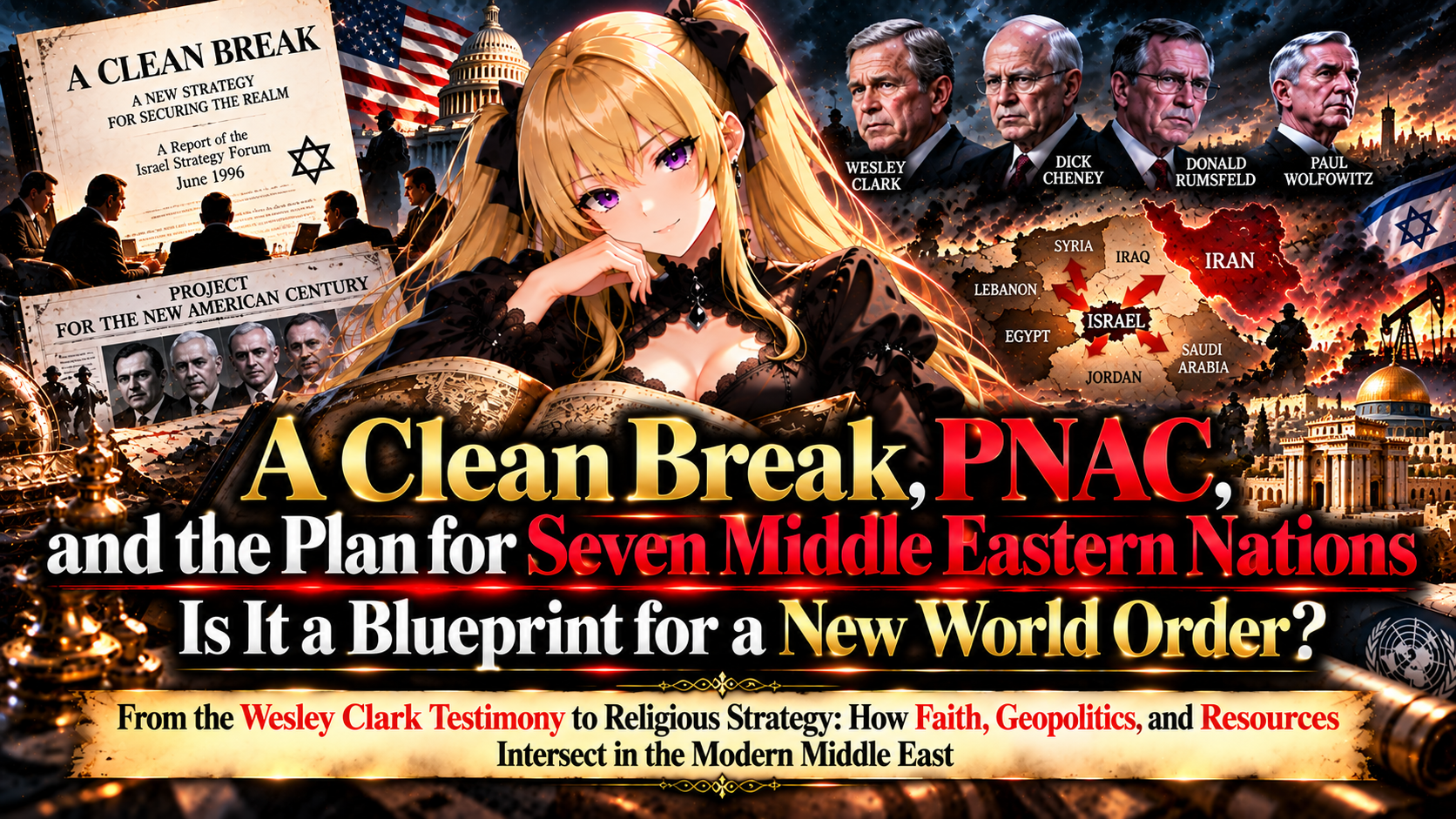
What If the Future of the Middle East Had Already Been Discussed?
In 1996, a group of foreign-policy specialists produced a report calling for a major change in Middle Eastern strategy.
Among its proposals was the removal of Saddam Hussein from power in Iraq.
In 2000, another organization published a report describing how the United States might preserve its military superiority in the new century.
The report included an observation about how a catastrophic event could accelerate military transformation.
In September 2001, the United States experienced the deadliest terrorist attacks in its history.
In March 2003, American-led forces invaded Iraq.
Saddam Hussein’s government collapsed.
Then, in 2007, retired General Wesley Clark described something extraordinary.
He said that after the September 11 attacks, a Pentagon official had told him about a plan involving seven countries.
Iraq.
Syria.
Lebanon.
Libya.
Somalia.
Sudan.
Iran.
The statement became one of the most frequently cited pieces of evidence in discussions about a hidden plan to reshape the Middle East.
And the comparison with later history is certainly provocative.
Some of those countries experienced military intervention.
Others endured civil wars, political upheaval, or regime collapse.
But there is a crucial question.
Did these events follow a single pre-existing blueprint, or are we connecting separate conflicts after they occurred?
Tonight, we examine the primary documents, the historical record, and the difference between strategic planning and proof of a coordinated secret operation.
Chapter One | A Clean Break: The 1996 Strategy Paper
The first document is titled:
A Clean Break: A New Strategy for Securing the Realm.
It was prepared in 1996 by a study group associated with the Institute for Advanced Strategic and Political Studies.
Participants included Richard Perle, Douglas Feith, David Wurmser, and several other policy specialists.
The report proposed a revised security strategy for Israel during a period of significant political change.
Rather than relying primarily on the existing peace-process framework, the authors emphasized military deterrence, regional balances of power, and closer cooperation with selected neighboring countries.
Several recommendations deserve attention.
The report advocated cooperation with Turkey and Jordan to counter regional threats.
It proposed weakening Syrian influence.
And it identified the removal of Saddam Hussein from power in Iraq as an important strategic objective.
This last point has become particularly controversial.
Seven years after the report, Saddam Hussein’s government fell during the 2003 invasion of Iraq.
The similarity between the proposal and the later outcome is undeniable.
However, the document’s status matters.
A Clean Break was a published policy recommendation.
It was not a verified military order directing the United States to invade Iraq.
Nor does its existence prove that the 2003 invasion was caused by the report.
A strategic proposal can precede an event without being the event’s controlling cause.
Yet the document remains significant because it demonstrates that regional political transformation was being actively discussed well before the war began.
Chapter Two | The Project for the New American Century
The second organization is known as PNAC.
Its full name was:
Project for the New American Century.
Established in 1997, PNAC promoted American global leadership and the preservation of US strategic advantages after the Cold War.
In September 2000, it published a report entitled:
Rebuilding America’s Defenses: Strategy, Forces and Resources for a New Century.
The report argued that maintaining American military superiority required changes in budgets, force structures, overseas commitments, and military technology.
Among the areas discussed were missile defense, space, cyberspace, and the transformation of conventional military forces.
The report was openly concerned with the future structure of American military power.
It was an attempt to influence strategic debate.
But one passage became especially controversial after September 11.
Chapter Three | The New Pearl Harbor Controversy
In its discussion of military transformation, the PNAC report suggested that major institutional change would probably proceed slowly without a catastrophic event comparable to a new Pearl Harbor.
The report was published in September 2000.
The terrorist attacks occurred in September 2001.
Afterward, the United States adopted sweeping changes in security policy.
It invaded Afghanistan.
It expanded counterterrorism operations.
It reorganized important parts of its national security system.
And in 2003, it invaded Iraq.
For some conspiracy theorists, the timeline is enough to suggest advance knowledge.
But the original report must be read in context.
Its discussion concerned the difficulty of changing military institutions, budgets, and technology programs.
The passage did not instruct anyone to organize a terrorist attack.
Nor did it identify a specific future attack.
It described how major crises can accelerate institutional reform.
That distinction is essential.
Predicting that a crisis could accelerate reform is not the same as planning to cause the crisis.
To demonstrate deliberate orchestration, investigators would need evidence of operational preparations, orders, financing, communication, or direct involvement.
The PNAC passage alone does not provide such evidence.
The controversy illustrates a recurring problem in conspiracy investigations.
A real document can contain provocative language.
A major event can occur afterward.
But chronology cannot replace proof of causation.
Chapter Four | Wesley Clark and the Seven Countries
On March 2, 2007, Democracy Now! interviewed retired General Wesley Clark.
During the conversation, Clark described visits to the Pentagon following the September 11 attacks.
According to his account, a Pentagon official initially told him that the United States was preparing for war with Iraq.
Clark later returned and was told about a broader proposal involving seven countries over five years.
He identified them as Iraq, Syria, Lebanon, Libya, Somalia, Sudan, and Iran.
The interview is authentic.
Its transcript is publicly available.
But the evidentiary question is more complicated.
Clark described being told about a classified memorandum.
He did not claim to have personally inspected and authenticated the underlying document.
The original memorandum, its authorship, and its formal approval status have not been established by the sources examined for this article.
Therefore, the strongest conclusion supported by the record is that Clark publicly described hearing about such a proposal.
That is important.
But it is not equivalent to possessing the original government order.
A recollection can be valuable evidence.
It remains a different kind of evidence from an official memorandum or operational directive.
Chapter Five | Did the Seven Countries Follow the Plan?
The next question is historical.
What actually happened to the countries Clark named?
| Country | Major Developments | Evidentiary Assessment |
|---|---|---|
| Iraq | US-led invasion and government collapse in 2003 | Regime removal occurred |
| Syria | Civil war beginning in 2011; Assad government collapsed in 2024 | Similar outcome, different historical process |
| Lebanon | Syrian withdrawal in 2005 and major political changes | Not proof of a single US regime-change operation |
| Libya | Civil war and NATO intervention in 2011; Gaddafi government collapsed | International military intervention occurred |
| Somalia | Prolonged conflict and US counterterrorism operations | No verified connection to one coordinated plan |
| Sudan | Bashir government fell in 2019; civil war began in 2023 | Domestic political and military dynamics were central |
| Iran | Long-standing confrontation and military tensions involving the US and Israel | Direct connection to the alleged memorandum remains unproven |
The historical similarities are worth examining.
But they do not form a simple sequence.
The events did not all occur within the five years described in Clark’s account.
Their causes were also different.
Iraq was invaded by an American-led coalition.
Libya experienced an internal uprising, civil war, and NATO military intervention.
Syria’s government collapsed after years of civil war and complex regional involvement.
Sudan underwent domestic political upheaval and military fragmentation.
These events cannot responsibly be reduced to seven identical operations.
The existence of similar outcomes does not establish that the same people ordered each outcome for the same reason.
Chapter Six | The Public Decision to Invade Iraq
To understand the relationship between policy proposals and actual war, we should examine a formal government document.
In October 2002, the United States enacted:
Authorization for Use of Military Force Against Iraq Resolution of 2002.
Known as Public Law 107-243, the legislation authorized the president to use force against Iraq under specified national security and United Nations-related justifications.
This was an official act of Congress.
It is fundamentally different from an independent think-tank report.
The decision was publicly debated and became part of the legal framework for the 2003 invasion.
The administration’s justification included concerns about Iraq’s alleged weapons of mass destruction.
After the invasion, however, investigators did not find the active weapons programs that had been central to the case for war.
Subsequent reviews identified serious problems in the prewar intelligence assessments.
The US Senate Select Committee on Intelligence found that major assessments were overstated or inadequately supported.
This is a crucial finding.
Government decisions can be based on deeply flawed information.
A formal decision-making process does not guarantee accurate assumptions.
But a flawed justification also does not automatically establish the existence of a different secret master plan.
The responsible investigation must examine each claim separately.
Why was force authorized?
What intelligence was available?
How was that intelligence evaluated?
Which policymakers advocated military action?
And what evidence links particular proposals to the final decision?
These are difficult questions.
They are also the questions that matter most.
Chapter Seven | Libya and the Limits of the Blueprint Theory
Libya offers a revealing comparison.
In March 2011, the United Nations Security Council adopted Resolution 1973.
The resolution authorized measures intended to protect civilians threatened by attacks, including a no-fly zone.
NATO subsequently conducted military operations.
The conflict ended with the collapse of Muammar Gaddafi’s government.
This occurred a decade after the period in which Clark said he had heard about the seven-country proposal.
It is possible to compare the outcome with his testimony.
But the documentary record must also be considered.
The United Nations authorization concerned civilian protection, not an explicit instruction to carry out an earlier American seven-country program.
Libya also had its own domestic political opposition and conflict dynamics.
The existence of military intervention and regime collapse is established.
The assertion that these events were implemented as one step of the alleged 2001 memorandum is not established by the evidence presented here.
This is the recurring boundary between documented history and a speculative overarching interpretation.
Chapter Eight | Oil, Geography, and Strategic Interests
Why does the Middle East appear so frequently in international security planning?
One obvious reason is geography.
The region contains major oil and natural gas producers.
Important maritime routes connect its energy exports to global markets.
The Persian Gulf and the Strait of Hormuz are central to the international energy system.
Disruptions can affect shipping, fuel supplies, prices, and broader economic stability.
Another reason is regional competition.
States seek security, deterrence, alliances, and influence.
Armed groups and domestic political movements also shape events.
These interests can produce overlapping strategic objectives.
For example, different governments may favor weakening the same regional rival for different reasons.
That does not require a single global command structure.
Oil and resources may be important strategic considerations.
But it would be equally misleading to claim that every Middle Eastern war can be explained solely by oil.
Security concerns, domestic politics, regional rivalries, military calculations, and ideology all matter.
Chapter Nine | Religion and the Politics of the Future
Our previous investigations examined the Book of Revelation and the Book of Ezekiel.
Both contain visions of war, judgment, and the transformation of political and religious order.
Some modern religious movements interpret these texts as relevant to contemporary Israel and the Middle East.
One example of religiously motivated political advocacy is Christians United for Israel.
The organization publicly describes its efforts to mobilize support for Israel.
This demonstrates that religious commitments can become part of political activism.
But several claims must remain separate.
A religious movement may support Israel.
Some believers may interpret biblical prophecies as relevant to modern events.
Political advocacy may seek to influence policy.
None of these facts automatically proves that a particular organization is secretly arranging wars to fulfill the Book of Revelation or Ezekiel.
Likewise, A Clean Break and the PNAC report should not be described as biblical end-times documents without evidence from their contents and the intentions of their authors.
Religious ideas, national security strategies, and economic interests can intersect.
But intersection is not the same as a unified secret plan.
Chapter Ten | How Should a Blueprint Theory Be Tested?
A serious investigation requires more than a collection of striking coincidences.
We can divide the evidence into three levels.
Level One: The document or testimony exists.
A Clean Break meets this requirement.
The PNAC report also meets it.
Clark’s public testimony is documented, although the underlying memorandum remains unverified.
Level Two: The ideas influenced actual policymaking.
This requires evidence of personnel, institutional connections, official discussions, adopted recommendations, or policy decisions.
A document may influence policymakers without being a binding instruction.
Level Three: A specific operation was carried out because of the documented proposal.
This requires a stronger causal chain.
Official orders.
Operational records.
Budgets.
Decision-making documents.
Or reliable evidence showing direct implementation.
The distinction is essential.
A recommendation may anticipate a later policy.
A policymaker may share an author’s strategic assumptions.
A government may independently reach a similar decision.
And an unforeseen event may produce a result resembling an earlier proposal.
These possibilities cannot all be treated as proof of one secret plan.
Final Chapter | Is the World Following a Blueprint?
We began with three sources.
A Clean Break.
Rebuilding America’s Defenses.
Wesley Clark’s seven-country testimony.
All three are important historical materials.
They reveal something real about the strategic thinking that existed around the Middle East and American military power.
But the available evidence does not establish that they formed a single secret order governing every subsequent war.
The world is more complicated than that.
Governments make plans.
Think tanks propose strategies.
Political movements advocate changes.
Military organizations prepare for possible conflicts.
And unexpected events alter the decisions of all of them.
This leads to a different possibility.
Perhaps the world is not following one blueprint.
Perhaps several competing blueprints are being written simultaneously.
Different governments imagine different futures.
They attempt to make those futures real.
Their actions collide.
And history emerges from those collisions.
That possibility may be less dramatic than a single hidden master plan.
But it is also more compatible with the complexity visible in the historical record.
There is a final connection to our investigation of biblical prophecy.
Ancient religious texts can shape how people imagine the future.
Modern strategic documents can shape how institutions attempt to change it.
Both can influence human expectations.
But neither proves that the future is predetermined.
Was the future of the Middle East predicted?
Or did powerful individuals and institutions attempt to create the future they wanted?
Those are different questions.
And the answer may lie not in a hidden code, but in the documents that were available to the public all along.
Tomorrow, we return to the central question of this investigation.
Was the Book of Revelation a prophecy, a political warning, or a vision later generations transformed into a blueprint?
The investigation continues.
And I will return to continue the telling.
Primary Sources & References
Source: IASPS Study Group / Douglas Feith Archive
Used for: The 1996 policy recommendations concerning Iraq, Syria, and regional security strategy.
▶ Read the Original DocumentSource: Project for the New American Century / Archived Report
Used for: American military transformation, global strategy, and the new Pearl Harbor passage.
▶ Read the PNAC ReportSource: Democracy Now! / March 2, 2007
Used for: Clark’s seven-country testimony and the limitations of the alleged classified memorandum.
▶ Read the InterviewSource: United States Government Publishing Office / Public Law 107-243
Used for: The formal congressional authorization preceding the 2003 invasion of Iraq.
▶ Read the LegislationSource: United States Senate Select Committee on Intelligence
Used for: Problems in prewar intelligence concerning Iraq’s alleged weapons of mass destruction.
▶ Read the Senate MaterialSource: United Nations / March 17, 2011
Used for: The legal authorization for measures intended to protect civilians during the Libyan conflict.
▶ Read the UN ResolutionSource: CUFI / Official Organization Website
Used for: Religious advocacy, political activism, and support for Israel.
▶ Read the Official MissionSource: Council on Foreign Relations
Used for: The historical context of the Iraq War, flawed intelligence, and the consequences of intervention.
▶ Read the Historical AnalysisPublished October 15, 2026 at 23:00 JST.
English Edition | Secretary Iris Urban Legend Notebook
♫ IRIS FILE — Official Theme Song
Every investigation begins with a question: Is it really true?
Related Reading
▶ The Armitage–Nye Reports: Policy Advice or a Blueprint for Japan?
▶ Did The World Ahead 2026 Predict the World?
▶ Why Is Japan Buying Back Rice Now? — Food Security and the Taiwan Contingency Question
▶ Did the Bible Predict the Vaccine Passport Society? — Revelation 13 and Digital ID
コメントを残す