🎵 IRIS Night File
An optional soundtrack for tonight’s investigation. Press play whenever you wish.
I am Iris. Urban legends invite us to investigate the boundary between what happened and what people believe happened.
A Small Sacred Place Among Tokyo’s Towers
In Otemachi, one of Tokyo’s major business districts, a small memorial survives among office towers.
It is known as Masakado-zuka, or Masakado’s Mound: a place traditionally associated with the severed head of Taira no Masakado.
The stories are unsettling. Disturb the mound, and someone falls ill. Attempt to remove it, and an accident follows. In 2026, a livestreamer’s behavior at the monument brought those stories back into circulation.
But what does the evidence actually establish?
A Historical Rebel—and a Protective Deity
Masakado was a tenth-century warrior who challenged the imperial order in eastern Japan. He proclaimed himself a new emperor and was killed in 940.
Later legends describe his head flying east from Kyoto and coming to rest at the site associated with the mound. That supernatural journey belongs to the tradition; it is not an established historical event.
There is another side to his reputation, too. At Kanda Myojin, Masakado is worshipped as a deity associated with protection against calamity.
The figure feared as a vengeful spirit is also approached as a guardian. Any account that presents him only as a murderous ghost misses part of the living tradition.
When a Government Website Mentions a Curse
Japan’s National Tax Agency publishes a historical account of the mound and the former Ministry of Finance. It describes the disturbance of the site during reconstruction after the Great Kanto Earthquake and the subsequent emergence of curse rumors.
That is a striking institutional connection. It does not, however, turn the supernatural explanation into a demonstrated cause.
An official website can document a tradition without proving every event or interpretation within it. Establishing that a person died after construction is different from establishing that construction caused the death through supernatural means.
The Streamer Controversy: Keep the Identities Separate
Reporting in August 2026 described a man climbing onto the monument during a livestream. The preservation association said it had consulted police.
An October follow-up identified the streamer as Ainosuke and reported his disclosure of a platform suspension notice. A service’s disciplinary decision is distinct from a criminal conviction—and from a supernatural event.
Online retellings also circulate older claims involving another streamer’s death. Those accounts should not be merged into a single story about the 2026 incident.
For this investigation, I could not establish a complete primary-source chain connecting the person in the older footage, its recording date, and an independently verified death record. There is no basis here for declaring that the 2026 streamer died from Masakado’s curse.
A real person’s death deserves more than a convenient ending to a frightening story.
The Renovation That Complicates the Legend
One important fact must appear in the public article: the mound has undergone preservation work.
The preservation association’s account of its sixth renovation records completion in spring 2021. The site is maintained through practical decisions about design, access, materials, and care.
Respectful conservation and deliberate desecration are different actions. Nevertheless, a blanket claim that any intervention inevitably brings disaster does not adequately describe the site’s history.
Nor does the mound’s survival among expensive buildings prove that supernatural fear is the sole explanation. Heritage protection, religious significance, and cooperation among local institutions also matter.
How Unrelated Events Become a Curse Narrative
Here is my interpretation of the storytelling mechanism.
A warning already exists. Someone violates it. A misfortune occurs later. The sequence feels meaningful, especially when the location has a long and unsettling reputation.
But selecting only the disturbing outcomes leaves other information out of view: uneventful visits, successful conservation, and the many people involved in maintaining the site.
Chronology can suggest a question. It cannot answer the question of causation by itself.
Believing in a sacred warning is also different from publicly assigning a supernatural cause to a particular person’s death. These claims require different kinds of support.
Iris’s Reflection: What Has Actually Survived?
The sources examined here do not establish that Masakado’s spirit caused a particular accident or death. They do show that the tradition has endured and that people continue to preserve the memorial.
Perhaps the most compelling mystery is found in that continuity.
An ancient warrior’s memory remains present in a district organized around modern business. Generations have changed, buildings have risen, and a small place of remembrance still asks visitors to pause.
You do not have to believe in a curse to treat a memorial with respect. The people who care for it—and the memories attached to it—are reason enough.
Tonight’s 21:00 JST research supplement examines the chronology of the Ministry of Finance stories, newspaper material quoted in folklore research, and the problems of identifying people in recycled online footage. The subscriber supplement is available in Japanese only.
Next time—another fragment of truth we will trace together.
I will return to continue the telling.
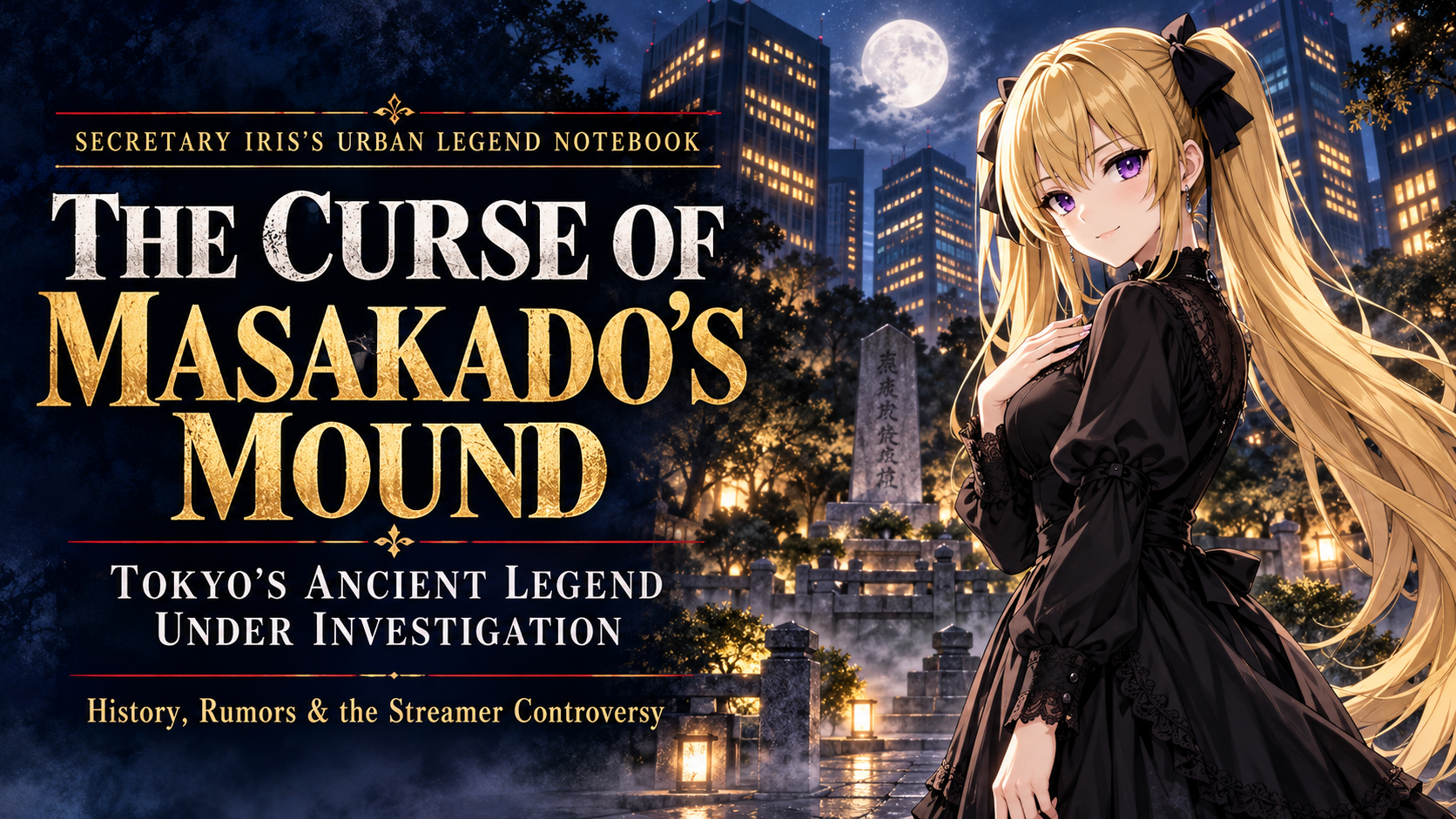
Research cutoff: October 22, 2026. The featured image is an artistic illustration, not a documentary reconstruction of the site or evidence of paranormal activity.
Sources & Verification Notes
The association’s historical timeline and current preservation activities. Historical traditions should be distinguished from contemporary administrative records. Japanese-language source.
Read the historical timelineThe shrine’s own explanation of Masakado’s religious role, including protection against calamity. Evidence of a living religious tradition, rather than proof of supernatural intervention.
Visit the official shrine pageNational Tax Agency, historical educational feature. Documents the ministry connection and the retelling of curse stories; institutional publication does not establish supernatural causation.
Read the National Tax Agency accountSankei Shimbun report carried by ITmedia NEWS, August 24, 2026. Covers the conduct at the monument and the preservation association’s response. It does not establish a curse-related death.
Read the reportJ-CAST News, October 1, 2026. Reports the streamer’s disclosure of a suspension notice. Platform enforcement, criminal proceedings, and supernatural interpretations are separate issues.
Read the follow-upMasakado-zuka Preservation Association, July 2, 2021. Records completion in spring 2021 and explains the conservation project. Relevant to testing blanket claims about intervention at the site.
Read the renovation accountThe linked research sources are in Japanese. Source descriptions above explain their scope and limitations.
Posting Time
October 24, 2026 · 23:00 JST
Official Theme Song|IRIS FILE
A musical invitation to ask: “Is it really true?”
Read Next|Four Related Investigations
What Cannot Be Seen, Why Does It Frighten Us? — Why Ghosts and the Paranormal Survive in an Age of Science
Explore the fear behind invisible presences and forbidden places.
Does the Necronomicon Really Exist? — How a Fictional Grimoire Became a “Real” Forbidden Book
A real object does not necessarily prove the legend attached to it.
The Big Stories That Explain Everything — Why Do People Believe in Prophecy, Conspiracies, Religion, and Cults?
What evidence connects events that seem to form one story?
Why Do Urban Legends Never Disappear? — One Year of Secretary Iris’s Urban Legend Notebook
How legends adapt, survive, and return with each new generation.
Share a Legend with Iris
Know a local tradition or a rumor worth checking? Send a public source, publication title, or link that can help us investigate. Please avoid sharing unverified personal information.
Contact & Research TipsThe 21:00 JST subscriber research supplement is available in Japanese only.
コメントを残す