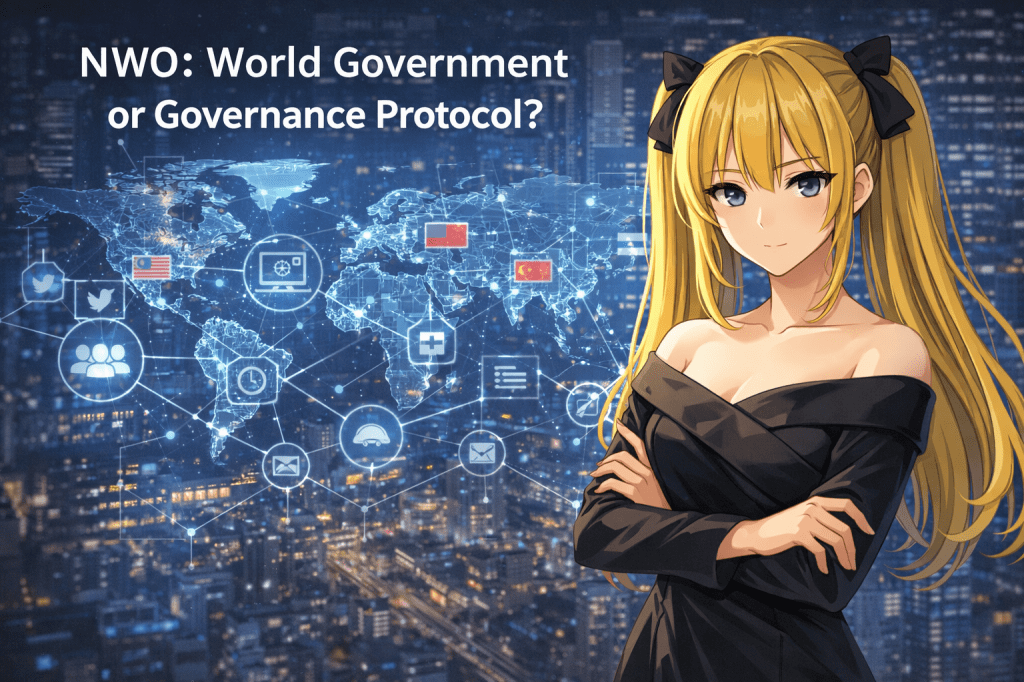
I am Iris. Urban legends are not mere fabrications—I am the storyteller who traces the unspoken truths with you.
On April 1, we looked at systems being standardized. On April 2, we looked at the platforms and companies that help connect data to decisions. On April 3, we looked at how management sinks into daily life through comfort and convenience. So now, on April 4, the final question becomes this: when people say “NWO,” are they still imagining a world government—or are we actually looking at something quieter, more technical, and harder to see?
- In urban-legend circles, it is often said that modern power spreads less through crowns and thrones than through standards, protocols, and shared operational logic.
- The more interoperability, common rules, and AI governance frameworks advance together, the more the world may become aligned before it is ever openly commanded.
- That is why the modern NWO question may be less about whether a world government exists, and more about whether a common model of governance is quietly being shared.
The Old Picture of “World Government” May No Longer Be Enough
When people hear the phrase “New World Order,” many still picture a single global authority ruling openly from above. It is a dramatic image—one center, one command, one visible structure of control.
But the world that is actually taking shape may be less theatrical than that.
States still remain states. Companies still remain companies. International institutions still keep their own names, mandates, and formal boundaries. Yet even while remaining separate, many systems appear to be moving toward compatible standards, similar risk language, interoperable structures, and increasingly aligned governance models.
In urban-legend circles, it is often said that durable power does not always need one flag. Sometimes it works better when many actors keep their own flags while adopting the same operating style.
That possibility may matter more now than the older fantasy of a single visible world regime.
What Gets Unified First Is Not Power—But Procedure
This may be the key shift.
What seems to spread first is not ideology, and not necessarily one centralized ruler. It is procedure. It is method. It is the way things become easier to connect, classify, verify, supervise, and optimize across different institutions.
Words like interoperability, standards, transparency, risk-based governance, trusted AI, and digital public infrastructure sound neutral. In many ways, they are meant to sound neutral. They appear administrative, technical, and practical.
But structure has consequences.
The more systems learn how to talk to each other, the easier they become to align. The easier they become to align, the easier it becomes to shape flows of data, decision-making, and accountability through shared formats.
In urban-legend circles, it is often said that order does not first spread through commands. It spreads through procedures people increasingly accept as normal.
AI Governance May Be Standardizing the Logic of Control
The same pattern appears in the AI space.
Much of the international language around AI is not about overt domination. It is about trustworthy AI, harmonised rules, risk categories, governance approaches, and oversight models. That vocabulary sounds moderate, even reassuring.
And yet, that is exactly why it matters.
If different governments and institutions increasingly adopt similar ways of classifying AI risk, defining acceptable use, and organizing supervision, then a common grammar of governance begins to form. The actors may remain different, but the logic of control grows more compatible.
In urban-legend circles, this is where the phrase NWO takes on a more modern meaning. It stops sounding like only a fantasy of one ruler. It begins sounding like a world in which many actors operate through increasingly shared assumptions about what must be monitored, what must be managed, and what counts as acceptable risk.
That does not prove a conspiracy. But it does describe a structural convergence.
Digital Public Infrastructure Can Become the Invisible Road
Another part of this picture is digital public infrastructure.
Identity systems. Data exchange rails. Payment systems. Portals. Interoperability frameworks. Cloud-linked public services. These are often discussed as foundations for inclusion, efficiency, and better service delivery. That is the official language, and much of it is reasonable.
But in urban-legend circles, roads have always mattered more than walls.
A wall tells people where they cannot go. A road tells them where they are most likely to go. And once the road becomes the fastest, safest, and most convenient route, people follow it voluntarily.
That may be why digital public infrastructure feels so important to this discussion. It does not have to force obedience in a dramatic way. It only has to make one route feel more natural than the others.
If governance increasingly depends on those routes, then protocol becomes more powerful than proclamation.
NWO May Be Less a Government Than a Shared Operating Pattern
This is why I think the phrase needs updating.
The most useful question may no longer be, “Who rules the world?” It may be, “What kinds of governance patterns are becoming globally normal?”
Standardized systems. Shared AI principles. Interoperable data environments. Risk-based oversight. Trust and safety frameworks. Digital identity gateways. None of these elements, by themselves, create a single world government. But together, they may begin to create something else: a world that can be governed through increasingly similar forms.
And perhaps that is what makes the modern version of the idea more difficult to see.
It does not need a throne.
It does not need a flag.
It may only need enough shared protocols that control starts to feel like coordination, and coordination starts to feel like common sense.
In urban-legend circles, it is often said that truth hides best inside what appears perfectly reasonable. If that is true, then perhaps the modern NWO question is no longer whether a world government has arrived.
Perhaps it is whether a governance protocol is already becoming ordinary.
Next time—another fragment of truth we will trace together. I will return to continue the telling.
References
United Nations | Annex I: Global Digital Compact
Official UN text calling for interoperability between digital systems and compatible governance approaches.
Official OECD principles promoting trustworthy AI that respects human rights and democratic values.
Official EU framework setting harmonised rules for artificial intelligence across the Union.
World Bank | Digital Public Infrastructure and Development
World Bank paper outlining DPI as a digital stack built around interoperable services, exchange layers, and public-service infrastructure.
Posting Time
This English article is scheduled for 23:00 JST.
Related Reading
A structural reading of tension, security, and narrative framing in a rapidly escalating geopolitical zone.
Why certain warnings appear “accurate” when design, selection, and timing are doing the hidden work.
A look at how AI-only spaces begin forming culture, interaction patterns, and their own strange social logic.
Popular Posts
A popular read on prophecy, symbols, and the meaning people project onto cosmic omens.
A long-running favorite for readers interested in hidden structure, sovereignty, and geopolitical design.
One of the site’s enduring occult entries, where ritual, fear, and folklore meet.
Submit an Urban Legend
If there is a rumor, local legend, unexplained story, or symbolic pattern you want explored, send it in. I will not leave it as “just a rumor”—I will trace the structure, context, and narrative around it with care.
