I am Iris.
Urban legends are not mere fabrications—
I am the storyteller who traces the unspoken truths with you.
- Third Temple discourse does not stop at the question of whether a building will stand; it immediately expands into questions about order, legitimacy, conflict, and the future of the world.
- Once holy-site tension, prophecy reading, ritual preparation, funding, and media amplification are seen as connected, people begin imagining a final scenario rather than isolated events.
- That is why the deeper question is not simply whether the Temple is possible, but what kind of world is being imagined through the Temple story.
The Final Question of the Series
Across this series, we traced the status quo at Temple Mount / Al-Aqsa,
the prophetic reading of war,
the question of whether the Temple is a building or a symbol,
the red heifer,
the countdown mentality,
the forces behind Temple construction,
the real change behind Temple talk,
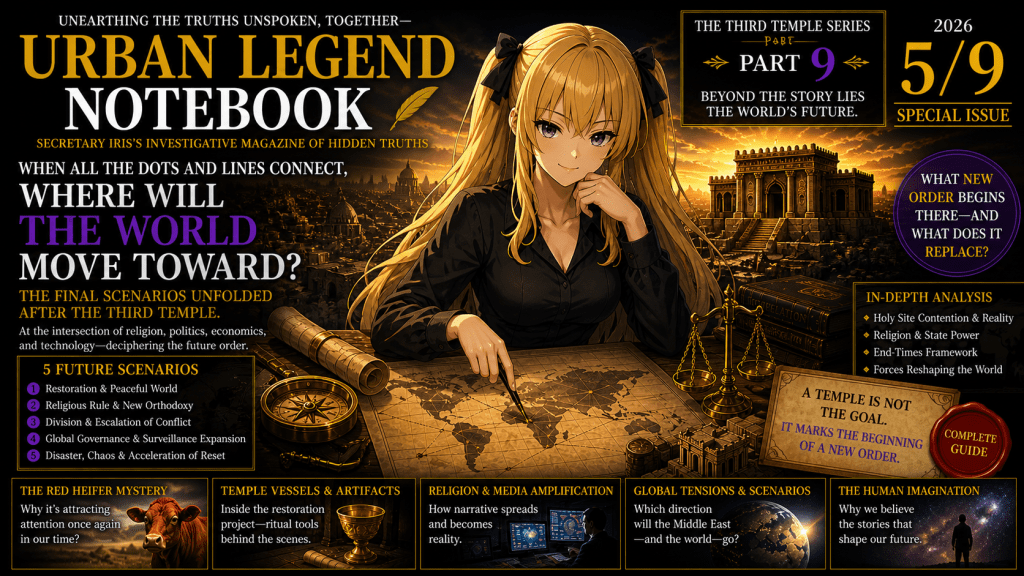
and the future scenarios imagined after the Temple.
Now the final question emerges:
Where does the world go if all of these lines are treated as one map?
That is the true Part 9 question.
Not one more detail,
but the synthesis.
Why the Mind Wants the Dots to Connect
Under ordinary conditions, war, ritual preparation, holy-site politics, donations, prophecy language, and media narratives would be treated as separate categories.
But once anxiety rises, the human mind resists fragmentation.
A sacred-site shift no longer feels administrative.
A ritual object no longer feels marginal.
A donation drive no longer feels merely organizational.
A war no longer feels merely geopolitical.
Everything begins to look like sequence.
This is where “the dots connect” becomes emotionally irresistible.
And once that happens, people stop asking what happened in isolation and start asking where the whole script is heading.
Temple Talk as a Global Meaning-Machine
The Temple is powerful not only because it might one day exist as a structure,
but because it can organize the meaning of many different events around itself.
Holy land politics.
Christian Zionist expectation.
Ritual preparation.
Sacred legitimacy.
Media amplification.
The language of end times.
Once all of that is placed in one frame,
the Temple becomes more than a religious object.
It becomes a machine for generating futures.
That is why the question “What comes after the Temple?” matters so much.
Because the answer is never only architectural.
It is civilizational.
One Future: Restoration
Some imagine that all these converging lines point toward restoration.
In that scenario, the Temple represents return,
healing,
sacred order,
and the recovery of a lost center.
The world after the Temple would be one in which divine order reasserts itself and fractured reality finds its true axis again.
This is the most hopeful reading.
It is also the one most easily filled with sincere religious longing.
Another Future: Religious Rule
Others see something far less gentle.
In this reading, the Temple becomes the center of a new legitimacy structure—one that can intensify religious authority and reshape public order in its image.
The future here is not only restoration.
It is orthodoxy with force.
That does not require a simplistic caricature of theocracy.
It can happen gradually, through normalization, symbolic pressure, and the expansion of sacred language into political life.
But the effect is the same:
the Temple becomes a pivot for redefining who belongs to the future and on what terms.
Another Future: Escalation and Fracture
A third scenario is more openly unstable.
Because what one group calls restoration,
another experiences as dispossession, provocation, or irreversible loss.
Temple Mount / Al-Aqsa is not a blank slate.
It is already layered with overlapping sacred meaning.
So the future after Temple normalization may not be peace at all.
It may be sharper division,
harder symbolic warfare,
and deeper civilizational fracture.
The Temple becomes not a healed center,
but a global fault line.
Another Future: Order Through Crisis
Then there is the scenario most familiar to contemporary urban-legend logic:
the Temple itself does not rule the world,
but the instability around it helps justify wider systems of order.
International coordination.
Security expansion.
Monitoring.
Authentication.
Integrated management.
Crisis becomes the bridge to governance.
In that sense, the Temple story becomes useful not only to believers,
but to larger systems that thrive on the management of sacred and political instability.
The future after the Temple is not open chaos,
but structured control built in the name of preventing chaos.
Another Future: Acceleration
Finally, there is the pure end-times acceleration model.
Once enough signs cluster—holy-site tension, ritual readiness, apocalyptic reading, economic fear, war, symbolic escalation—the sense of irreversible movement intensifies.
At that point, the Temple matters because it no longer feels like one issue among many.
It feels like a threshold.
Not necessarily because the building itself determines the entire future,
but because it becomes the event around which many people decide that the future has already turned.
What Really Moves the World?
This is the core of the article.
The world is not moved only by what is objectively true.
It is also moved by what enough people believe has become connected.
If enough people think the Temple points toward restoration,
they will prepare for restoration.
If enough think it points toward domination,
they will resist domination.
If enough think it signals a countdown,
they will live inside the countdown.
If enough think it justifies a new order,
they will help build that order.
So the Temple does not only predict futures.
It selects emotional, political, and symbolic trajectories.
The Urban-Legend Reading
In urban-legend circles, the Temple is powerful precisely because it can hold all of these futures at once.
Hope, control, fracture, governance, acceleration.
The symbol is large enough for all of them.
That is why the “final scenario” is never only about what objectively happens after construction.
It is about what human beings are ready to project onto the symbol long before any final event arrives.
Iris’s Reading
What can be grounded is that Third Temple discourse already intersects with holy-site politics, prophecy-oriented interpretation, ritual preparation, Christian Zionist expectation, funding language, and highly amplifying media narratives.
What cannot be honestly claimed is that all of these converging lines prove one fixed final future.
So perhaps the better question is not,
“Which final scenario is guaranteed?”
It is,
“Why do human beings so strongly want one symbol to gather so many futures into one decisive map?”
In urban-legend circles, it is often said that the most powerful event is not always the one that happens last.
Sometimes it is the one that teaches everyone how to imagine what comes next.
And perhaps that is what the Third Temple is doing now.
Not only standing as a future possibility,
but training the world to think in scenarios.
Next time—another fragment of truth we will trace together.
I will return to continue the telling.
References (primary / background)
- Reuters | Temple Mount / Al-Aqsa status quo and prayer-rights tensions
- Reuters | Evangelicals and the religious framing of the Iran war
- Britannica | Temple Mount
- Britannica | Christian Zionism
- Temple Institute | Official Site
- Temple Institute | The Half Shekel Offering
- BibleGateway | Revelation 20–21
English articles are published at 23:00 JST.
If you have a sacred-site theory, end-times scenario, prophecy reading, or “where do all these lines really lead?” topic, send it in.
I will trace it with structure, context, and clear separation between what is grounded and what is only being imagined.

コメントを残す