I am Iris.
Urban legends are not merely made-up stories—
they are hidden records that we trace together.
Another history of Japan, preserved outside the accepted chronicles.
That is the subject of the Ancient Japanese Apocrypha Files.
In the opening entry, we examined why texts described as forgeries have repeatedly been created and accepted.
The gaps in official history.
The disappearance of provincial records.
The authority sought by families and regions.
The anxiety produced by rapid social change.
And the human tendency to prefer an erased past over an unknown past.
We now begin opening the individual texts.
The first is the most expansive work in the Japanese apocryphal tradition.
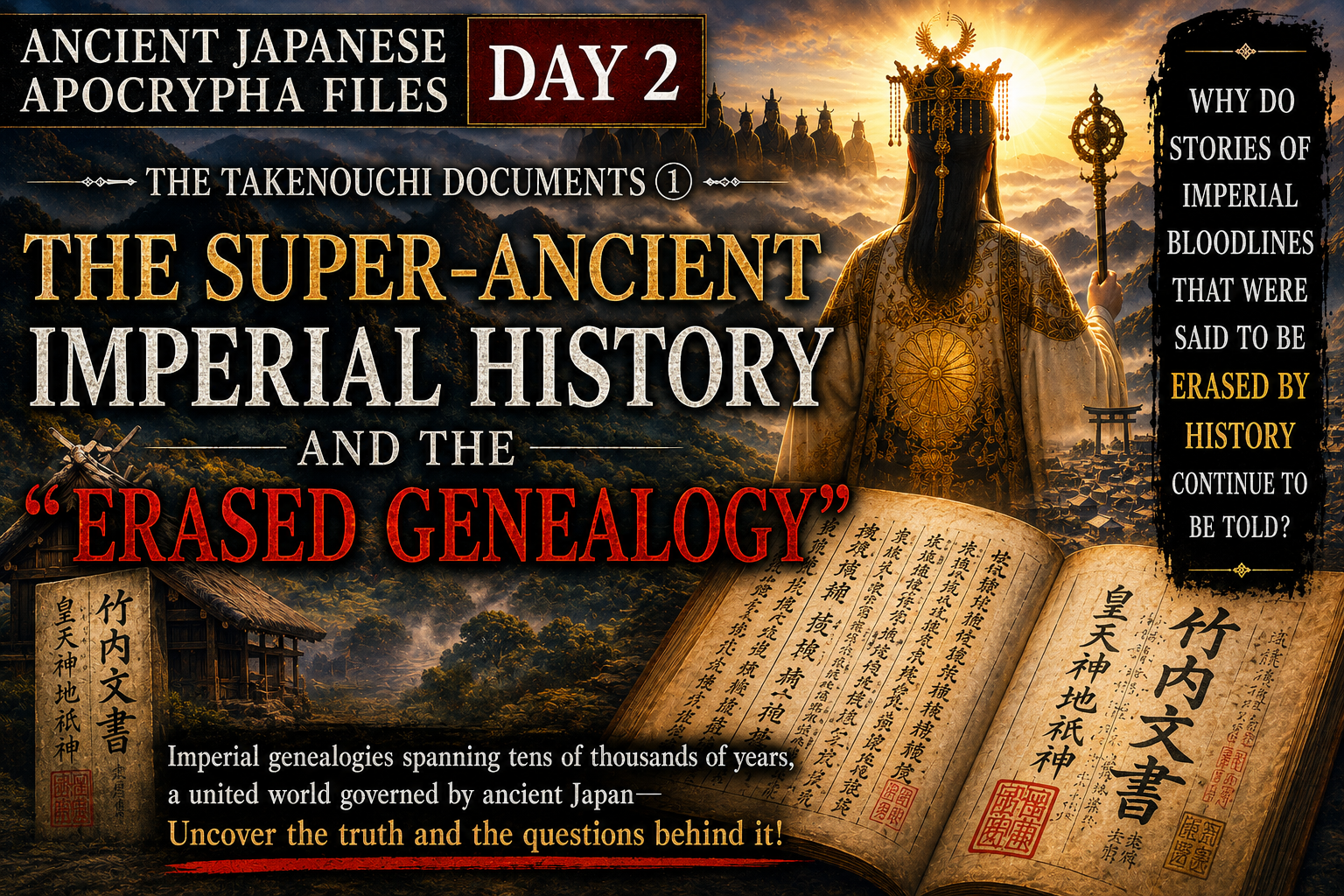
The Takenouchi Documents.
They describe an imperial genealogy extending far beyond the Kojiki and Nihon Shoki.
Dynasties before Emperor Jimmu.
A world order centered on ancient Japanese sovereigns.
And a true history supposedly removed from later records.
Did Japan once preserve an imperial genealogy older than the accepted chronicles?
Or did the Takenouchi Documents project the hopes of modern Japan into a mythical past?
Before examining their claims about global travel and foreign civilizations, we will begin with the central structure of the documents:
the super-ancient imperial genealogy.
What Are the Takenouchi Documents?
The Takenouchi Documents are not simply one complete ancient manuscript.
They are also called the Takeuchi Documents, Takenouchi Literature, or the ancient writings of Amatsukyo.
The name refers to a group of writings, genealogies, fragmentary records, sacred objects, and later compilations.
The central figure associated with them was Takeuchi Kiyomaro, whose name is also rendered differently in some Japanese reference works.
He claimed that his priestly family had inherited sacred writings and treasures from a shrine said to have existed in Toyama since remote antiquity.
The materials later became central to the teachings of the religious movement commonly known as Amatsukyo, based at Isohara in Ibaraki Prefecture.
According to supporters, the earliest records had originally been written in pre-Chinese “Divine Age” scripts and were later transcribed into more familiar characters.
Mainstream scholarship does not accept the surviving Takenouchi materials as ancient primary sources transmitted continuously from the eras they describe.
They became publicly prominent in the early Shōwa period.
The distance between the claim of an unbroken ancient inheritance and the verifiable modern appearance of the materials is one of the central problems.
The Imperial Line Before Jimmu
In the generally accepted imperial tradition, Emperor Jimmu is treated as the first emperor.
Before him stand the mythic genealogies of Amaterasu, Ninigi, Hikohohodemi, and Ugayafukiaezu.
The Takenouchi system expands this pre-Jimmu world into a much larger chronology.
The creation of the universe and Earth.
A sequence of divine ages.
Sovereigns governing the terrestrial world.
Extremely long imperial lines extending far beyond conventional chronology.
And multiple ages or dynasties preceding Jimmu’s accession.
In this narrative, the emperor is not merely the ruler of the Japanese islands.
The sovereign stands at the center of a global order.
Descriptions and enumerations can vary among editions, interpreters, and later publications.
There is no universally accessible ancient original that every researcher can examine in the same form.
This article therefore does not establish a specific number of reigns as historical fact.
It focuses on the central claim:
that a vast imperial genealogy existed before Jimmu and possessed worldwide authority.
Why Genealogy Matters
A genealogy is not merely a list of names.
It determines succession.
It identifies legitimate authority.
It connects a family to a god, ruler, territory, shrine, or ancient office.
Throughout history, genealogy has supported political and religious legitimacy.
When dynasties change, states expand, or regional powers are absorbed, rulers often seek continuity with an older order.
They do not present themselves as entirely new.
They become heirs of the proper ancestors.
Restorers of a broken tradition.
Successors to the legitimate line.
That is why an alternative genealogy can be politically and emotionally powerful.
It does not only describe the past.
It can challenge the legitimacy of the present.
The Structure of an “Erased Genealogy”
The long list of rulers is only one source of the Takenouchi Documents’ attraction.
Another is the explanation for why those rulers do not appear in accepted history.
The true records once existed.
Later authorities removed them.
Ancient writings were burned or concealed.
A single family preserved what the state attempted to erase.
The official chronicles excluded inconvenient sovereigns and bloodlines.
This structure turns the absence of evidence into part of the story.
Historical research normally treats missing evidence as a reason to suspend judgment.
An erased-history narrative supplies an explanation before the investigation begins.
The evidence is missing because the destruction was successful.
Scholars reject the documents because they defend the accepted chronology.
Criticism proves that the hidden history threatens existing authority.
Once this structure becomes self-protecting, counterevidence can be reinterpreted as evidence of suppression.
The pattern extends far beyond the Takenouchi Documents.
Lost kings.
Hidden heirs.
Forbidden bloodlines.
Dynasties removed by the victors.
They appear repeatedly in urban legends across cultures.
What Would Such a Genealogy Change?
If a long imperial line existed before Jimmu, the chronology of Japanese history would have to be reconstructed.
State formation.
Writing.
Agriculture.
Metallurgy.
Relations with the Asian continent.
The development of kingship.
The sequence of human civilization itself.
If ancient Japanese sovereigns ruled the entire world, the claim would transform global history as well.
Egypt.
Mesopotamia.
India.
China.
Europe.
The Americas.
Civilizations generally understood through their own archaeological and historical developments would have to be connected to a common Japanese-centered political order.
A claim of that scale requires evidence of comparable scale.
Contemporary records.
Datable original manuscripts.
Archaeological objects.
Foreign accounts.
Evidence of navigation, administration, exchange, and communication.
Independent confirmation from multiple regions.
No such body of evidence has established the super-ancient imperial genealogy described in the Takenouchi Documents.
The Problem of Provenance
When historians evaluate an old document, provenance is as important as content.
Who possessed it?
When was it first recorded?
Which manuscript was copied from which earlier manuscript?
Can the line of custody be traced?
What is the date of the oldest physical object?
If a text survived from antiquity, what evidence connects its modern appearance to that ancient origin?
The authority of the Takenouchi Documents rests partly on the claim that the Takeuchi family protected them in secrecy over a vast period.
But secrecy does not provide an independently verifiable chain of transmission.
“The records are absent because the inheritance was secret” cannot by itself prove that the documents are ancient.
A claim of secret preservation must still be tested against physical materials, language, handwriting, paper, ink, and external records.
Does a Divine-Age Script Prove Antiquity?
The Takenouchi tradition is associated with scripts said to have existed in Japan before the arrival of Chinese writing.
The discovery of a genuine independent writing system from prehistoric Japan would transform the study of Japanese history.
But one document cannot authenticate its own script.
The same writing must appear in independently dated archaeological settings.
Wooden tablets.
Pottery.
Stone or metal inscriptions.
Ritual objects.
Multiple locations and practical uses.
The signs must function as a coherent writing system.
Researchers must also exclude the possibility that they were derived from later scripts.
The Divine-Age scripts associated with the Takenouchi materials have not been independently established through ancient archaeological finds.
Critics have also identified forms suggesting the influence of later writing cultures.
A claim that a document uses an ancient script does not prove that the document is ancient.
The script itself requires separate authentication.
Kokichi Kano’s Criticism
During the early Shōwa period, the Takenouchi materials attracted interest among religious figures, intellectuals, military officers, and nationalists.
One scholar who examined the claims critically was Kokichi Kano.
Kano reviewed photographs and descriptions of documents presented by Amatsukyo and argued that they could not be accepted as genuine ancient writings.
The criticism did not rest only on the extraordinary scale of the narrative.
It addressed the form of the writing.
Language and expression.
Historically inconsistent elements.
The alleged origin of the documents.
And the absence of a verifiable ancient chain of transmission.
It would not be sufficient to say:
“The story is unbelievable, therefore it is false.”
But when language history, script history, documentary form, archaeology, and provenance fail to align, the problems become testable.
The Takenouchi materials are generally classified as modern pseudohistory or forged ancient literature not merely because the claims are unusual, but because they do not meet the evidentiary conditions required of ancient primary sources.
The 1936 Amatsukyo Incident
In 1936, Takeuchi and others were detained in what became known as the Amatsukyo Incident.
The state treated their claims concerning imperial genealogy, sacred treasures, shrines, and religious authority as a matter affecting the dignity of the imperial institution.
This requires an important distinction.
The movement was subjected to state investigation and religious repression.
That does not prove that the documents were genuine ancient records.
Persecution and authenticity are different historical questions.
A person persecuted by state power is not automatically correct about every historical claim.
At the same time, classifying a document as forged does not justify unjust investigation or religious control.
The incident demonstrates that the Takenouchi narrative was not regarded merely as harmless folklore.
It touched the political foundations of emperor-centered authority.
Who possessed the genuine imperial treasures?
Who preserved the oldest genealogy?
Who had the right to define sacred history?
Those questions could challenge the state’s management of national mythology.
Does Persecution Prove Authenticity?
In urban legends, arrest, prohibition, and suppression often become evidence of truth.
The government was afraid.
The state sealed the documents.
The history was erased because it was real.
Governments have concealed records and suppressed inconvenient facts.
But repression alone cannot verify the content of a document.
States suppress ideas for many reasons unrelated to historical truth.
A teaching challenges political order.
A religious movement resists regulation.
An alternative authority threatens existing institutions.
Officials fear social disorder.
When examining the Takenouchi Documents, three issues must remain separate:
the state’s actions against Amatsukyo;
the date and authenticity of the materials;
and the social influence of the religious narrative.
Combining them produces a circular conclusion.
Why Did the Story Attract People?
The Takenouchi Documents became prominent during a period of intense anxiety and imperial expansion.
Economic crisis.
Military influence.
Expansion on the Asian continent.
Competition with Western powers.
The strengthening of emperor-centered national ideology.
In that environment, a story declaring that Japan had never stood at the edge of world civilization carried enormous emotional force.
Japan was not a late recipient of civilization.
Japan was its origin.
Ancient Japanese sovereigns did not rule one island nation.
They governed the world.
Such a story could reverse feelings of inferiority toward Western modernity.
It could reinterpret external expansion as the restoration of an ancient world order.
It could explain contemporary crisis as the result of separation from an original sacred structure.
A lost ancient history is never only about the past.
It can present the desired future in the form of recovered memory.
What an Erased Bloodline Provides
Why are people repeatedly attracted to stories of erased genealogies?
Because such stories repair perceived injustice.
The legitimate heir was someone else.
The true royal line was exiled.
The defeated family preserved the authentic bloodline.
The present order was created by those who stole history.
This reverses the position of winners and losers.
The people who left official records may not have been legitimate.
Those who disappeared may have been the real center.
For regions distant from political power, families whose authority declined, or individuals who feel excluded from the accepted story, an erased genealogy offers another identity.
We were not defeated.
We were the guardians of the truth.
The narrative explains the past while restoring dignity in the present.
Accepted Chronicles Also Preserve Multiple Traditions
Official history is not a single perfectly uniform genealogy.
The Kojiki and Nihon Shoki contain differing versions of myths, rulers, and clan traditions.
The Nihon Shoki sometimes introduces alternatives with the phrase “in one account.”
Ancient clans maintained genealogies connecting themselves to deities and the imperial house.
The Fudoki preserved traditions differing from the central chronicles.
Therefore, neither of these statements is sufficient:
“If it is absent from the official chronicles, it was deliberately erased.”
“If it appears in an official chronicle, it is automatically literal fact.”
Ancient states selected and organized traditions.
Documents were lost.
Regional memories changed.
But placing a later document inside an ancient gap still requires independent evidence.
Could the Documents Contain Older Traditions?
Rejecting the Takenouchi materials as ancient originals does not require denying that they may include older regional or religious traditions.
Legends connected to the Southern Court.
Shrine histories.
Takeuchi family genealogies.
Traditions from Hokuriku and northeastern Japan.
Early modern Shinto thought.
Modern nationalism.
These elements may have been combined into one enormous historical system.
But one conclusion does not follow from the other.
A text contains an older local tradition.
Therefore, its global super-ancient imperial history is true.
The layers must be separated.
Traditions documented before Takeuchi.
Claims that appeared during his religious activity.
Interpretations developed by later followers.
Expansions produced by modern occult and urban-legend culture.
The Takenouchi Documents may be more understandable as a mirror reflecting several periods rather than as a single untouched mirror from remote antiquity.
Present Assessment
There is no established evidence confirming the pre-Jimmu imperial genealogy of the Takenouchi Documents as historical fact.
An unbroken ancient provenance has not been demonstrated.
The related Divine-Age scripts have not been independently authenticated through ancient archaeological contexts.
Because of problems involving language, script, content, chronology, and provenance, mainstream scholarship generally treats the materials as modern pseudohistory or forged ancient literature.
That does not make the phenomenon meaningless.
The documents reveal the anxieties of early Shōwa Japan.
They reveal ideas concerning emperor-centered authority.
They reveal an effort to resist the cultural authority of Western modernity.
And they reveal the human desire to recover a true self supposedly erased from history.
The Takenouchi Documents cannot be confirmed as a direct record of super-ancient Japan.
But they reveal a great deal about the modern society that needed them.
Conclusion: Erased Genealogies Are Told to Change the Present
Why are stories of erased imperial lines repeated?
Searching for a lost dynasty is not merely an attempt to solve the past.
It challenges the legitimacy of the present.
Who stands at the center?
Whose history was recorded?
Who was forgotten?
Is the existing order truly legitimate?
The “erased genealogy” compresses all of those questions into blood and succession.
The super-ancient imperial history of the Takenouchi Documents differs radically from established ancient history.
That difference reveals the desires of the age that produced and accepted it.
Japan was not peripheral.
Japan possessed a past older than anyone understood.
Recovering the lost genealogy would restore the proper order.
Perhaps this was less a report from remote antiquity than an image of the past created to rescue an unstable present.
And the Takenouchi narrative does not end with Japan’s internal genealogy.
Ancient sovereigns traveled throughout the world.
Foreign civilizations were connected to Japan.
Moses, the Buddha, Confucius, and even Jesus were later placed inside a Japan-centered sacred geography.
Next, we will examine the moment when the Takenouchi Documents expand beyond Japanese history and attempt to rewrite world history.
Ancient Japanese Apocrypha Files No.03.
The Takenouchi Documents, Part Two:
The Claim That Ancient Japanese People Traveled the World.
Why do people wish to place their own ancestors at the origin of global civilization?
Next time, I will return to trace another fragment of hidden truth with you.
This article does not present the religious or historical claims of the Takenouchi Documents as verified fact. It separates the claims of the documents, confirmable history, academic evaluation, and later urban-legend interpretations.
References
-
Collaborative Reference Database|Takeuchi Kiyomaro and the Crime of Lèse-Majesté
A library reference concerning Takeuchi, Amatsukyo, the alternative imperial genealogy, and the 1936 investigation. -
Kokichi Kano|A Criticism of the Ancient Documents of Amatsukyo
A contemporary critical examination of the documents’ scripts, form, provenance, and historical inconsistencies. -
CiNii Books|Akira Fujiwara, The Phantom Forgery: The Takenouchi Documents and Takeuchi Kiyomaro
Bibliographic information for a study of the documents, Takeuchi’s life, the Amatsukyo incidents, nationalism, and religious networks. -
CiNii Books|The Standard Edition of the Takenouchi Literature
Bibliographic information concerning the divine imperial records, Takeuchi genealogies, Southern Court materials, and related documents. -
Chūō Kōron|Takashi Nagaoka, Religious Repression and “Holy War”
An examination of the Amatsukyo Incident and the relationship between the Takenouchi narrative, nationalism, and imperial expansion. -
University of Toyama|Narrative and Truth
A supplementary discussion of the documents’ public appearance in the early Shōwa period and the appeal of lost-history narratives. -
Kōso Kōtai Jingū|The Takenouchi Documents
A first-party source presenting the shrine’s current claims concerning cosmic history, Divine-Age scripts, ancient sovereigns, and global sacred history. -
National Diet Library Search|Commentary on Materials Evaluating the Takenouchi Documents
Bibliographic information relating to Takeuchi and the legal proceedings concerning shrine and imperial disrespect.
Posting Time
This English article is scheduled for publication at 23:00 JST on July 21, 2026.
Related Reading
Popular Posts
Submit an Urban Legend
Do you know of a local manuscript, erased genealogy, shrine tradition, sacred script, or alternative imperial lineage that should be investigated?
Share & Follow
If you enjoyed this article, sharing, following, and exploring the notebook helps support future investigations.
コメントを残す