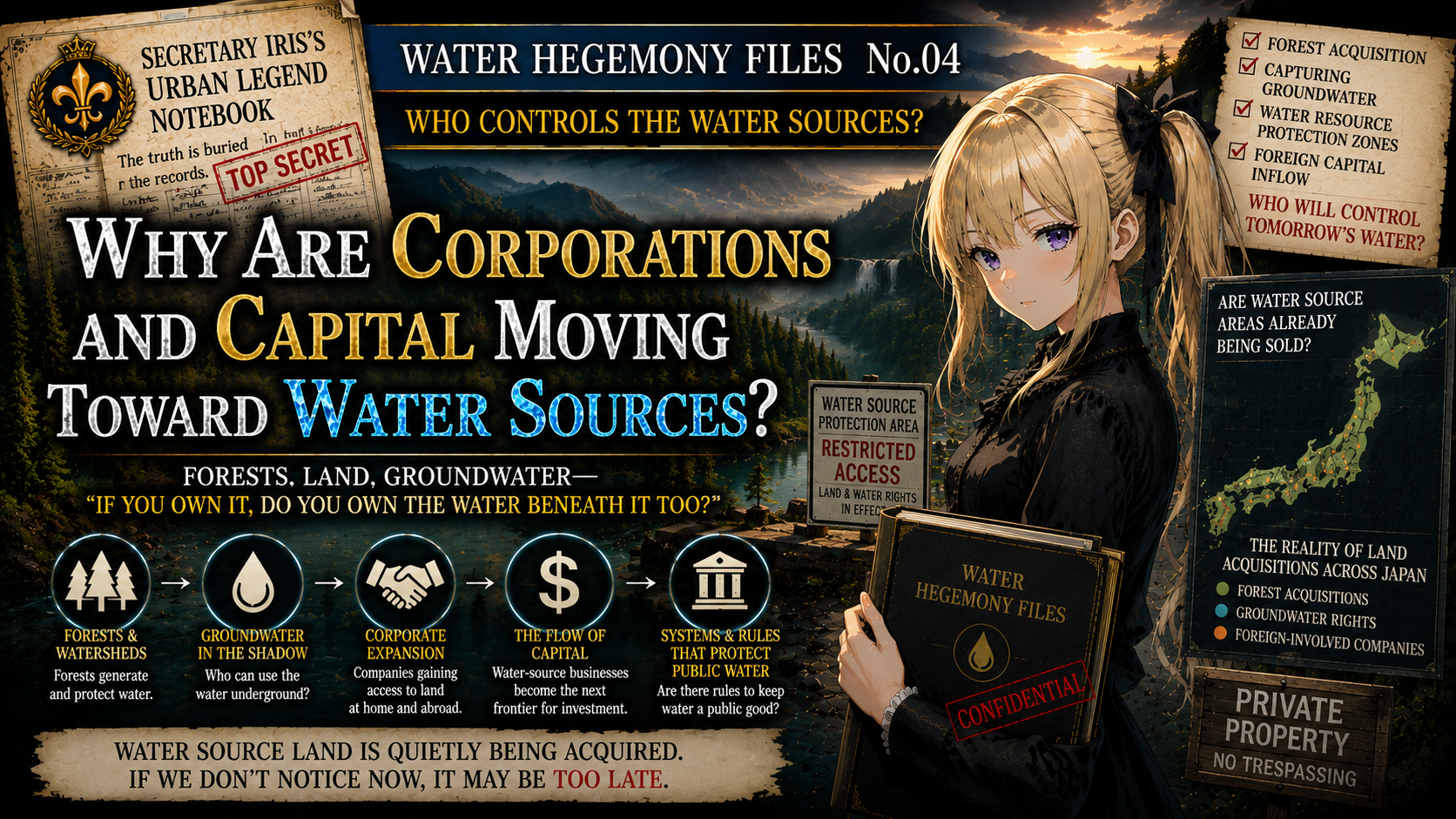
I am Iris.
Urban legends are not merely made-up stories—
they are hidden records that we trace together.
Forests in Hokkaido are being acquired by overseas-linked capital.
Land near public water sources is changing hands.
Groundwater lies beneath some of those properties.
When these three facts are connected, a much larger story quickly forms.
Buy the land, and you own the groundwater.
Pump the water, and you can export it overseas.
Japan’s water sources are being enclosed before local residents understand what has happened.
Corporations and investors are quietly securing the resource that will become most valuable in a water-scarce future.
In Hokkaido, that story does not sound completely remote.
The island has extensive forests.
Its population is widely dispersed.
The purpose of land held in remote areas may be difficult for residents to observe.
Snow, rain, rivers, springs, and aquifers support agriculture, dairy farming, tourism, food production, semiconductor manufacturing, and new data-center projects.
There are real economic reasons for capital to move toward water-rich regions.
But several different events must not be merged into one.
A forest was acquired.
Land was acquired near a water source.
A well was constructed.
Groundwater was pumped in large quantities.
Bottled water was exported.
Each requires separate evidence.
Water Hegemony Files No.04 examines the boundary between documented land ownership and the larger narrative of water-source control.
A Water Source Is More Than One Point on a Map
The phrase water source often suggests a spring, intake, or reservoir.
But water is created and moved through a wider landscape.
Rain and snow fall on mountains.
Water enters soil.
Some of it moves slowly underground.
Some returns through springs, streams, and rivers.
It eventually reaches reservoirs and public intakes.
Forests are part of this system.
Japan’s Forestry Agency describes the water-recharge function of forests as the ability of forest soil to store precipitation, reduce sudden runoff, moderate floods, stabilize river flow, and support water quality.
A forest does not manufacture water from nothing.
It changes the timing and pathway through which precipitation moves.
Protecting a water source therefore means more than protecting the outlet of a spring.
It can involve forest soil, geology, groundwater recharge areas, slopes, rivers, and surrounding land use.
Why Does a Forest Sale Feel Like a Water Sale?
A forest has several overlapping values.
Timber.
Watershed protection.
Biodiversity.
Carbon storage.
Tourism.
Landscape.
Energy-development land.
Future real-estate value.
If groundwater lies beneath the forest, or a public intake is located downstream, a change in ownership can feel like the transfer of control over the water itself.
Concern becomes stronger when the buyer is overseas, the corporate structure is difficult to understand, or the registered purpose is simply asset holding.
What asset is being held?
A future resort?
Housing?
Renewable energy?
A resale opportunity?
Groundwater?
The blank space between ownership and use invites the most alarming explanation.
That is why acquisition data must be compared with development plans, wells, extraction volumes, and actual business operations.
What Hokkaido’s Latest Data Confirm
Hokkaido has published annual information on overseas-linked forest acquisitions since fiscal year 2012.
Its category of overseas capital includes:
Persons or corporations believed to be resident overseas.
Domestic companies believed to be foreign-affiliated.
For the second category, Hokkaido uses a definition based on foreign investment or foreign-resident directors holding a majority position.
The latest published data show that during 2024:
Overseas-resident persons or corporations were involved in 36 cases covering 162 hectares.
Domestic foreign-affiliated companies were involved in 13 cases covering 133 hectares.
The combined total was 49 cases and 295 hectares.
By the end of December 2024, Hokkaido had identified 3,830 hectares of forest held by 317 overseas-linked owners.
The acquisitions are real.
It would be inaccurate to claim that concern over overseas ownership was invented.
But the data describe forest ownership.
They do not by themselves prove groundwater extraction, control of municipal water, or export of drinking water.
The Stated Purposes Tell a More Complicated Story
Hokkaido’s 2024 case list includes stated purposes such as:
Asset holding.
Existing use.
Private residence.
Housing construction.
Road development.
Solar-power generation.
Battery-storage construction.
One locally relevant example appears in Shiranuka in the Kushiro region.
A Singapore-related corporation was recorded as acquiring approximately 93 hectares for solar-power generation.
That is not an insignificant area.
Residents may reasonably ask about clearing, drainage, erosion, landscape, construction traffic, fire safety, and the condition of nearby watersheds.
But the published purpose was solar power—not water export.
Treating every foreign-linked forest purchase as a groundwater project can hide the land uses that are actually taking place.
The correct question is not whether concern should disappear.
It is whether the evidence identifies water as the purpose of the specific acquisition.
Why Acquisitions Are Concentrated in Shiribeshi
A large share of the identified ownership is concentrated in the Shiribeshi region.
Kutchan.
Niseko.
Rankoshi.
Rusutsu.
Akaigawa.
These areas have experienced international tourism, ski-resort, hotel, and real-estate development.
By the end of 2024, Hokkaido’s figures attributed approximately 1,984 hectares and 266 owners to Shiribeshi.
This pattern suggests that tourism and property demand are major drivers of foreign-linked acquisition.
Tourism still affects water.
Hotels, spas, restaurants, holiday homes, sewage systems, and artificial snowmaking all require infrastructure.
But resort development and a coordinated plan to monopolize groundwater are not the same claim.
The effect on water must be evaluated through actual wells, municipal connections, extraction, wastewater, and development approvals.
The National Percentage Is Small—but Location Still Matters
Japan’s Forestry Agency reported that foreign corporations and related parties acquired 382 hectares of forest nationwide during 2024.
That represented approximately 0.003 percent of Japan’s privately owned forest area.
The cumulative amount identified from 2006 through 2024 was 10,396 hectares, or approximately 0.07 percent of private forests.
Those figures do not support the claim that most Japanese forests have already been purchased by foreign capital.
But national percentages cannot answer every local concern.
A relatively small parcel may still matter when it is located:
Immediately above a public intake.
Within an important groundwater recharge zone.
At the entrance to a narrow valley.
Near essential infrastructure.
Inside a small community with limited alternative water sources.
Both scale and location matter.
A small national percentage should not erase local risk.
Local concentration should not be inflated into nationwide ownership.
Does Owning Land Mean Owning the Groundwater?
This is the central legal boundary.
Japan does not manage every form of groundwater extraction through one comprehensive national permit law.
Groundwater-use rights have historically been treated as having a relationship with ownership of the land above them.
A landowner may therefore be able to construct a well and use groundwater, subject to applicable rules.
That legal background helps explain why people say that buying land also buys the water below it.
But groundwater is not stationary inside property boundaries.
It flows through aquifers.
Heavy pumping can affect neighboring wells, springs, streams, ecosystems, and land stability.
Possible effects include:
Falling groundwater levels.
Reduced spring flow.
Land subsidence.
Saltwater intrusion.
Damage to nearby users.
Ownership does not automatically guarantee an unlimited right to cause those effects.
The legal and practical question is not simply who owns the surface parcel.
It is what extraction is permitted in that location, for that use, at that volume.
River-Water Rights and Groundwater Are Different
The continuous and exclusive use of flowing river water generally requires permission from the river administrator under Japan’s River Act.
That permission is commonly described as a water right.
Groundwater is handled through a different legal structure.
Buying land beside a river does not automatically grant the owner the right to divert the river.
Owning land over an aquifer does not automatically transfer ownership of a municipal utility.
River water.
Groundwater.
Springs.
Hot springs.
Public water supply.
Each can involve different laws and authorities.
The single word water hides several separate rights.
Two National Laws Regulate Specific Groundwater Uses
Japan’s Ministry of Land, Infrastructure, Transport and Tourism identifies two principal national laws that directly regulate groundwater extraction.
The Industrial Water Law.
The Act on Regulation of Pumping-up of Groundwater for Use in Buildings.
They apply to defined industrial or building uses in designated areas, particularly where land subsidence has been a concern.
They do not create a single nationwide permit system covering every well and every purpose.
Domestic supply.
Agriculture.
Food and beverage production.
Tourism.
Snow melting.
Other commercial uses.
Rules can vary.
That is why local ordinances are important.
Local Groundwater Rules Differ
Groundwater conditions are local.
Volcanic areas, plains, basins, islands, and snow regions do not share the same aquifers or risks.
Local governments may therefore require:
Permission before drilling.
Advance notification.
Reports on extraction.
Limits based on pump capacity or well diameter.
Groundwater-level monitoring.
Consultation for large projects.
Conservation and recharge measures.
Hokkaido and several of its municipalities maintain groundwater-related ordinances or environmental rules.
A land registry cannot tell a buyer the full extent of permissible water use.
The buyer must examine local rules, the well design, the intended use, extraction volume, and environmental effects.
Why Hokkaido Created Its Water-Resources Ordinance
Hokkaido adopted the Hokkaido Water Resources Conservation Ordinance in 2012.
The prefecture states that its background included large-scale forest acquisitions near water sources by overseas-linked capital and transactions whose intended use was unclear.
The ordinance promotes:
Water-resource conservation.
Protection of watershed functions.
Reliable public water.
Appropriate land use around water sources.
The rules are not limited to foreign buyers.
Japanese individuals, domestic companies, foreign residents, and foreign corporations are subject to the relevant land-transaction process when the designated land is involved.
Water protection is more effective when the standard is based on land use and environmental impact, rather than nationality alone.
What Is a Water-Resource Protection Zone?
Hokkaido can designate areas surrounding public water-source intake points where appropriate land use requires particular protection.
Designation is generally based on a proposal from the relevant municipality.
The system does not automatically cover all land in Hokkaido.
It identifies specific water sources and surrounding areas.
Protected zones exist in communities across Hokkaido, including municipalities in Tokachi such as Shikaoi, Shimizu, Taiki, Shintoku, Hiroo, and Obihiro.
For those communities, water-source protection is directly connected to public supply, agriculture, dairy farming, and local industry.
The Three-Month Advance Notification Rule
When rights to land inside a designated water-resource protection zone are to be transferred, the seller or other transferring party must generally notify the relevant authority at least three months before the contract.
There is no minimum parcel size.
Even a small transaction can be covered.
Hokkaido or a municipality with delegated authority may obtain local opinions and provide advice to the notifying party.
The advice is then communicated to the intended buyer.
The purpose is to allow public authorities to understand the transaction before it is completed and to communicate the local land-use guidance.
Notification Is Not an Automatic Prohibition
The advance-notification system does not give the governor unlimited power to block every sale.
It is not a blanket ban on foreign ownership.
Its central tools are information, consultation, advice, and administrative response to non-compliance.
That limitation can be criticized.
Advice may appear weak when a community believes an important watershed is at risk.
But the system still creates functions that did not previously exist.
The transaction can be identified before completion.
The intended use can be recorded.
Municipal concerns can be communicated.
A compliance history can be created.
In 2025, Hokkaido also revised its administrative handling so that malicious failures to notify may be considered for recommendation without waiting for repeated violations.
The system is neither an absolute veto nor complete deregulation.
Several Notification Systems Can Apply to One Transaction
A forest acquisition can involve more than one legal process.
The Hokkaido ordinance may require advance notification for a designated water-resource protection zone.
The Forest Act requires notice when a person becomes an owner of eligible forest land, regardless of area.
The National Land Use Planning Act can require notification for transactions above applicable area thresholds.
Development, clearing, construction, roads, and environmental effects can trigger additional procedures.
It is therefore too broad to say that all forest land can be secretly acquired without public authorities receiving information.
A more difficult question remains:
Can authorities identify the ultimate beneficial owner behind complex corporate structures?
Can they track later changes in land use?
Can they connect ownership records with wells and extraction?
Those are the transparency gaps that deserve attention.
Are Foreign-Related Groundwater Extractions Real?
A national government survey conducted in 2025 asked local governments about groundwater extraction involving persons or corporations believed to be foreign-related.
Twelve local governments reported 49 cases, including two planned cases.
The stated purposes included domestic water, use at recycling and other business facilities, snow melting, and alcohol production.
The result confirms that foreign-related groundwater extraction is not nonexistent.
But it does not establish that all 49 cases involved:
Water-source land purchases.
Large-scale pumping.
Exports.
Public-water disruption.
A coordinated national strategy.
The effect of extraction cannot be determined by nationality alone.
Authorities need volume, location, aquifer, monitoring, and impact data.
Exporting Water Is More Complicated Than Owning Land
The sequence from land ownership to water export contains several steps.
A well must be constructed.
Applicable groundwater procedures must be followed.
Water must be tested and treated.
A licensed and hygienically managed production facility may be required.
Bottling, storage, roads, transport, ports, and destination-country standards must be addressed.
Water is also heavy.
One cubic meter weighs approximately one metric ton.
Land ownership alone does not make large-scale export economically or legally automatic.
A claim that forest purchases are producing substantial water exports requires evidence such as:
Extraction facilities.
Plant capacity.
Reported pumping volumes.
Shipping operations.
Export records.
Hokkaido’s 2024 forest-acquisition list did not identify water export as a stated purpose.
That does not prove that no future project could involve water.
It defines what the current published evidence supports.
Why Water-Rich Land Has Ordinary Business Value
Companies have practical reasons to seek reliable water.
Food and beverage manufacturing require suitable process water.
Agriculture and dairy production require stable supply.
Semiconductor fabrication requires source water for ultrapure-water systems.
Data centers may require water, depending on cooling design.
Hotels and ski resorts require water for guests, sanitation, kitchens, spas, and sometimes snowmaking.
Energy projects may seek land, grid access, roads, and favorable development conditions rather than groundwater.
A company’s location decision may therefore consider water without representing a plan to own the public’s water.
The public question is how the company’s rational resource strategy affects the host community.
Focusing Only on Foreign Capital Can Hide Domestic Extraction
Nationality attracts attention.
Chinese capital.
Singaporean capital.
Hong Kong capital.
But environmental impact is not determined by a passport.
A Japanese beverage company can pump large volumes.
A domestic agricultural corporation can affect an aquifer.
A Japanese data-center developer can compete with local demand.
A foreign-affiliated operator may use little water and comply with strict monitoring.
The same questions should apply to all large users:
How much land?
What development?
Which water source?
How much extraction?
What happens during drought?
How is wastewater handled?
What is disclosed?
What agreement exists with the community?
Nationality may matter for ownership transparency and national-security policy.
It does not replace hydrological assessment.
Abandoned Forests Do Not Automatically Protect Water
Preventing a sale does not by itself guarantee good watershed management.
Forests require management.
Thinning.
Road control.
Erosion prevention.
Fire response.
Pest and wildlife management.
Boundary records.
In some unmanaged plantations, poor ground vegetation and soil damage can reduce environmental performance.
Capital investment can improve management in one case and finance destructive development in another.
The outcome depends on what the owner does.
Public policy must therefore examine ownership, management, and land-use change together.
Why Do Water-Control Conspiracy Theories Emerge Here?
There are verifiable facts.
Overseas-linked forest acquisitions occur in Hokkaido.
Concern about acquisitions near water sources contributed to the creation of a prefectural ordinance.
Land ownership can have a legal relationship with groundwater use.
Japan does not have one comprehensive national groundwater-permit system.
Companies require water for several industries.
Foreign-related groundwater-extraction cases have been reported.
Those facts generate reasonable suspicions.
Are investors buying land before future shortages?
Are complex corporate structures preventing local oversight?
Will industrial users receive priority over residents?
Could groundwater be pumped and exported?
Are notification rules too weak to stop harmful development?
Social media then adds a larger leap.
Foreign capital already controls Hokkaido’s water sources.
Buying forest land creates absolute ownership of all groundwater.
Foreign companies can pump without limits.
Japanese water is being removed by tanker.
A small group of investors is enclosing every national watershed.
Available public evidence does not establish one plan of that kind.
The acquisitions are real.
Some groundwater extraction is real.
But acquisition, pumping, export, and control require separate evidence.
Why Are the Claims Persuasive?
Land transactions are difficult for residents to observe.
Corporate ownership can be complicated.
Forests are remote.
Groundwater is invisible.
Extraction volumes may not be publicly accessible.
Water is essential.
Damaged aquifers and forests may take years to recover.
Official explanations are often written in technical language.
Some properties are held for unclear future purposes.
Real opacity exists.
That opacity allows a larger story to grow.
Mocking the story will not remove the concern.
Data can.
The Real Risks to Monitor
The most important questions include:
Can authorities identify beneficial owners?
Is the stated land use still accurate?
Has forest been cleared?
Where are the wells?
What is their pumping capacity?
Are annual volumes reported?
Is groundwater level monitored?
What limits apply during drought?
Are neighboring wells affected?
Is wastewater controlled?
Are protection-zone boundaries adequate?
Are notification violations enforced?
Does the municipality have specialist staff?
Are domestic and foreign companies measured by the same standard?
Can later resale and land-use changes be tracked?
Those are practical tests of water governance.
What Hokkaido, Kushiro, and Tokachi Should Ask
Eastern Hokkaido appears water-rich.
The Kushiro wetlands.
Akan.
Lake Mashu.
Lake Kussharo.
The Tokachi Plain.
The Hidaka Mountains.
But these systems are not one reservoir.
Wetland water.
Volcanic groundwater.
Agricultural irrigation.
Public drinking water.
Hot springs.
Industrial water.
Each has a different function and legal setting.
A land acquisition in Shiranuka, forest ownership in Teshikaga, and agricultural watershed protection in Tokachi should not be compressed into one conspiracy map.
Each case requires local examination:
Which parcel?
Which aquifer?
Which buyer?
Which project?
Which extraction?
Which ordinance?
Local knowledge is valuable because residents understand geography, distance, snow, roads, and seasonal water.
What Governments and Companies Should Disclose
When important water-source land changes hands, the public should be able to examine:
The buyer and beneficial ownership.
Parcel area.
Stated purpose.
Development plans.
Forest clearing.
Planned wells.
Pump capacity.
Expected annual extraction.
Aquifer information.
Water-balance studies.
Monitoring methods.
Effects on neighboring users.
Wastewater treatment.
Drought-reduction rules.
Community consultation.
Agreements with the municipality.
Conditions for resale.
Restoration after closure.
With that information, the debate moves from “foreign means dangerous” to “what will this project do to the watershed?”
Protecting water requires a map of extraction and land use—not only a map of nationality.
Conclusion—Owning Land and Controlling Water Are Not the Same
Land ownership creates substantial power over land use.
Forest owners can influence management, clearing, development, and resale.
A landowner may sometimes construct a well and use groundwater.
Ownership is therefore not irrelevant to water.
But the reasoning cannot automatically continue to:
The forest was purchased.
Therefore all groundwater became unrestricted private property.
Therefore the water can be freely exported.
Therefore the public water system has been captured.
Groundwater moves.
It crosses property boundaries.
It supports rivers, farms, communities, and ecosystems.
It cannot be governed responsibly through a land deed alone.
Protecting water does not require fear of foreign capital alone.
It requires:
Identifying ownership.
Publishing land use.
Measuring groundwater.
Reporting extraction.
Applying the same rules to domestic and foreign companies.
Establishing drought priorities.
Protecting minimum domestic access.
Maintaining forests.
When opacity produces a great story, transparency is the strongest response.
Next time, Water Hegemony Files No.05:
After a Major Disaster, Who Receives Safe Water?
Broken pipes.
Water trucks.
Evacuation centers.
People sheltering at home.
Older residents.
Infants.
People with chronic illnesses.
Pets.
When the system fails, will safe water reach everyone equally?
Next time—we will trace another fragment of the hidden record.
I will return to tell the story.
References
-
Hokkaido Government|Forest Acquisitions by Overseas-Linked Capital
Used to verify Hokkaido’s definitions, the 2024 acquisition totals, and cumulative area and owner figures through December 2024. -
Hokkaido Government|Overseas-Linked Forest Acquisition Cases During 2024
Used to verify municipalities, acquisition areas, buyer locations, and stated purposes including asset holding, housing, roads, solar power, and battery storage. -
Hokkaido Government|Cumulative Forest Ownership at the End of 2024
Used to examine cumulative area and owner distribution in Shiribeshi, Kushiro, Tokachi, and other Hokkaido regions. -
Forestry Agency of Japan|2024 Forest Acquisitions by Foreign Corporations and Related Parties
Used to verify the nationwide 2024 acquisition total of 382 hectares and the proportions of Japan’s privately owned forest area. -
Hokkaido Government|Background to the Hokkaido Water Resources Conservation Ordinance
Used to examine how large forest acquisitions near water sources and unclear land-use purposes contributed to the ordinance. -
Hokkaido Government|Advance Notification for Land Transactions in Water-Resource Protection Zones
Used to verify the definition of protected zones, the three-month advance-notification requirement, the absence of a minimum area, and the advisory process. -
Japan Ministry of Land, Infrastructure, Transport and Tourism|Groundwater Laws and Ordinances
Used to distinguish the Industrial Water Law, the building-groundwater law, and locally administered groundwater rules. -
Japan Ministry of the Environment|Groundwater-Extraction Ordinances in Hokkaido
Used to confirm that groundwater-extraction and conservation rules exist at the prefectural and municipal level within Hokkaido. -
Cabinet Secretariat|Survey of Groundwater Extraction Involving Foreign-Related Persons and Corporations
Used to verify the 49 reported cases from twelve local governments and stated purposes such as domestic water, business use, snow melting, and alcohol production. -
Forestry Agency of Japan|Water-Recharge Functions of Forests
Used to explain precipitation storage, flood moderation, stabilized river flow, and water-quality functions associated with forest soil.
Posting Time
This article is scheduled for publication on July 30, 2026, at 23:00 JST.
Related Reading
An examination of the water behind data-center cooling, electricity generation, and semiconductor manufacturing—and why industry values reliable supply.
Aging pipelines, shrinking populations, workforce decline, higher bills, and the real cost of maintaining public water infrastructure.
A detailed distinction between physical water, water rights, price indexes, futures contracts, and the financialization narrative.
How real structures involving corporations, capital, states, and resources are transformed into narratives of coordinated control.
Popular Posts
A popular investigation into why financial, political, and technological symbols can appear to predict later events.
A structural reading of finance, corporations, standards, governments, information control, and resource-management narratives.
An exploration of how mythology, environmental change, celestial events, and civilizational anxiety become connected.
Submit an Urban Legend
Have you encountered claims involving watershed land, forest purchases, wells, groundwater extraction, foreign investment, bottled-water plants, or unexplained development near a local water source?
Submit your story or investigation request →
Share & Follow
If you found this investigation valuable, sharing, following, and exploring the journal helps support future files.
Blog Top Share on X Share on Facebook Follow on X Instagram YouTube
コメントを残す